
Crown Jewel Kenya Washed Peaberry Kirinyaga Kii Factory
08KN0012 – 36564-1 – SPOT RCWHSE
Boxes 0
Warehouses Oakland
Flavor Profile Peach, orange blossom, mango, butter, and grape
Out of stock


Overview
Overview
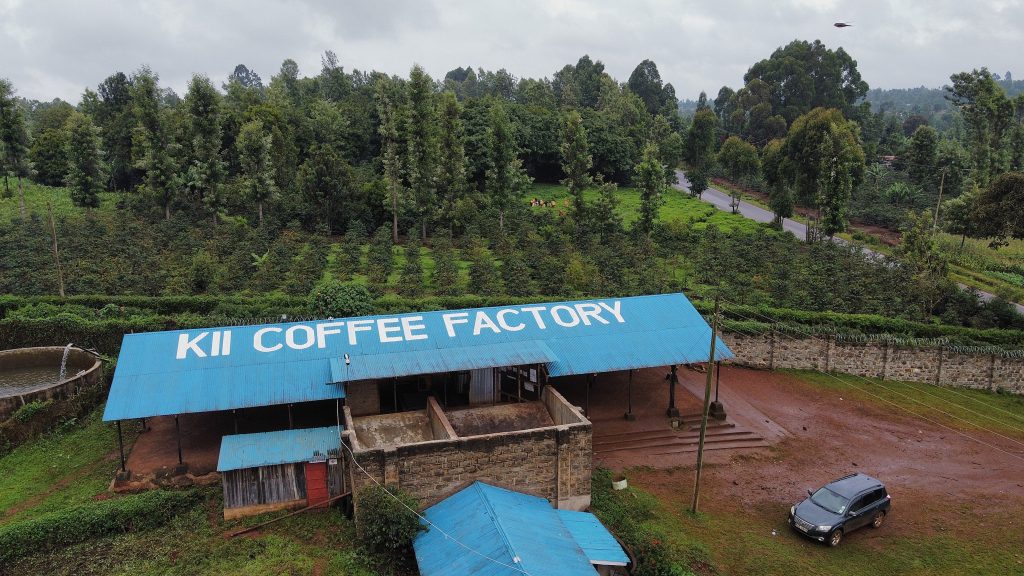
This is a low intervention washed peaberry coffee from Kirinyaga, Kenya, produced by smallholder members of the Kii cooperative.
The flavor profile is sweet, sparkly, and glamorous, with tropical fruit notes like mango and pineapple, classic citrus like tangerine and grapefruit, and hints of florality.
Our roasters recommend putting the pedal to the metal and letting it rip.
When brewed, we especially enjoyed conical pour-overs with a low dose and coarse grind, but honestly it’s really hard to extract this one the wrong way.
Taste
Taste Analysis by Isabella Vitaliano
A feeling of awe, heart floating, the peripheral of your vision becoming a blurry sparkle spurred on by the endless nostalgic memories one may have with a celebrity or in this case, a coffee. Being starstruck is such a rare occurrence and when it starts to happen with regularity that feeling fades into the mundane. This coffee is anything but mundane. It gives a feeling akin to old Hollywood glamour that receives endless attention or is constantly newsworthy.
Tropical fruits are no stranger to this cup profile with notes like mango, guava, pineapple lychee and kumquat. Dancing with the sort of classical Kenya flavors, you’ll also find tangerine, caramel, lemon and a touch of tomato paste. I think what really struck us about this coffee was how crisp and clean it was while also being soft; contrasting green apple and grapefruit notes with white grape and oolong. Upon arrival of this coffee it received atmospheric scores from the team. New arrivals are always so exciting and their small quantities makes the experience all the more special. You’ll want to experience the short run we have of this coffee, it won’t last long. Cheers!
Source
Source Analysis by Charlie Habegger
Rungeto is a producer organization that has been around since 1997, when it was created out of a previous local producer society. It is robust in membership and exemplary in quality. In the cup this is a quintessential Kirinyaga coffee: lime-like and very tart, with a brisk mouthfeel and a savory-sweet balance.
Central Kenya & Kirinyaga County
Mt. Kenya, at the helm of Kenya’s Central Province, is the second tallest peak on the continent of Africa and a commanding natural presence. The mountain itself is a single point inside a vast and surreal thicket of ascending national forest and active game protection communities. The central counties of Kenya extend from the center of the national park, like five irregular pie slices, with their points meeting at the peak of the mountain. It is along the lower edge of the forests where, in wet, high elevation communities with mineral-rich soil (Mt. Kenya is a stratovolcano) many believe the best coffees in Kenya, often the world, are crafted. Kirinyaga is one of the best-known of these central counties.
Rungeto FCS and Processing Style
Rungeto FCS oversees the operations of all three member cooperatives, Karimikui, Kii, and Kiangoi. The group, as is common to cooperative societies country-wide, has a farmer-elected board with members from each sublocation. Rungeto was originally formed after the closure of a previous society, Ngiriama FCS, in the 1990s, when the asset holders of these three factories decided to re-organize anew. In 1997 the factories reopened under the new society name and have been operating together as Rungeto FCS ever since.
Kenya is of course known for some of the most meticulous at-scale processing that can be found anywhere in the world. Bright white parchment, nearly perfectly sorted by density and bulk conditioned at high elevations is the norm, and a matter of pride, even for generations of Kenyan processing managers who prefer drinking Kenya’s tea (abundantly farmed in nearby Murang’a county) to its coffee. Ample water supply in the central growing regions has historically allowed factories to wash, and wash, and soak, and wash their coffees again entirely with fresh, cold river water.
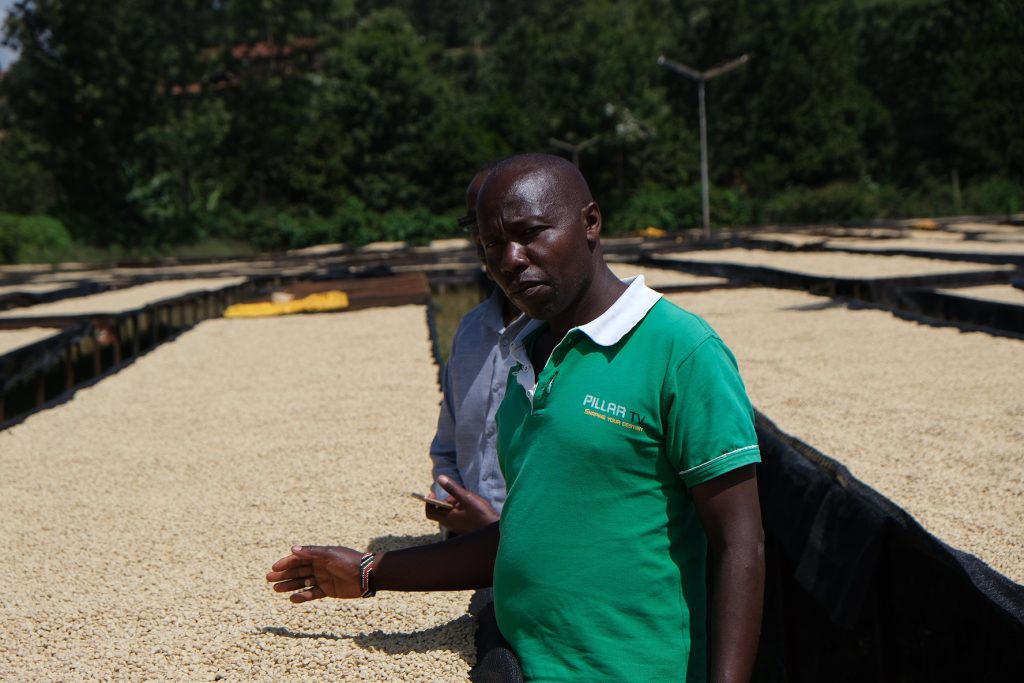
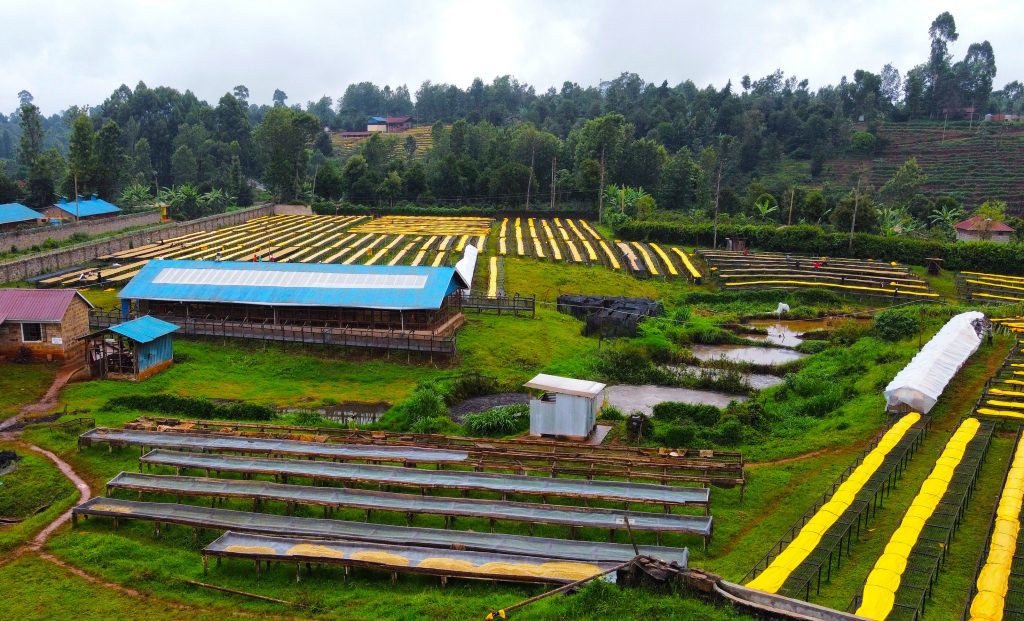
Kii typically ferments for 16-18 hours depending on ambient conditions (the changing mountain climate, as for many processors, tends to dictate fermentation temperatures, and processing staff are required to check fermentation progress every three hours). After fermentation, the parchment is washed clean in long cement channels using fresh running water, a step that also allows the denser, heavier parchment to separate from the rest. After washing and grading is complete, the parchment is moved to the factory’s raised tables to dry, typically for two weeks. After drying is complete the coffee is conditioned in large, perforated bins on site to allow moisture to stabilize, preparing the coffees for transit and a long shelf life.
The established milling and sorting by grade, or bean size, is a longstanding tradition and positions Kenya coffees well for roasters, by tightly controlling the physical preparation and creating a diversity of profiles from a single processing batch.
Green
Green Analysis by Isabella Vitaliano
This coffee is in the average range for density and water activity. The moisture content is slightly below average at 9.8%. High density coffees are expected from this region and on top of that, we have a super condensed screen size in the 14-15 range. These are small beans!!
This lot contains a very classic mix of cultivars that one can expect from the region including legacy selections SL28, SL34, and the more recent hybrids Ruirui 11 and Batian. To find out more information on these cultivars check out our blog post here.
Diedrich
Diedrich IR5 Analysis by Doris Garrido
Complexity in a unique form, vibrant, and beautifully harmonious in its sweetness. Our new Kenyan offering is simply outstanding. Just picture the notes we have had in this roast: Oolong tea, blood orange, lychee, mango, kumquat, pomegranate, sweet orange, and lemongrass. Subtle body, with a juicy and clean finish.
This is easily one of my favorite coffees to roast. The Diedrich roaster truly shines utilizing the heat retention from its infrared panels to complement this coffee’s unique profile.
To begin the roast, I warmed the drum to 446°F. After stabilizing the roaster, I dropped the coffee, applying 100% gas power within the first 20 seconds. I maintained this for approximately three minutes before reducing the gas to 60%, and then a minute later, to the lowest setting of 30%. That was the extent of the gas adjustments. From that point, I focused on observing the Maillard reaction, carefully adjusting the airflow to refine the cup’s clarity and gently slow the roast’s progression. The coffee finished smoothly, with a post-development time of 1 minute and 31 seconds and an end temperature of 397°F.
This was a straightforward roast, leveraging the initial heat to guide the coffee through to ending in a total of 8 minutes and 27 seconds. This exceptional and delicious coffee will hit the menu very soon. It was surprisingly easy to roast, especially considering these are small Peaberry beans that arrived with slightly low moisture. Despite that, this roast resulted in a remarkably juicy cup.
While I often find myself roasting to highlight acidity in most coffees—especially Kenyans, my personal preference—I must say that this coffee also delivers an incredible clarity of sweetness. It offers great caramel and guava complexity and an incredibly enjoyable body if you choose to caramelize it further.
Aillio bullet R1
Aillio Bullet R1 IBTS Analysis by Evan Gilman
We use the RoasTime app and roast.world site to document our roasts on the Bullet. You can find our roast documentation below by searching on roast.world, or by clicking on the link below.
Take a look at our roast profiles below, as they are constantly changing!
Independently of my cohort, I saw this coffee and exclaimed to myself a touch. This is a repeat offender (in the best possible way) on our menu, and while I’m always enthusiastic to see a Kenya, I’m especially excited to see this mark, as it sometimes never makes it past the arrivals table. It just sells too fast.
I was away from the office while this one was released, but I knew that it would need high heat and would crack graciously early to afford plenty of time in post-crack development. Such was the case, since this is a smaller, tightly distributed screen size with lower moisture content than average.
My roast cycle started off with the high temperature, 464F, P8 power, and F2 fan. Just before turning point, I ramped it up to P9 power and took fan down to F1 to really get things cooking. At my peak rate of change of about 35F/min, I held back a little and reduced back to P8 power and increased fan to F3. A little before yellowing I decreased power to P7, and didn’t mark yellowing until later than usual – this coffee doesn’t take on color as readily as all the naturals I’ve been roasting lately. At my mark, I increased fan to F4, then decreased power to P6 shortly afterwards. This was a short roast after all, so all the adjustments happened in fairly quick succession. At first crack, I increased airflow to F5.
You may notice that my bean probe rate of change increases at this point as hot moisture is released into the drum, but the IBTS probe is reading a steady decline. This happens quite often, though at the end of my roast they inverted a bit, giving me something of a scare. Due to the super early crack on this coffee, however, I spent nearly as much time in post-crack development as I did in Maillard. Pretty uncommon.
The cup: This coffee is chock full of stonefruit, but plenty of other bright fruits as well. Look for super ripe juicy pineapple and even a touch of dried fig at the finish. Taking this coffee darker, I’d definitely see some marshmallowy chocolate notes and powdered sugar come through. Drink this coffee any way you like, you are not likely to be disappointed!
You can follow along with my roast here at roast.world: https://roast.world/egilman/roasts/0Q69UzrXTtfOoUuWbanQL
Ikawa
Ikawa Pro V3 Analysis by Chris Kornman
Our current Ikawa practice compares two sample roast profiles, originally designed for different densities of green coffee. The two roasts differ slightly in total length, charge temperature, and time spent between color change in first crack. You can learn more about the profiles here.
No surprises here, despite this summer-arrival peaberry’s moderate density, it’s Kenyan provenance demands hot, fast profiles and the High Density roast proved a winner. Doris and I cupped the two iterations together and here’s what we tasted.
The Low Density roast surprised us both with incredible floral aromas and a dense, complex cup that was attention-grabbing if not a bit confusing. It had a heavy body and stronger savory notes layered on top of notes of plum, guava, and slated caramel. If you like heavy, savory coffees, you can try slower roasting styles with this one.
However, the High Density profile produced the expected clarity and electric acidity I especially love in Kenyas like this, and preserved its lovely stone-fruit sweetness. I could drink this roast all day. Shame it’s only 50 grams at a time. I tasted jasmine, peach, and pink grapefruit, while Doris lauded its guanabana acidity, buttery mouthfeel, and incredibly clean finish.
We highly recommend putting the pedal to the metal and letting it rip when roasting this one!
You can roast your own by linking to our profiles in the Ikawa Pro app here:
- Roast 1: Low Density Sample Roast
- Roast 2: High Density Sample Roast
Brew
Brew Analysis by MJ Smith
As soon as I heard that we had a new Kenya coming down the line, I immediately begged to be the one to lead the Brew Analysis. Anyone who has seen my write-ups over the past three years known how much I adore Kenyan coffees. This one from the Kirinyaga Kii Factory is no exception. I swear to you, every single brew I made had something delicious to offer. In the words of our barista Asha, this coffee tastes like sunshine! Lots of juicy stone fruit sweetness, some delightfully bright citrus, and just a hint of the classic Kenyan tomato-y savoriness that we all know and love. After much consideration, I was narrowly able to pick my two favorite brews for this analysis. Let’s get into them!
For my first brew, I brought out the beautiful Saint Anthony Industries C70 brewer, because a beautiful coffee deserves an equally beautiful brew device, of course! I used a dose of 18g of coffee at a 10-grind setting, with our usual water dose of 300g. I found that the 16.67 ratio worked really nicely with this coffee. I let it bloom for 40 seconds and then was left with a final brew time of 4:45. This brew left all of us buzzing! Personally, I picked up notes of high-quality olive oil, orange blossoms, cane sugar, peach rings, cream soda, and just a hint of grapefruit. The rest of the team tasted some additional notes of plumcots, mango, glou glou, caramel, green grape, and “effervescence.” I agree; this brew truly did sparkle!
For my next recipe recommendation, I wanted to switch things up a bit. I left the dose at 18g but increased the grind size to 11. Instead of our usual 40 second bloom, then pouring to 200g, then adding the last 100g after 1:40, I decided to bloom it for a full minute, then slowly poured without stopping until I reached 300g. This left me with a slightly faster brew time of 4:00. I also switched to the Kalita Wave to see how this coffee would taste using a flat bottom device. As soon as I lifted my cup to my mouth for a sip, my nose was greeted with the sweet smell of ripe cherries! This carried over to my tongue as well, giving me notes of cherry, sweet basil, sun-gold tomatoes, stone fruit, lemonade, and just a hint of cardamom. The rest of the team gave me some additional notes of peaches, clove, chamomile, and of course, sunshine!
As I mentioned at the beginning of this writeup, I thoroughly enjoyed all my brews of this coffee, but these were my favorites. I do recommend a brew ratio of 16.67, a slightly coarser grind, and a lower dose of coffee. Honestly, you really can’t go wrong with this coffee. I hope you enjoy it as much as I do!
Related Coffee

Orange blossom, ruby red grapefruit, cherry juice, bright, clean
Oakland 9 Boxes
Crown Jewel Rwanda Washed Rwamiko Washing Station
Lot 1 – 38183-1 – SPOT RCWHSE
Orange blossom, ruby red grapefruit, cherry juice, bright, clean
Spot
9 Boxes
$204.39 per box

Black Tea, caramel, lemongrass, passion Fruit, apricot
Oakland 40 Boxes
Crown Jewel Burundi Honey Peaberry Heza Washing Station
38863-1 – SPOT RCWHSE
Black Tea, caramel, lemongrass, passion Fruit, apricot
Spot
40 Boxes
$255.49 per box
Caramel, fig, raisin, apricot, baking spice
Oakland 29 Boxes
Crown Jewel Brazil Natural Red Catuai Paulo Alexandre Fernandes
39722-1 – SPOT RCWHSE
Caramel, fig, raisin, apricot, baking spice
Spot
29 Boxes
$249.71 per box
Cherry, grapefruit, apricot, floral, and lime
Oakland 14 Boxes
Crown Jewel Colombia Washed SL-28 Juliana Guevara & Wbeimar Lasso
38868-1 – SPOT RCWHSE
Cherry, grapefruit, apricot, floral, and lime
Spot
14 Boxes
$259.91 per box