
Crown Jewel Sumatra Bener Meriah Asbi Anaerobic Lychee Cofermented Wet Hull
34347-1 – SPOT RCWHSE
Boxes 0
Warehouses Oakland
Flavor Profile Lychee, rose, dark chocolate, and melon
Out of stock
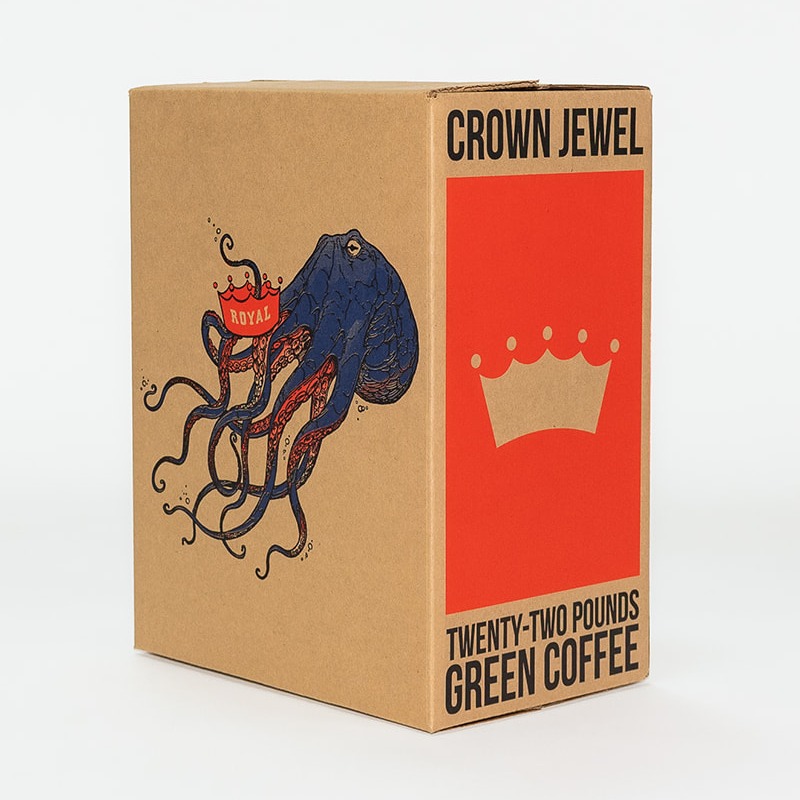
Overview
Overview
This is a high intervention yeast-inoculated and anaerobically fermented coffee, both cofermented and infused with lychee fruit, and subsequently wet hulled. It hails from Bener Meriah, Sumatra, Indonesia produced by Asbi’s estate in association with the Aalamin brand and Central Sumatra Coffee company.
The flavor profile is on-the-nose with hyperrealistic lychee fruit flavor, augmented by notes of rose, dark chocolate, melon, and hibiscus.
Our roasters found that going easy on the heat early in the roast worked well, and encourage you to keep an eye out for quick heat absorption as the roast enters first crack.
When brewed, our baristas enjoyed high dose pour-overs in conical filters.
Taste
Taste Analysis by Isabella Vitaliano
In the lush forests of west Sumatra, innovation takes place in the form of this expertly curated Lychee cofermented coffee.
Equally whimsical and sharp in its execution, prepare yourself to experience a melody of honeydew, jolly rancher, root beer and bubblegum. These flavors might seem disjointed, but as they play together in the cup, it presents itself as ethereal. Of course, we get hyperrealistic flavors of lychee, without the artificial twinge that sometimes come with coffees that are processed like these.
Rambunctious and clean; all in one go, you won’t be able stop thinking of the magical whimsy that the Asbi’s estate, Aalamin brand and Central Sumatra Coffee have created.
We get it, co-ferments are all the rage, you love them, or you hate them. No matter your opinion, this is an incredibly special project and not one to miss out on. You’ll wow anyone by serving them this coffee.
Source
Source Analysis by Evan Gilman
As so often happens in Indonesia, I was introduced to Enzo Sauqi and Hendra Tjanaka of Central Sumatra Coffee through friends I’d met on past visits. In this instance, it was my friend Novrin Situmorang who was in the same Q-graduating cohort as me, way back in 2014. In some ways, this was a meeting 10 years in the making! It’s a small coffee world.
Central Sumatra Coffee’s (hereafter ‘CSC’) projects in Northern Sumatra have been undergoing development for more than five years now. Their crew has solidified methods and procedures for producing excellent coffee over this time, and has grown their community along the way. Through an organic compost program that uses the organic material leftover from processing, to a technical assistance program that focuses on pruning, rejuvenation and replanting, CSC is also engaged in assisting production from harvest to final sale. They are currently working with 400+ farming families and are expecting to expand.
This particular coffee is sourced from the estate of one smaller producer, Asbi. As is common in this area of the world, this is his full name. Go to Bener Meriah and ask for Asbi, and you might find that someone can point you in the right direction. Asbi’s estate mostly grows Typica and Abyssinia, but also has some of the usual S795 and Sigarar Utang. Don’t let this common spread fool you, you’re about to dive into a very uncommon coffee processing story.
Under the guidance of Chief Science Officer Ricky Sugiarto T., who has attained his Q Processing Professional status, and Saiful Hairi, the Manager of Processing, CSC explores novel methods of post-harvest processing for coffee. After numerous trials with different types of yeast, inoculation, and infusion methods, CSC and Aalamin found their desired set of best practices for producing incredibly unique and lively coffees.
For this coffee in particular, they start with ripe red cherry which is pulped and placed in fermentation tanks for 14-16 hours. Then the coffee is added to sealed vessels with fresh water and Saccharomyces cerevisiae yeast sourced from Lallemand, and allowed to sit for 48 hours. On the third day of fermentation, they add freshly juiced lychee fruits and leaves. From this point the coffee is moved directly to drying tables without further flushing or soaking. At 55% moisture, a mixture made from the juiced lychee fruits and leaves suspended in food grade propylene glycol is applied. After drying in direct sunlight to 25-30% moisture, the coffee is hulled and allowed to rest before shipping. The result is a mouthful in so many more ways than one: a yeast inoculated, anaerobic, inoculated, infused, wet hulled lychee coffee.
The result is a flamboyantly vibrant juice-bomb of a coffee. If you’ve ever tasted fresh lychee, the verisimilitude in the cup here will wow you. In line with Isabella’s comment of hyperreality above, this coffee is almost more lychee than what we would commonly understand lychee to be. In counterpoint to this notion, CSC offers the reality through their transparency, disallowing the information to devour its own content so that you can devour it yourself: the true fruit and leaves of lychee, no simulacrum necessary.
So move over Baudrillard, this is a McLuhan coffee. The medium is the coffee, and it’s delicious!
Green
Green Analysis by Isabella Vitaliano
A blend of a regional Catimor and Typica cultivars there is a blend of yeast inoculation as well as cofermentation with lychee. Catimor, initially planted in Brazil, in the 60’s was created to retain hardiness and produce high yields. Typica is the original cultivar introduced by the Dutch, but much was wiped out in the coffee least rust epidemic.
First thing you’ll notice upon receiving this coffee is the delicious smell on the green. Density is roughly average with a little bit below average moisture content and average water activity. It’s promising when co-fermented coffees have ideal metrics as they can act a little wonky in the roaster at times. Our team had no problems with it in the roaster but keep an eye just in case!
The producer did a lot of heavy lifting to make this coffee great, aromatic florals and hyperrealistic lychee notes will be hard to mess up.
Diedrich
Diedrich IR 5 Analysis by Doris Garrido
Exceptionally aromatic coffee, reminiscent of perfume with a raspberry candy taste, a hint of rose water, and an overall sweet and fruity fragrance. This delightful combination is complemented by a Lychee fruitiness that makes it very enjoyable without overwhelming the palate. The process behind this coffee is fascinating, and the craftsmen have gifted us with a very clean and extraordinary final cup. I appreciate the effort they have put into it and eagerly anticipate people’s reaction when they get to taste it. For now, it will be served as a pour over at the crown Oak, but the possibilities for incorporating it into different parts of our menu are endless
I roasted this coffee similarly to a normal wet-hulled coffee. This means starting gently, adding heat after the first third of the roast, increasing heat in the middle and lowering it as I approach the last third, aiming for a total time of around 10 minutes.
This is a co-fermented, and infused coffee; even from the green beans it would make your mouth water, but no need to be afraid on the roaster.
We can all agree that fruits are delicious, but Sumatra fruits must be on another level, the fragrance from the green and roasted will blow your senses, The processes they have mastered with this coffee would not affect the roasting method. At least that was my experience, having roasted this coffee twice, following the behavior of wet-hulled coffees my roast has resulted perfectly.
For this roast, I warmed up the drum to 415F and did a soak for 2.5 minutes before adding heat -first 70% and then 100% just before the color change. This approach is because wet-hulled coffee will start absorbing heat at this point. During the yellowing phase, I began lowering the gas, first to 60% then 30% at 343F, and let it run until the end of the roast at the lowest flame.
The cracking started at 8:08 minutes, let it go for 1 minute and 39 seconds. Usually, I would extend the development time to stretch the caramelization on a Sumatra coffee, but in this case even a shorter time would also work well to highlight the delicate lychee taste that this coffee strongly possesses.
Take this chance to taste the co-fermented coffees, I am sure this coffee would give you an extraordinary experience.
Aillio
Aillio Bullet R1 IBTS Analysis by Evan Gilman
Unless otherwise noted, we use both the roast.world site and Artisan software to document our roasts on the Bullet. You can find our roast documentation below, by searching on roast.world, or by clicking on the Artisan links below.
Generally, we have good results starting our 500g roasts with 428F preheating, P6 power, F2 fan, and d6 drum speed.
Despite the incredible amount of complexity in processing this coffee, it roasts very easily and with little intervention. Just handling the green will leave you with a whiff of lychee, and you can expect that to show in the cup no matter how you’re roasting this coffee (super dark Vienna roast not guaranteed).
I was pleased to see middle-of-the-road moisture content an fairly low water activity in such a high intervention wet hulled coffee. The green is clean and well sorted, though there’s a decent spread in screen sizes that will put up a bit of resistance in the roaster. I decided to start this one medium-hot and give plenty of airflow along the way.
With a charge temperature of 464F, P9 power, and F2 fan I started off on the roasting journey. At Turning Point, I added fan to F3, then at peak rate of change of 39F/min lowered heat application to P8. Shortly after, I reduced heat further to P7 and increased airflow to F4 at Yellowing. So far so good, but around 370F I noted that the rate of change was holding steady around 18F/min, when I wanted to be a bit lower going into First Crack. I adjusted air to F5 (usually my maximum) and reduced heat to P6 to dampen the roast a bit. No joy, however, and I revised my fan speed to F6 to really bring the rate of change down a notch. With another brief adjustment upwards so the roast didn’t crash after First Crack, I felt comfortable adding the airflow back in for post-crack development. By no means a perfect roast, but the results looked consistent and smelled fantastic.
If I were to roast this coffee again, I may keep the heat on for a bit longer than I did with the above roast and add in extra airflow later as well.
In the cup, huge lychee came through (of course). Beyond that, some interesting florals mixed with strawberry hard candy (think of the foil-wrapped after dinner candies) sweetness really added dimension. Dark chocolate aftertaste rounded out the clear lychee, and as the cup cooled, creamy texture coupled with grape jelly and powdered sugar sweetness. Just a lovely cup all around.
While it may seem like a wild outside-the-box coffee, and it is, the coffee is super approachable and delicious. I could realistically drink a few cups of this without batting a lash. And I suggest you do too, before this coffee flies off the shelves!
IKAWA
Ikawa Pro V3 Analysis by Isabella Vitaliano
Our current Ikawa practice compares two sample roast profiles, originally designed for different densities of green coffee. The two roasts differ slightly in total length, charge temperature, and time spent between color change in first crack. You can learn more about the profiles here.
The dreamiest of coffees, and with a cup profile that will have you thinking of summer year-round. Bubblegum, honeydew, jolly rancher, lilac; a stunning mix of flavors that you can’t miss out on.
On the light-density roast I experienced camphor, sweet maple syrup and slight herbal notes. This was great, the camphor was compelling especially paired with the maple syrup note.
The high-density roast expressed more florals like lilac and lavender. Lychee and mangosteen were front and center, the stars of the show. You’ll also find some layers of mint and honey to round it all out.
I highly recommend using the high-density profile on this cup as the florals and lychee combination were whimsical and delicious. Cheers!
You can roast your own by linking to our profiles in the Ikawa Pro app here:
- Roast 1: Low Density Sample Roast
- Roast 2: High Density Sample Roast
Brew
Brew Analysis by Taylor Brandon
You ever been so consumed by a sensory experience that you stop disassociating? This Sumatran lychee coferment had me grounded, fully embodied and touching grass to tend to its breadth of flavor. We’re excited to serve this offering in our tasting room as a pour over and it arrives with great anticipation on the heels of a SF Chronicle article highlighting coferment coffees in the Bay Area.
I wanted to see what the hype was about, so I conducted four brews of this coffee to gauge its flavor range. Be sure to check the table on this page for all recipe details mentioned and let me know if you try any of these recipes for yourself.
Brew #1
I opted for the V60, a high dose of 19 grams of coffee, and a grind of 9. Notes of root beer, honeydew, bubblegum, dark chocolate, and florals. Some would consider this over extracted with a TDS of 1.58 This was a pleasant punch of flavor and I decided to dose down in brew #2 in search of more subtlety.
Brew #2
I stuck with the V60, dosed down to 18 grams of coffee, and continued with a grind of 9. Notes of baker’s chocolate, hibiscus, rose, cardamom, cinnamon and cranberry. At first sip, I was not sold but the more I tasted it I fell in love with this brew. My TDS was on par at 1.36 and an extraction rate of 20.02%.
Brew #3
I coarsened the grind of this brew to 10 and went back to a dose of 19 grams of coffee. Notes of Sprite, tonic water, rose, brown sugar, and milk chocolate. According to Josh, this brew presented with a distinct floral bitterness that mirrored quinine and I agree. I achieved a TDS of 1.44 and an extraction rate of 19.86%.
Brew #4
I switched to the Kalita Wave for the final brew, a dose of 18.5 grams of coffee and a grind of 10. Notes of honey, plum, hibiscus and green chile. This was not a favorite and it presented a high TDS of 1.53.
It’s a great coffee with depth and good body. I would opt for a higher dose and a conical brewer like the V60. I’m curious to see how it performs on other brew methods like espresso. Try it out and let me know if it brings you back down to earth.
Espresso
Espresso Analysis by Asha Wells and Joshua Wismans
Recipe #1: 18g in, 36g out, 30 seconds.
Recipe #2: 18.5g in, 40g out, 25 seconds
Bold and brave are the ones who pull shots of cofermented coffee, yet the returns on this coffee when prepared as espresso are delicate and nuanced. This beautiful coffee from Bener Meriah shines in all the ways you’d hope.
For our first recommended recipe, our approach was to use the classic 1:2 ratio, with a slightly slower shot time. This shot brought out a lot of the florals in this coffee, along with notes of caramelized sugar and pear.
For our second recommended recipe, we used a slightly higher dose, but with a much higher yield. This recipe brought out more citrus and cranberry, but with an amazing juicy-savory flavor profile that had our mouths watering. This recipe forgoes some of the more obvious floral notes and invokes some unexpected flavors inherent in this coffee.
With a moderate dose, you can use different ratios to bring out all sorts of unique flavors in this coffee.
Related Coffee
Floral, vanilla, brown sugar, honey, apricot
Oakland 9 Boxes
Crown Jewel Colombia Honey Gesha Juliana Guevara & Wbeimar Lasso
38869-1 – SPOT RCWHSE
Floral, vanilla, brown sugar, honey, apricot
Spot
9 Boxes
$277.59 per box
Tomato, caramel, orange, lime, and tropical fruit
Oakland 22 Boxes
Crown Jewel Kenya Washed Ngomano Factory
45KF0153 – 38302-1 – SPOT RCWHSE
Tomato, caramel, orange, lime, and tropical fruit
Spot
22 Boxes
$207.57 per box
Orange, vanilla, mandarin, cocoa, chocolate
Oakland 7 Boxes
Crown Jewel Timor Leste Organic Washed Café Brisa Serena
38840-1 – SPOT RCWHSE
Orange, vanilla, mandarin, cocoa, chocolate
Spot
7 Boxes
$188.47 per box

Lime, raspberry, peach tea, honey, sweet, clean
Oakland 27 Boxes
Crown Jewel Rwanda Natural Busanze Washing Station
Lot 3 – 38186-1 – SPOT RCWHSE
Lime, raspberry, peach tea, honey, sweet, clean
Spot
27 Boxes
$206.66 per box