
Chris Kornman and I traveled North to Portland, Oregon along with Coffee Traders Laurel Wirth and Kevin Morales to teach some classes and visit with friends. The first day we were privileged to participate in a full day of presentations on buying green coffee hosted by the Oregon Coffee Board at Buckman Coffee Factory. Kevin presented on C Market Basics and I taught an introductory course on their sample roaster. The event was well attended and a total blast; Portland even turned into a snow globe for us.
For the past several weeks, the Crown team has been working on creating original and thought provoking curriculum. On Friday December 9th, it was time to see if all of our hard work would pay off. Aspect Coffee Collective was kind enough to let us use their cupping lab and roaster in SE Portland for the day. The courses: Green Coffee Analytics; Density, Screen Size, and Water Activity and Roasting Styles & Impact on Flavor. We had an amazing turnout for our first class and people traveled far. One roaster flew in from Montana and another drove through a snowstorm from Vancouver BC.
Chris’s course on green coffee analytics is invaluable to any roaster. He has experience in quality control and in production roasting, making him exactly the person you want to speak with when talking about these green coffee metrics. His lecture explains what these metrics are and how you can determine them in your own quality control lab. He then demonstrates how this information is useful with three great sensory exercises. The two hour lecture and cupping exercises dovetail nicely into my Roasting Styles course.

Jen Apodaca teaching the Roasting Styles course at Bay Area CoRo in Berkeley on a Loring S15.
Starting off I introduce the class to three very different coffees that vary by origin, process, density, moisture content and screen size variance. Then I introduce three different roasting styles and how the author of said style believes it will change the flavor of the coffee we are roasting. After the key concepts have been explained, it is time to roast. In Portland I was roasting on a 1990’s Probat L12. Honestly, I was a bit nervous, the last time I roasted on an L12 was in 2009 (not-pictured above). After just a few minutes, it was like riding a bike and all of my muscle memory came rushing back. The class and I were able to pull of three successful roasts and talk a little shop about the challenges with this machine and the machines that they roast on at their facilities.

CJ1036 – Ethiopia Shilcho Bedame Special Prep Crown Jewel roasted on a 5 kilo Probat using three different roasting techniques. The yellow curve demonstrates RoR Constant Descent, the blue curve demonstrates Elongated Maillard for Body, and the red curve demonstrates “S” Curve – Rest After First Crack.
The roasting portion was my favorite part of the class. Learning how to manipulate the roaster and see how it changes the heat transfer in the drum is powerful. Experiencing another person’s approach and having the opportunity to dialogue with others can open up a roaster to a lot more possibilities and techniques to take with them back to their shop. Because this class is on the road, not every roast will go perfectly to plan. Showcasing these obstacles gives newer roasters an idea how someone else handles a roast that has gone off track. It also brings an element of honesty to our craft, which can be overly romanticized.
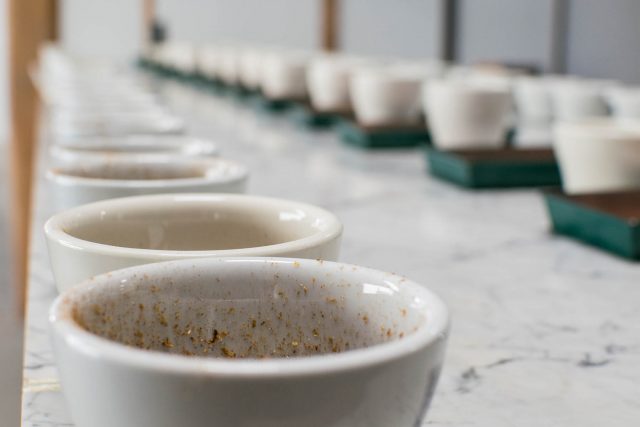
After we finish roasting, it is time to cup. On the tables are the three batches we just roasted together as a class and six more batches that I had roasted previously to save time. We cup blind and reveal the coffees and the curves at the end of the class. This is followed with discussion and further analysis on how the roasts differed. We ask questions like: Do the roasting styles pair well with a particular brew method? Origin? Density? Which roast is the sweetest or the most acidic? The best part of the reveal is that the results always seem to surprise us.
In addition to these two courses, our current Crown on the Road series includes a new course dubbed Menu Development & Inventory Management. It takes a tremendous effort to get a coffee from purchase to launch for your customers whether they are wholesale accounts, online customers, or your own retail cafes.. This course covers common purchasing pitfalls, marketing strategies, production flow, and how to schedule coffees to appear on your menu with intention. This class is an amalgamation of best practices from decades of experience working for coffee Roasting companies and will help you and your team stay one step ahead with your purchasing strategies
These three classes are being offered as a full day of courses at select cities in January and February. You can find all the details on our blog here. The crown team will be travelling to Denver, Milwaukee, St. Louis, Austin, and New Orleans to teach these courses hosted by some of our roaster friends in each city. If you are unable to come to one of our classes, we will be at both US Coffee Champs Qualifying events in Knoxville and Austin. Come by our booth and say hello.

Latest Articles by Jen Apodaca

Roasting Coffee for Competitions
Roasting coffee influences flavor, but it is not the final step in the process. Unless you are roasting your own competition coffee, roasting for a barista or brewer competitor is...

Holiday Coffee Selections!
If you are still shopping around for an amazing competition coffee or a unique holiday offering, there are several coffees on our Crown Jewel menu that fit the bill. As...
考Q的经验分享
考Q的经验分享 2003年,CQI(咖啡品质协会)推出了阿拉比卡咖啡Q grader项目,向咖啡专业人士授予专业证书,并利用这套体系对咖啡进行评分和定级。这是一项致力于咖啡全球标准化的项目,因为曾经通过感官来对咖啡进行分析和评价是非常主观的认定。一个人认为的深度烘焙,在另外一个人眼中可能是中度烘焙,或者在一个人的认识当中这种味道是浆果果酱的味道,而同样的味道,另外一个人却说是意大利黑醋,还有人说是……,还是让我们一起努力把标准统一了吧。 目前,世界范围内共有4000多人拥有Q grader的认证,通过这套体系的培训,这些人,包括从咖啡种植者到咖啡烘焙师,他们对阿拉比卡咖啡拥有共同的感官评价语言。由于大家使用共同的语言进行描述,并促进了相互理解,这样价格也会更公正和透明。在咖啡生产、进出口以及烘焙领域,很多设计咖啡品控检验的人都拥有Q grader认证。该认证体系除了对于生豆品质评定有很大帮助以外,很多咖啡培训领域的人士认为拥有该认证对于培训本身也有很大帮助。有时候想要五个人一起,相互合作,没有共同的标准真的是非常困难的事情。 成为一个真正的Q grader是一个长期积累的过程,是一个让自己对于咖啡的感官认识逐渐变得更为专业的过程,我还依旧在这条路上。尽管在过去的十年来,我每周可能都要做至少五次杯测,可以说积累了很多经验,但是我还是觉得参加Q grader的认证考核还是很值得的,虽然其价格也非常不菲,2000美元。但是我觉得这是一次对自己自身价值的投资。 有些人可能因为其价格高昂而放弃。但你可以想想,你会不会因为有了Q grader的认证而提升了自己?我相信答案一定是肯定的。虽然在美国人们不太看重证书本身,但是Q认证确实会让你更加自信,是对你的经验的一种肯定。拥有Q grader认证甚至可能让你得到更好的工作机会。至少Q grader的认证给我带来了很多好处,无论通过与否, 我相信我所得到的远比我所付出的成本高的多。 我的一个朋友参加了Q grader的测试,并发给我了一些相关文字资料,但这些资料很多基本已经过时,并为显示测试的一些更新信息。如果你要向你的朋友询问一些相关信息的话,你首先要确认他是什么时候参加的测试,并确认他给你的信息是不是最新的信息。 实际上,很难找到一些Q grader的学习信息。但也不要因此而失望,在六天的学习测试过程中,大部分基本是在培训室中度过,其中三天是实践。你要尽可能的充分利用这段时间,专注于学习,从中发现自己的强项和不足。下面我就与大家分享一下我参加测试的感受,以及经验和方法。 嗅觉测试 嗅觉测试是测试辨别咖啡芳香的能力,以“咖啡鼻子”(Le Nez du Cafe)为测试工具,辨别咖啡相关的气味。实际上,测试过程就是辨别和确认不同的芳香。在参加Q grader测试两年前,我曾经使用过“咖啡鼻子”这套芳香工具。我还记得其中的一些我不太熟悉的芳香名称。如果你在测试前,了解过这套工具,肯定对于测试有一定的帮助。SCA就有销售“咖啡鼻子”,而且还有配套的对其中的36种芳香的文字说明,可以帮你进一步理解这些风味。 不管你是在学习中第一次使用咖啡鼻子,还是以前就使用过,都没关系,并不会影响测试本身。对于很多人来,将香瓶的味道与杯测感受相联系,确实有点困难。但真的没关系。 感受记忆是一种短期记忆,与我们对周围环境的认识相关,我们通过自己视觉、听觉、味觉、嗅觉和触觉感受世界。在我们进行咖啡杯测时,我们是有意识的调动感受器官,感受气味,再将感受记忆进行处理,形成短期记忆。 与其他感官相比,嗅觉感受更容易产生强烈的印象和记忆。这是由于嗅束与嗅觉皮质层(人体处理嗅觉感受的部分)位置相距海马体和杏仁体非常近的原因(人脑处理记忆的部分),在其之间仅有2-3个神经元突触链接。因此,嗅觉感受的刺激更快也更强烈,与其他感官感受相比,气味更容易被记忆,刺激也更强,在大脑中对气味的记忆存留时间也更长,甚至不用反复去强化。 我们通过信息加工处理(选择性将认知感受集中于环境的某个特定特点,而忽略其他方面的认知处理过程)有效的过滤掉无效信息,仅保留特定感受信息,将感受记忆再转化成大脑中的短期记忆。...
Thank you for doing this! I’m hoping you wind up in Phoenix or Flagstaff at some point where I’ll be able to attend without scheduling issues!
Richard
Hi Richard
Thank you for the kind words! Perhaps one day we will offer coursework in Arizona. We do hope you are able to join us at our other stops around the nation. If not, we cannot wait to host you in our future facility, The Crown: Royal Coffee Lab & Tasting Room.
All the best!
Richard Sandlin