
Crown Jewel Uganda Natural Kigezi Valley
39619-1 – SPOT RCWHSE$267.84 per box
Boxes 93
Warehouses Oakland
Flavor Profile Lavender, lemon, strawberry, floral, and berry jam
Add to your artisan.plus account: 
 Download PDF
Mountain Harvest’s coffee has quickly become one of the most popular and sought after East Africas we offer.
22lb Boxes
Spot



Overview
Overview
This is a minimal intervention natural Nyasaland variety coffee from Kigezi Valley, Uganda, produced by 300 smallholder farmers organized around Kigezi Valley Coffee and Mountain Harvest.
The flavor profile is immaculate and impressive, with hues evocative of a summer sunset and a cup that brims with autumnal stone fruits. We taste strawberries and lemons, lavender and rose jam, pear tart and pluot.
Our roasters found this coffee rewards a gentle, slower hand, stretching the drying phase and pulling back heat early protected the fruit notes.
When brewed, our baristas favored a fine grind, a slightly lower dose, and conical brewer for pour-overs.
Taste
Taste Analysis by Isabella Vitaliano
Likely one of the best Ugandan coffees I’ve ever tasted, this natural processed coffee comes to us from the Kigezi highlands. As iconic as this flavor profile is, this coffee has an approachable profile that is sure to be delicious in any brewing form. On the nose it’s full of stone fruit and in the cup, there are notes of raisin, honey, plum and blueberry.
The perfect summer-to-fall coffee, it has those pink and orange hues of a summer sunset; rose jam, pluot and ripe strawberries. And it also has the essence of the changing season of fall; pear tart, raw honey, and deep chocolate. A synthesis of two opposite flavors creates an incredibly cohesive experience.
Mountain Harvest is a supplier that has been doing excellent work to raise the level of awareness around the potential for high quality Ugandan coffee. All the while, they are providing better pay as well as education for farmers that contribute to their program. Uganda doesn’t historically have the best reputation for coffee quality, and it’s coffees like this one that are going to change the narrative.
Source
Source Analysis by Charlie Habegger
Mountain Harvest’s coffee has quickly become one of the most popular and sought after East Africas we offer. It’s limited, admirably sourced, and insanely good.
One of their more recent expansions has been to the Kigezi Highlands, a wide and high elevation territory in Uganda’s Southwest that shares a border with northern Rwanda. In true Mountain Harvest fashion, their value chain in Kigezi began not with aggressive cherry buying but with the slow and steady training of local agronomists, processing education, and the full network of financial services they developed on Mt. Elgon over five years.
This has got to be one of the most elegant straight naturals from Uganda we’ve ever tasted. The cup is lavender-like with grape candy and rose jam, invigorating lemongrass, strawberry, and a rich pastry sweetness underneath all the top notes. The long ocean transit seems to have only opened up the flavors even more.
Welcome to the Kigezi Highlands
Close your eyes and picture western Rwanda: steep grassy mountainsides groomed with perfect terraces, deep blue lakes, forest gorillas. This is Uganda’s Kigezi Highlands. Geographically, this region is a stark contrast to the rest of Uganda’s landscape. Uganda as a whole just doesn’t have other widespread highland territories like this. Nearly the entire country is low, tropical, and consistently warm, save for only three dramatic and concentrated exceptions: Mt. Elgon in the East, the Kigezi Highlands, and the Rwenzori Mountains in the West. Coffee-wise the country is well suited for Coffea canephora (robusta), which grows wild here and is commercially critical as well: 80% of Uganda’s almost 9 million annual exportable bags are robusta. If you’ve tasted great coffee from Uganda (and many have not), chances are it came from one of only a handful of producer groups, and chances are also that they were founded in the past 10 years. Arabica, and especially great tasting arabica, is still incredibly scarce.
The Kigezi Highlands maintain a consistent high elevation across many kilometers, rarely dropping below 1,500 meters, and climbing as high as 2,700. Despite the fact that coffee itself is underdeveloped, mountainside farming overall is well established here. The districts in the Kigezi Highlands are not especially known for coffee and are far behind Mt. Elgon and even the Rwenzori mountains in notoriety. That said, the terroir here is an extension of Rwanda’s, and vice versa. It should be no surprise that incredible coffees are likely, with the right effort.
Mountain Harvest
Mountain Harvest is a young and big-thinking group, first established in 2017 in Mbale, near Mt. Elgon. Mountain Harvest’s entire structure was designed from scratch to be the antithesis of Uganda’s typical arabica value chains. They specialize in farmer empowerment, transparent pricing in all directions, and slow and steady processing innovation. They invest heavily in their farmers’ equity in the final product, as well as constantly diversifying their cup profiles available to the world.
For its first 5 years, Mountain Harvest dedicated itself to smallholders on Mt. Elgon. They began in Mbale as an impact investing project underwritten by Lutheran World Relief, and for the first couple years were based, presciently, in a dilapidated dry mill deserted by a bankrupted cooperative union. By the end of this short first phase, the business model included farmer education and training, investments in centralized processing, community storage facilities, detailed quality control, and international marketing. All the while staying very modest in size, exporting only five to seven containers per year.
In 2022 Mountain Harvest set its sights on the Rwenzori Mountains, for the same reasons: incredible quality potential and under-resourced arabica growers. Within a couple years, they were working there full time, processing cherry centrally at their “Mountains of the Moon” station, and marketing the results.
In 2023, they started working in the Kigezi Highlands, with a local producer group there called Kigezi Valley Coffee (KVC). This has been a small and very precise initiative, with only 300 smallholders belonging to KVC, but with Mountain Harvest’s full suite of expertise applied.
Natural Processing at KVC & A Brief History of Nyasaland
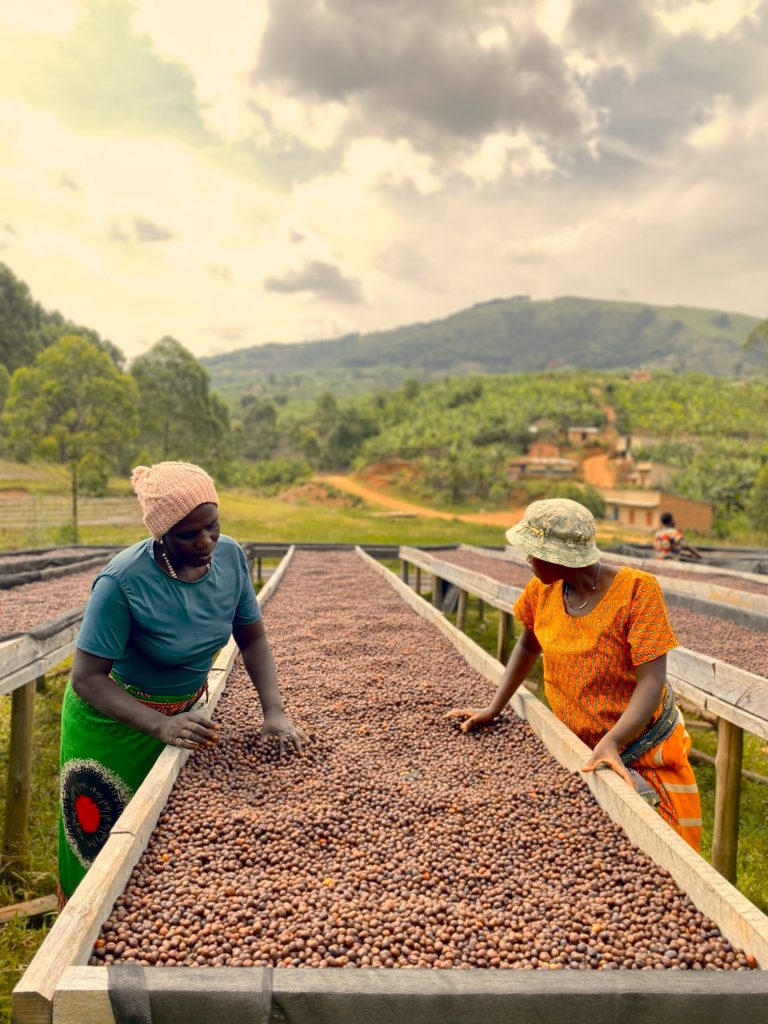
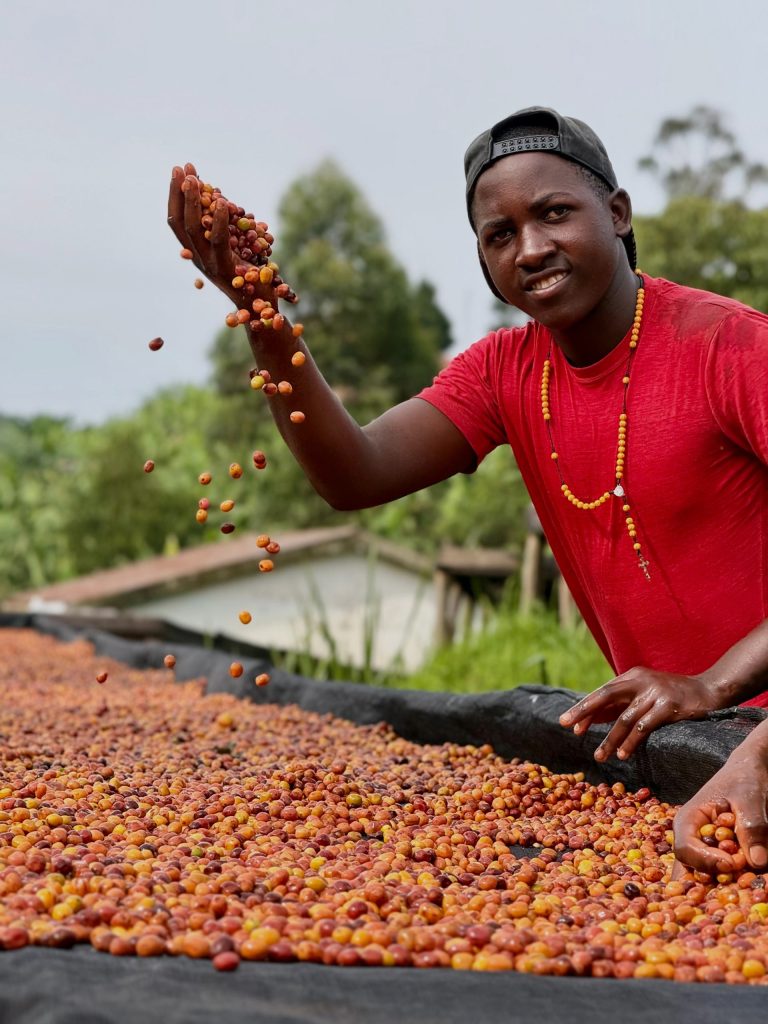
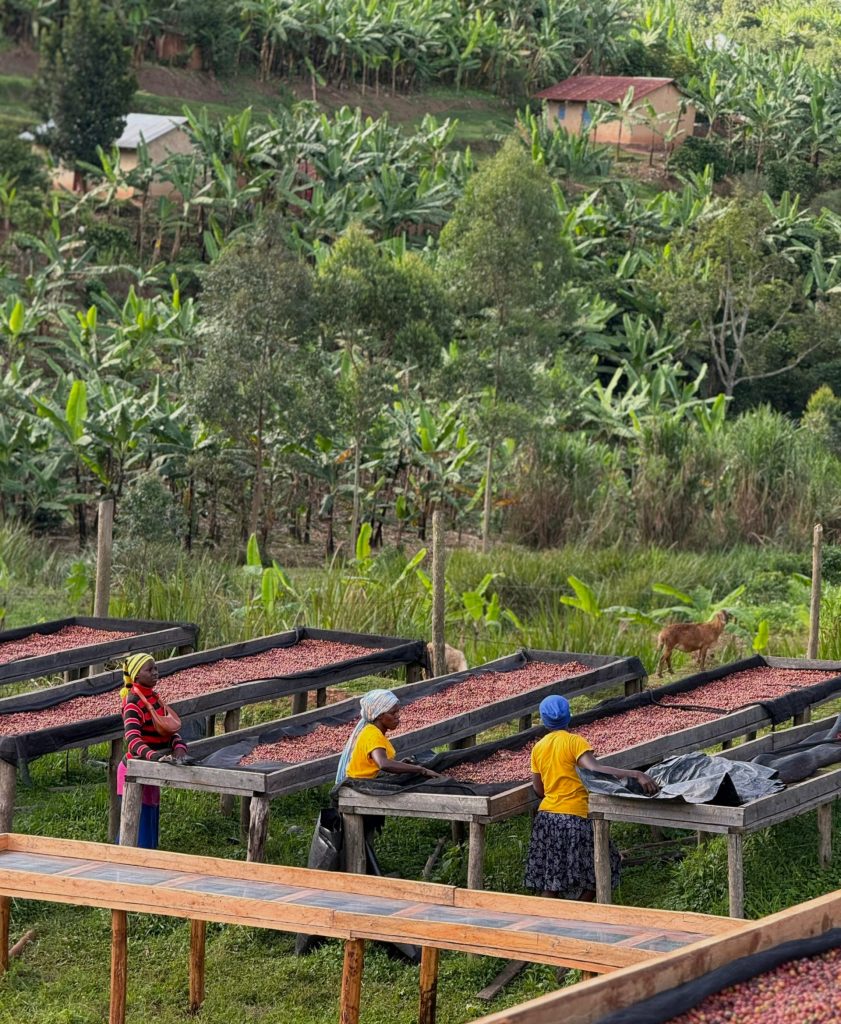
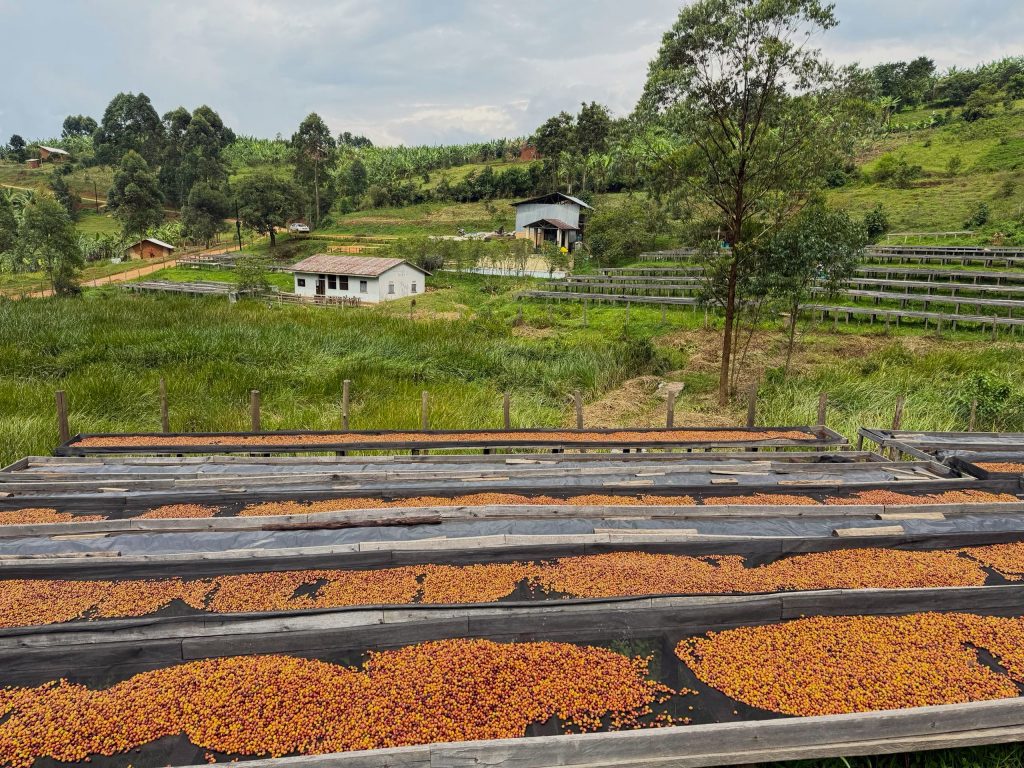
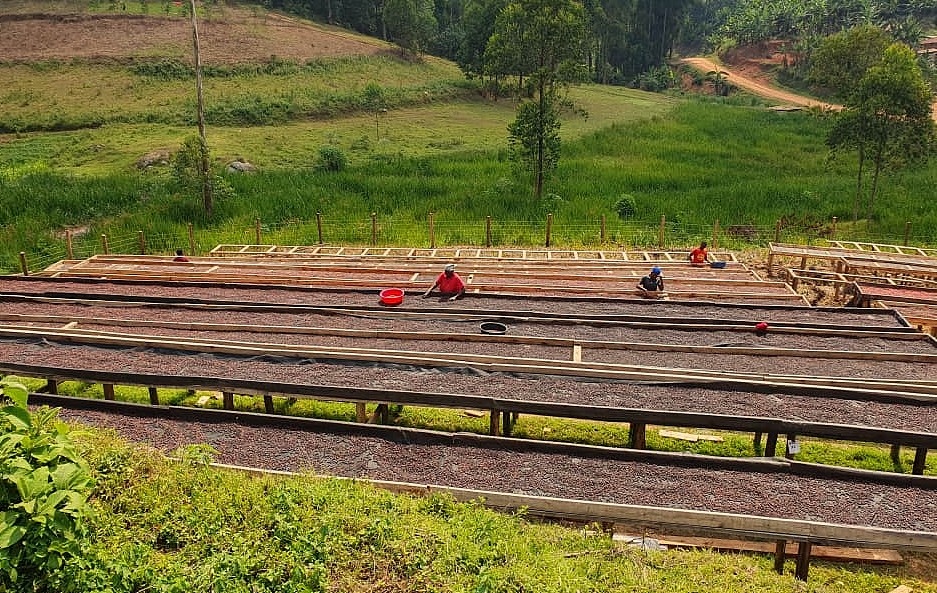
This small lot of coffee was processed as a traditional, minimal intervention natural. Ripe cherries were delivered daily by farmers, sorted for impurities, and moved immediately to raised screen beds to dry. While drying the cherry was consistently rotated and monitored until reaching the final 11% moisture content, at which point the dried pods were transported to Mountain Harvest’s temperature controlled warehose in Mbale to cure and stabilize for two full months.
Nyasaland, the cultivar grown in this part of Kigezi, is rarely found these days but is a kind of antique with an interesting past. Nyasaland is a typica lineage arabica first brought to Malawi (then known as Nyasland) from Jamaica in the late 19th century. This was very early-stage commercial East African coffee, but the British colony of Nyasland was flourishing at the time and the variety was widely planted. Nyasland’s climate, however, was not nearly as cool or amenable to the fragile arabica genetics, and much of the new arabica plants overbore, then dropped production dramatically, leaving Nyasland with a cratered coffee sector (that still struggles today). The variety was moved north to Uganda in the early 20th century where, despite its fragility and lower yields, is still a favored arabica heirloom in higher elevations. It is sometimes known locally as Bugisu (though this term is also used as a geographical indicator), and it is directly related to Jamaica Blue Mountain Typica.
Green
Green Analysis by Isabella Vitaliano
This coffee comes from 300 smallholder farmers organized through Mountain Harvest. Density and moisture content are both on the below average side. Water activity is a little bit above average ranges, and the screen size is between 15-18. Try and be a little bit more gentle with this in the roaster considering the lower density and slightly higher water activity. All around, these pristine specs are sure to make for easy breezy roasting.
Diedrich
Diedrich IR5 Analysis by Doris Garrido
Ugandan coffees have just arrived, and this year we got three incredible lots from Mountain Harvest: a natural, a natural anaerobic, and a honey process. In previous years, the Uganda coffees I got to roast have shown kind of high in density. This season, however, the green grading showed that the density is hovering right slightly lower than the average, paired with a stable 10.5% moisture content. So, my approach for them was on a more moderate thermal trajectory through the Maillard phase and post-development.
Starting with the natural process lot, I initiated the charge at 441°F. I opted for medium start of charge temperature and utilized a short soak before engaging 100% gas at the 00:34 mark, looking to safeguard the batch against any early surface scorching. The drum hit a smooth turning point at 1:27 at 196.9°F, allowing the internal moisture to evaporate evenly so I could lock in a balanced, four-minute target for the drying phase. By stretching out this window, I was looking to obtain those vibrant, candy-like fruit flavors. I dropped the gas to 30% as soon as the bean temperature reached 280°F, and by 3:48 at 285°F, seeing the Rate of Rise spiking aggressively at 49°F/min, I turned the burners completely to zero. This effectively slowed the momentum just before I marked color change at 4:18 at 317°F with a stabilized RoR of 41.2°F/min.
To transition into the mid-roast, I opened the full airflow at 4:55 (336.3°F) to clear out the drum, and just a few seconds later at 5:07 at 340.9°F, I brought the burners back to 30% to support the curve. The Maillard phase lasted an optimal 3:57, allowing ample time for deep sugar development before the coffee started to crack at 8:15 at 385.4°F with a RoR of 12°F/min. I let the batch navigate a clean 1:35 of post-development before dropping the coffee at 395.3°F. This tailored approach worked just perfect for this lot. On the cupping table, it beautifully showcased a complex fruit profile of fresh plum, tangy acidity, and blueberry, alongside layered notes of cooked peach, figs, honey, raisins, and a sweet strawberry jam, all tied together by an incredibly clean chocolate finish.
Aillio
Aillio Bullet R1 IBTS Analysis by Evan Gilman
We use the RoasTime app and roast.world site to document our roasts on the Bullet. You can find our roast documentation below by searching on roast.world, or by clicking on the link below. Take a look at our roast profiles below, as they are constantly changing!
It’s been a minute since I’ve had my hands on a Ugandan fruit dried coffee, but what better one to have than one from this processor? We know that Mountain Harvest produces reliably delicious coffees from their aerie in the Rwenzori Mountains. I’ve been cupping coffees from this dry mill with Charlie since 2012 (when it was owned by Gumuntindo), and Mountain Harvest since 2017 with the Royal Team. I have never known Mountain Harvest’s coffees to disappoint.
So, I knew from both my experience and looking at (and smelling) the green that I would be in for a treat. Huge fruit notes emanated out of the bag. This is a fairly dense and large-bean coffee that I knew could take some heat – but that’s not the direction I decided to go. I also knew from experience that this coffee could stand some slow and deliberate caramelization, and I decided to start with a low charge temperature and a gentler approach, spending an even amount of time in Green/Drying and Maillard while still giving decent post-crack development.
To that end, I started with 446F charge temperature, a very low P5, and lots of airflow at F4. This led the roast with a bit of a ‘soak’ (where the coffee pulls energy from the environment of the roaster without too much additional heat application), and I only increased to P7 and F3 once turning point came around. Plenty of airflow. I kept this up until 336F / 5:30, when I decreased heat to P6 and returned to F4 fan speed in anticipation of the later stages of roasting. I only changed to P5 / F5 once first crack began to roll, and F6 at the very end of roast to eke out a bit more development.
The result in the cup was berries, berries, berries. Blackberry fragrance, raspberry liqueur sweetness, and tons of sweet dried fruit notes. This coffee is going to perform phenomenally as an espresso, filter drip, or even a chocolate-covered coffee bean. No matter how you slice it, this is a juicy fruit masterpiece.
You can follow along with my roast here at roast.world: https://roast.world/egilman/roasts/bPQ6RQoCDktV5KNS9GbeB
IKAWA
IKAWA Analysis by Isabella Vitaliano
Our current Ikawa practice compares two sample roast profiles, originally designed for different densities of green coffee. The two roasts differ slightly in total length, charge temperature, and time spent between color change in first crack. You can learn more about the profiles here.
On the cupping table, this coffee has so much to explore in the profile. I was curious to see how this East African coffee did on the different profiles. The high-density roast was sweet and fruity but oddly a little bit starchy. The low-density roast had way more complex acidity and rounded tones. Notes like pineapple, mango and rose jam were all present, I highly recommend trying out the low-density roast of this coffee.
You can roast your own by linking to our profiles in the Ikawa Pro app here:
- Roast 1: Low Density Sample Roast
- Roast 2: High Density Sample Roast
Brew
Brew Analysis by Joshua Wismans
Often overlooked in the world of specialty coffee, Uganda has many treasures to be found. Mountain Harvest is one of those treasures; an organization of skilled professionals who are committed to the land and the communities growing coffee. This classic natural from them is bursting with red grape, florals, and complex sweetness.
We’ve found that a conical brewer works best to balance the sweet body with more nuanced acidity. This coffee is not especially soluble, so you’ll have a bit more luck with a finer grind. A lower dose at a ratio of 1:16.67 coffee to water and slightly finer grind gave us a TDS of 1.24. A bit on the lower end, but there were some really nice notes of ripe melon and citrus.
Bumping up the dose a bit to a ratio of 1:16.22 coffee to water gave us our favorite cup. We also made the grind even finer, ending up with a TDS of 1.31. This is on the lower end for TDS, but the fruit was able to really shine and still leave room for nuanced floral notes. This brew also had an incredible caramel-esque sweetness.
Overall, we recommend a fine grind, a slightly lower dose, and conical brewer to bring out everything this coffee has to offer – fruit, florals, and incredible sweetness.
Related Coffee

Berries and cream, lemon, raspberry, red wine, and allspice
Oakland 80 Boxes
Crown Jewel Uganda Anaerobic Natural Kigezi Valley
39620-1 – SPOT RCWHSE
Berries and cream, lemon, raspberry, red wine, and allspice
Spot
80 Boxes
$276.91 per box
Honey, dark chocolate, passion fruit, persimmon, and baking spice
Oakland 45 Boxes
Crown Jewel Uganda Honey Rwenzori Mountains
39618-1 – SPOT RCWHSE
Honey, dark chocolate, passion fruit, persimmon, and baking spice
Spot
45 Boxes
$242.92 per box

Black Tea, caramel, lemongrass, passion Fruit, apricot
Oakland 12 Boxes
Crown Jewel Burundi Honey Peaberry Heza Washing Station
38863-1 – SPOT RCWHSE
Black Tea, caramel, lemongrass, passion Fruit, apricot
Spot
12 Boxes
$255.49 per box
Lemon, floral, hibiscus, rosemary, and apple
Oakland 59 Boxes
Crown Jewel Ethiopia Anaerobic Natural Rue Co-ferment Banko Chelchele
40654-1 – SPOT RCWHSE
Lemon, floral, hibiscus, rosemary, and apple
Spot
59 Boxes
$358.51 per box