
Crown Jewel Ethiopia Anaerobic Natural Rue Co-ferment Banko Chelchele
40654-1 – SPOT RCWHSE$358.51 per box
Boxes 45
Warehouses Oakland
Flavor Profile Lemon, floral, hibiscus, rosemary, and apple
Check out our Guide to Ethiopian Coffee Grades
Add to your artisan.plus account: 
 Download PDF
This coffee comes from smallholders in the Chelchele area, part of the Gedeb district in southern Gedeo Zone, where some of Ethiopia’s most complex and aromatic naturals come from year after year.
22lb Boxes
Spot


Overview
Overview
This is a high-intervention anaerobic natural coffee, co-fermented with rue, from Chelchele, Ethiopia, produced by smallholder farmers organized around the Banko Chelchele washing station and EDN.
The flavor profile is intensely aromatic with plenty of floral notes underpinned by candied fruits and herbs. It is not heavy on process flavors, and distinctly Ethiopian in its taste. We noted lavender, mission fig, raspberry, and blood orange.
Our roasters found this natural wants heavy heat up front and heavy airflow to keep it from taking off.
When brewed, we recommend a conical brewer to bring clarity to the cup.
Taste
Taste Analysis by Isabella Vitaliano
Rarely do you see co-fermented coffee from Ethiopia, and we are thrilled to be offering to be offering this selection. Rue is a native plant to Ethiopia and has a lot of cultural importance to the country. You’ll often be served a small branch of it with thing elliptical shaped leaves when ordering coffee. The idea is to stir the leaves in your cup to allow the aromatics to warm up and seep into the coffee. Flavor wise it’s has what I consider ‘high’ botanicals, this upper range of light but intense aromatics akin to menthol, lilac or lavender but hard to pinpoint which one exactly. The pairing of the heavy brewed coffee and this aromatic herb creates a really lovely experienced for the drinker.
If you haven’t had the chance to experience this age-old Ethiopian tradition, trying this coffee is going to emulate this experience to a T. Flavors like coriander seeds, marjoram, citrus, deep chocolate and almost truffle like aroma comes from the cup. The merging of indigenous heirlooms, a traditional herb all from the country of origin is an incredible thought experiment brought to a cup of coffee. In so many ways coffee drinkers miss opportunities to confront the history of coffee and this is a really beautiful way of bringing it to their homes and in their coffee mugs.
Source
Source Analysis by Charlie Habegger, with Joshua Wismans
This coffee comes from smallholders in the Chelchele area, part of the Gedeb district in southern Gedeo Zone, where some of Ethiopia’s most complex and aromatic naturals come from year after year. Gedeb is a unique area dense with coffee growers and processors. The coffee was processed at a central site in Banko Chelchele, one of the district’s most prolific coffee areas.
This very special process involves an anaerobic fermentation with added local rue, also known as tena adam, which is a widely appreciated herb in traditional Ethiopian medicine as well as a common garnish for coffee brewed in a traditional jebena. Both the fermentation and the added fresh herb are used to create a transformed cup profile.
Gedeb’s Significance and Coffee Profiles
The district of Gedeb takes up the south-eastern corner of Ethiopia’s Gedeo Zone—a narrow section of plateau dense with savvy farmers whose coffee is known as “Yirgacheffe”, after the zone’s most famous district. Gedeb, however, is a terroir, history, and community all its own that merits unique designation in our eyes. Coffees from this community, much closer to Guji Zone than the rest of Yirgacheffe, are often the most explosive cup profiles we see from anywhere in Ethiopia. Naturals tend to have perfume-like volatiles and fully washed lots are often sparklingly clean and fruit candy-like in structure.
The municipality of Gedeb itself is a is a bustling outpost that links commerce between the Guji and Gedeo Zones, with an expansive network of processing stations who buy cherries from across zone borders. These processors (and we would agree) would argue their coffee profiles are not exactly Yirgacheffe, but something of their own. The communities surrounding Gedeb reach some of the highest growing elevations for coffee in the world and are a truly enchanting part of the long drive into Guji. Banko Chelchele is one of the communities in eastern Gedeb and includes numerous local cooperatives, as well as independent processing stations of various types, like this one.
EDN Ethiopian Coffee
EDN Ethiopian Coffee, founded in 2018, is an independent processor and exporter of coffee with processing sites in Guji, southern Yirgacheffe, and Sidama. Over the years, Royal and EDN have developed a special relationship, with Royal accounting for 85% of their business. This coffee was processed at the group’s site in Banko Chelchele, one of Gedeb’s most prolific coffee producing areas.
The Banko Chechele station was established in 2021, and is overseen by station manager Memebre. This station in particular has become the focus of our Crown Jewel offerings. Uniting unmatched cherry from 1,400 smallholder farmers in the surrounding kebeles and farmer communities with the meticulous processing overseen by Memebre and his team.
The site employs over 200 people during harvest months to manage the continuous rotating and sorting of sundried cherry and parchment, as well as all other intake, payment, security, and inventory operations. Being a processor for EDN is much more than transactional—they prefinance all their contributing farmers, provide educational resources, daily meals and lodging for staff. Amenities like these are both a gesture of care and acknowledgment of the potential instability inherent to small-scale farming. They are also strategic, since many processors in the area compete for farmer loyalty, and important for the sustainability of coffee and its workforce in the area.
Processing at Banko Chelchele
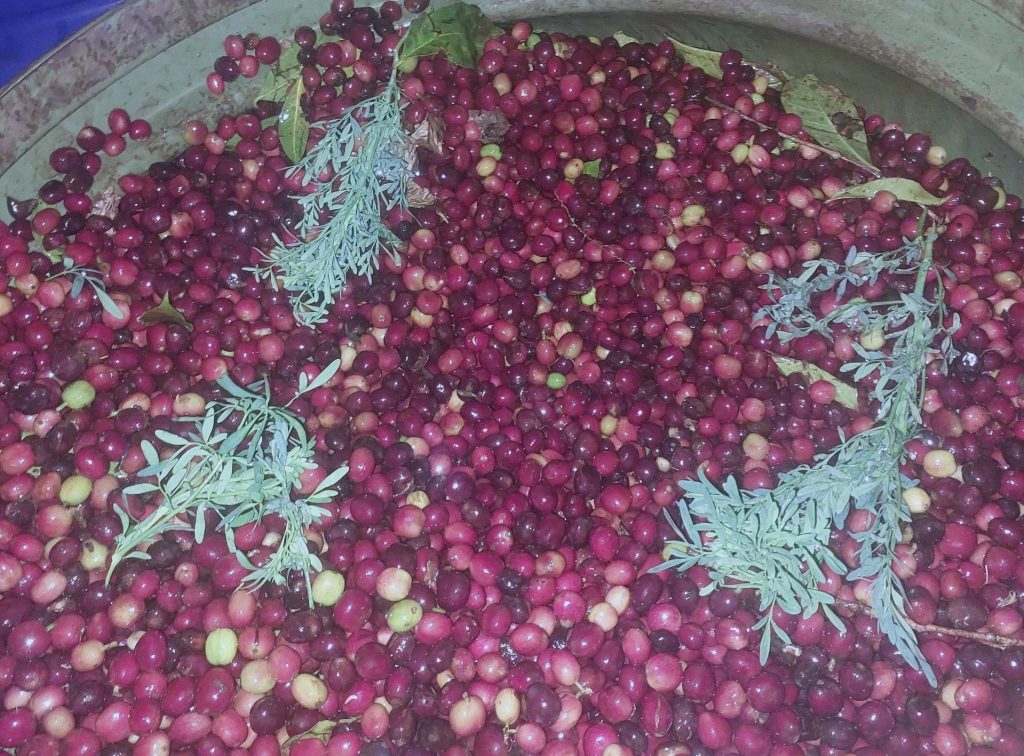
Normally, naturals at the Banko Chelchele station are hand-sorted upon delivery and moved directly to raised screen beds to sun-dry. In the case of this special microlot, fresh cherry is sealed into carbon fiber drums with fresh cuttings of local rue and left to ferment anaerobically (deprived of fresh oxygen) for 10 full days between 15-18 degrees Celsius. This stage allows the sugars in the fruit to develop far beyond where they would in a traditional natural without the risk of over fermenting. The addition of the local herb infuses the cherry must that surrounds the fruit and creates new aromatic esters in the fermentation that wouldn’t otherwise form.
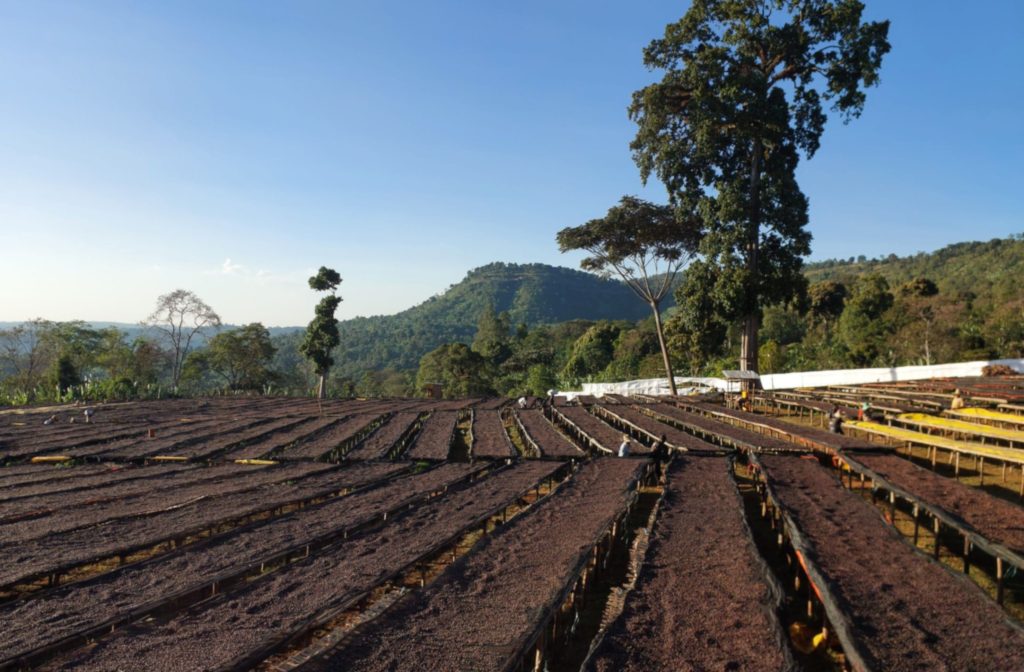
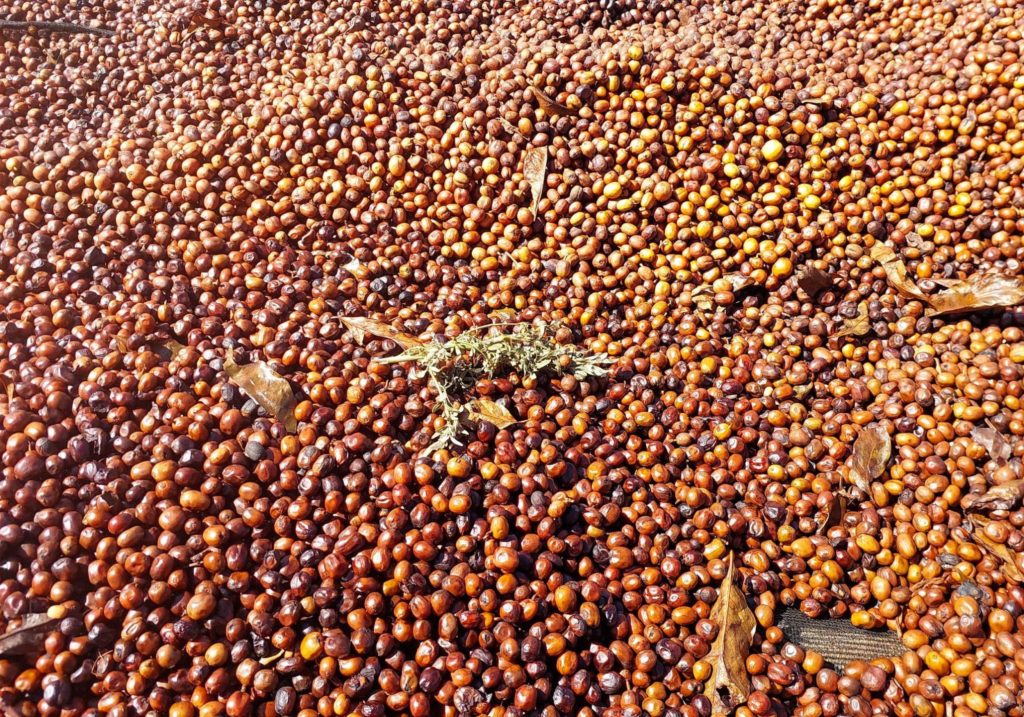
After the 10-day drum fermentation, the soft and syrupy cherry mixture is carefully moved to raised screen beds to dry, slowly and gradually, between 15-20 days. Once it reaches 11% moisture, the pods are moved to a cool warehouse where they are left to rest for a number of weeks. This last step allows the internal moisture to equilibrate and the water activity to settle, preparing the green coffee for a long shelf life of vibrant flavors.
Green
Green Analysis by Isabella Vitaliano
A high density coffee with average ranges of moisture content and water activity makes for easy, breezy roasting. 84% of screen size is condensed into 17-15, which is as expected for regional Ethiopian cultivars.
74110 is a common cultivar from Ethiopia and was selected by JARC researchers in 1974 in the Metu province of the Illubabora zone. After stabilizing the cultivar they were they confirmed its resistance to coffee berry disease and high yield potential. This is a very famous lineage due to its excellent cup profile, and is known for its citrus notes and high florals. The plant is short and compact, which allows for condensed planting and higher yield for farmers.
74112 is another cultivar found in 1974 in the Metu-Bishari forest. It showed signs of resistance to coffee berry disease and was officially approved for release in 1979. Planted in abundance in high altitudes of southern, southwestern and western parts of coffee growing regions in Ethiopia. This plant is short statured as well with smaller fruit and small bean size.
Diedrich
Driedich IR5 Analysis by Doris Garrido
What happens when a beautiful coffee from Chelchele meets a traditional plant named Rue in the fermentation tank? In Ethiopia, this herb is known as tena adam and is widely used in food, medicine, and daily coffee rituals. As a Mexican, I immediately recognized it as a sister plant we called ruda, an herb we use back home to soothe stomach aches and infuse spirits.
The resulting cup is beautifully sweet and full-bodied, wrapped in a distinct botanical finish. Thankfully, the co-fermentation processing on this lot wasn’t overly intense, which kept the green easy to manage on the machine. Because it wasn’t temperamental, I was able to approach the roast profile similarly to a standard natural-process Ethiopia.
I charged the machine at a medium-high drum temperature of 450°F and hit it with full gas for the first few seconds. I love how well Ethiopian coffees can handle high heat; it allows me to drive off the moisture quickly and drive straight toward the Maillard reaction. This aggressive start gave me a 4-minute drying phase. Right before the color transition at 280°F, I dropped to my lowest gas setting, opened up the airflow completely, and let the coffee ride through Maillard to hit those sweet caramelization notes.
After a 3:20 yellowing phase, first crack began at 390°F. I gave the batch 1:21 of development time, pulling back the burners near the very end to keep the final temperatures from running away on me, before finally dropping the roast at 411°F.
The final cup is incredibly round, sweet, and berry-forward with a full body and that signature herbal touch. I would say this coffee is a taste of how Ethiopians traditionally enjoy their own coffee
Aillio
Aillio Bullet R1 IBTS Analysis by Evan Gilman
We use the RoasTime app and roast.world site to document our roasts on the Bullet. You can find our roast documentation below by searching on roast.world, or by clicking on the link below. Take a look at our roast profiles below, as they are constantly changing!
This phenomenal coffee is in its second year with us, and while I was expecting greatness, I wasn’t prepared for this coffee to have leveled itself up so significantly. Bright and zesty but with nuance, this coffee makes for an incredible cup, and it will be very difficult to get bad results in the roaster.
I knew that I was in for a treat just opening up this coffee and smelling the green, and knew it could handle plenty of heat due to the small bean size. A pleasantly typical Ethiopian selection.
Starting with a 455F preheat, I charged this coffee with P9 power and quickly adjusted down to P8. At peak rate of change, I increased fan from F2 to F3, then lowered heat further to P7 after about a minute, just before yellowing. I knew I’d want intense airflow for this coffee in order to keep it from taking off after my heavy heat application, so I really played it up on this roast. I started with F4, then ramped up to F5, F6, and finally F7 in successively shorter intervals through first crack and into the finish of the roast. The result was a fairly fast roast finishing at 8:47 / 402.8F, and 13% roast loss. Regardless of the slightly higher finish temperature and roast loss percentage, the coloring on this coffee was still quite light – it’s a tough bean.
But not tough on the palate! Datelike sugary notes came through first off, followed quickly by the gentle herbals I was expecting from this rue coferment: sage, and of course, rue. The natural process comes through in a very clean and concise manner as well, showing itself as freeze dried raspberry tartness, juicy blood orange, and a cleanly fruit finish. Drinking this coffee is an elegant experience.
Personally, I’d recommend a coffee this delicate for pourover. Filter drip will really bring out the clean herbal nature and crystalline sugars in this coffee. I don’t think anyone would be disappointed in its perfomance as an espresso, and call me a traditionalist, but I’d drink this one for days as a drip coffee. Maybe I’ll do just that…
You can follow along with my roast here at roast.world: https://roast.world/egilman/roasts/DDjRSRFlRGgl-M5hrUdgY
IKAWA
Ikawa Pro V3 Analysis by Author’s Name
Our current Ikawa practice compares two sample roast profiles, originally designed for different densities of green coffee. The two roasts differ slightly in total length, charge temperature, and time spent between color change in first crack. You can learn more about the profiles here.
No surprises here, this rue tastes great on both the high density and low density profile although they are wildly different expressions, I had a preference for the low density as the clarity in the coffee was more crisp and had some tropical fruit notes. The low density coffee was also great and had some flavors like cranberry and chocolate cake.
You can roast your own by linking to our profiles in the Ikawa Pro app here:
- Roast 1: Low Density Sample Roast
- Roast 2: High Density Sample Roast
Espresso
Espresso Analysis by Marie de Courcy
I didn’t remember trying the rue co-ferment that came in from the Banko Chelchele Washing Station last year, so I was excited to get to play around with some espresso recipes. Ethiopian coffees continue to amaze me in their ability to carry such deep and rich flavors; this anaerobic natural is just a further expansion on what we know of Ethiopian coffee with some very compelling departures from our preconceptions.
My first recipe used a dose of 19g, with a 41g yield, pulled at 31 seconds. The body was mild, fairly sweet with some strong florals and rich nuttiness. I tasted candied orange, roasted peanut, and rosemary. This coffee is very citrus heavy in its profile, but the herby notes really come through and round things out.
The second recipe used a dose of 18.5g, a yield of 44g, extracted at 29 seconds. This shot was much more herbal and lighter in body. Some sweetness remained but it ended up feeling a bit more medicinal and pleasantly bitter. I tasted fernet, dark chocolate, orange peel, and fennel.
This coffee is fairly versatile, a heavier dose with a longer extraction will bring out the natural sweetness present in this coffee. Lower your dose and pull a little faster for something a bit more nuanced and complex. This coffee is quite delicious and very able to cater to any palate.
Brew
Brew Analysis by Joshua Wismans
Royal’s relationship with EDN has been a tremendously fruitful one. These last few years, They’ve been providing us with some of the most exciting coferments and process forward coffees out of southern Ethiopia. In particular, their Banko Chelchele station produced some of our favorites this year, and we’re excited to feature them on the Crown Jewel menu. This rue coferment is clean, fruity, and herbal in a fascinating way, uniting traditional with innovation.
This coffee is especially soluble. Expect it to extract easily, giving you a higher TDS even at course grinds. We found a lot of particularly exciting flavors on the V60, ensuring a clean crisp profile to balance the anaerobic fruity sweetness. Our first brew was a bit dense, with a 15.78 ratio of water to coffee and a more moderate grind. The fruit was more concentrated, however more herbal and citrus bitterness were present in the brew.
Utilizing a very coarse grind, and a moderate dose, we found a profile that highlighted the delicate stonefruit of the precise anaerobic processing while presenting a sweeter herbal character more reminiscent rosemary and basil.
Again, this coffee is very soluble, and brews well at a very coarse grind. If one wants to bring out more of a hibiscus delicate profile, we recommend dosing down slightly. We recommend a conical brewer to bring clarity to the cup.
Related Coffee

Black Tea, caramel, lemongrass, passion Fruit, apricot
Oakland 6 Boxes
Crown Jewel Burundi Honey Peaberry Heza Washing Station
38863-1 – SPOT RCWHSE
Black Tea, caramel, lemongrass, passion Fruit, apricot
Spot
6 Boxes
$255.49 per box

Caramel, jasmine, floral, milk chocolate, and peach
Oakland 25 Boxes
Crown Jewel Tanzania Washed Simba Neel & Kavita Vohora
Lot 159 – 39894-1 – SPOT RCWHSE
Caramel, jasmine, floral, milk chocolate, and peach
Spot
25 Boxes
$267.56 per box
Plum, caramel, graham cracker, cranberry, green apple
Oakland 22 Boxes
Crown Jewel Tanzania Karatu Vohora Family Washed SL-28
Lot 158 – 39893-1 – SPOT RCWHSE
Plum, caramel, graham cracker, cranberry, green apple
Spot
22 Boxes
$257.28 per box
Floral, jasmine, cherry, plum, apricot
Oakland 16 Boxes
Crown Jewel Tanzania Washed Gesha Neel & Kavita Vohora
Lot 156 – 39891-1 – SPOT RCWHSE
Floral, jasmine, cherry, plum, apricot
Spot
16 Boxes
$308.67 per box