
- Sorry, this product cannot be purchased.
Crown Jewel Uganda Honey Rwenzori Mountains
39618-1 – SPOT RCWHSE$242.92 per box
Boxes 45
Warehouses Oakland
Flavor Profile Honey, dark chocolate, passion fruit, persimmon, and baking spice
Add to your artisan.plus account: 
 Download PDF
Mountain Harvest’s coffee has quickly become one of the most popular and sought after East Africas we offer.
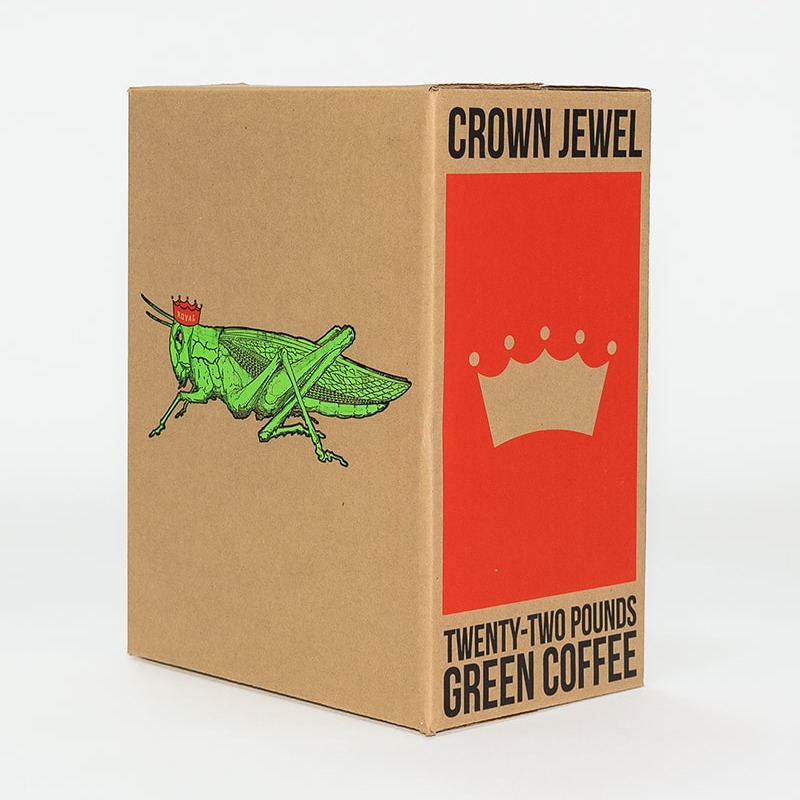
22lb Boxes
Spot


Overview
Overview
This is a low intervention honey-process SL-14 variety coffee from the Rwenzori Mountains of western Uganda, produced by 600 smallholder farmers organized around Mountain Harvest.
The flavor profile is bright, sweet, deep, and uniquely fruited. We taste dark chocolate, honey, persimmon, and passion fruit.
Our roasters found this coffee needs a long, gentle drying phase and careful heat management through crack to avoid a roasty finish.
When brewed, our baristas preferred pour-overs made using a coarser grind, a slightly higher dose, and a conical brewer.
Taste
Taste Analysis by Isabella Vitaliano with Chris Kornman
A crowd-pleaser, this honey Ugandan is the perfect way to showcase the potential of high-quality coffee from the country. It’s a sweet and tangy coffee with flavors of raisin, praline, pecan and dried cherry. It’s deeply comforting and unique, all at the same time.
Honey processing, once a specialty coffee darling, has been relegated to second-tier status by many roasters chasing the bolder flavors of newer fermentation styles, or by those seeking to return to the classic restraint of washed offerings. Recently, however, our interest has been reinvigorated, particularly in East Africa, as the best honey coffees tend to show similar bright clarity as in washed coffees, but with enhanced sweetness, depth and complexity. They also have the benefit of being less water intensive.
This particular honey struck us as both nuanced and familiar, with the kinds of zesty citrus top notes we love from nearby Rwanda and Kenya, but with floral subtlety and attention-grabbing fruit notes like passionfruit and persimmon, all while being anchored to reality with a deep, chocolaty density and honey-like sweetness.
Quite literally the perfect coffee to introduce folks to the possibility of flavor combinations they wouldn’t expect from East African coffees. There are certain coffees that are exemplary displays of origin and processing, and it’s those that introduce new concepts to coffee customers while keeping the flavor profile in the lane that a lot of people will enjoy – this is one of those coffees. From seasoned coffee drinkers to pre-ground coffee lovers, I think anyone will be able to see that this isn’t just a good coffee, it’s a great one.
Mountain Harvest is a supplier that has been doing excellent work to raise the level of awareness around the potential for high-quality Ugandan coffee. All the while, they are providing better pay for farmers that contribute to their program as well as education. Uganda doesn’t historically have the best reputation for coffee and it’s coffees like this one, with the accompanying natural and natural anaerobic coffees, that are going to change the narrative.
Source
Source Analysis by Charlie Habegger
Mountain Harvest’s coffee has quickly become one of the most popular and sought after East African coffees we offer. It’s limited, admirably sourced, and insanely good.
One of their most recent expansions has been to the Rwenzori mountains, in Uganda’s West. In true Mountain Harvest fashion, the expansion began not with aggressive cherry buying but with the slow and steady training of local agronomists, processing education, and the full network of financial services they developed on Mt. Elgon over five years.
The Rwenzoris are synonymous with naturals (and usually not good ones), but our Crown Jewel from this project is a traditional honey process. The coffee was pulped and dried carefully in three stages, resulting in a creamy, tangy cup with tropical fruit and chocolate truffle. One of the Crown cuppers described the flavor balance as “precise”, which, if you think about it, is about the highest praise available for an unconventional coffee, and the effort itself of producing it.
Welcome to the Rwenzoris
Geographically, the Rwenzori mountains are a colossal anomaly to the rest of Uganda’s landscape. They explode steeply from the surrounding lowlands in a dense, craggy outpouring of mineral rock, less than 20 miles across but including Africa’s second highest peak at over 5,000 meters (the peak, Mt. Stanley, is the highest non-volcanic, non-tectonic mountain on Earth). As you can imagine, the way up includes an incredible range of microclimates, everything from tropical rainforests to arid loamy hillsides, alpine meadows, and glacial fields. Coffee in this area reaches elevations as high or higher than those on Mt. Elgon, in Uganda’s East, but it has always been less established and of much lower reputation. Because of this the Rwenzori mountains represent one of the highest-potential but least-realized regions in Africa’s specialty coffee. There are a number of specialty groups working to establish themselves here, with varying goals and levels of success.
Uganda as a whole just doesn’t have widespread highland territories like nearby Kenya or Ethiopia. Nearly the entire country is low, tropical, and consistently warm, save for only three dramatic and concentrated exceptions: Mt. Elgon in the East, the Kigezi highlands in the southwest corner, and the Rwenzori Mountains in the West. The country is otherwise well suited for Coffea canephora (robusta), which grows wild here and is commercially critical as well: 80% of Uganda’s almost 9 million annual exportable bags are robusta. If you’ve tasted great coffee from Uganda (and many have not), chances are it came from one of only a handful of producer groups, and chances are also that they were founded in the past 10 years. Arabica, and especially great tasting arabica, is still incredibly scarce.
Mountain Harvest
Mountain Harvest is a young and big-thinking group, first established in 2017 in Mbale, near Mt. Elgon. Mountain Harvest’s entire structure was designed from scratch to be the antithesis of Uganda’s typical arabica value chains. They specialize in farmer empowerment, transparent pricing in all directions, and slow and steady processing innovation. They invest heavily in their farmers’ equity in the final product, as well as constantly diversifying their cup profiles available to the world.
For its first five years, Mountain Harvest dedicated itself to smallholders on Mt. Elgon. They began in Mbale as an impact investing project underwritten by Lutheran World Relief, and for the first couple years were based in a dilapidated dry mill deserted by a bankrupted cooperative union. By the end of this short first phase, the business model included farmer education and training, investments in centralized processing, community storage facilities, detailed quality control, and international marketing. All the while staying very modest in size, exporting only five to seven containers per year.
In 2022 Mountain Harvest set its sights on the Rwenzori Mountains, for the same reasons: incredible quality potential and under-resourced arabica growers. Within a couple of years, they were working there full time, processing cherry centrally at their “Mountains of the Moon” station and marketing the results.
Honey Processing at “Mountains of the Moon”
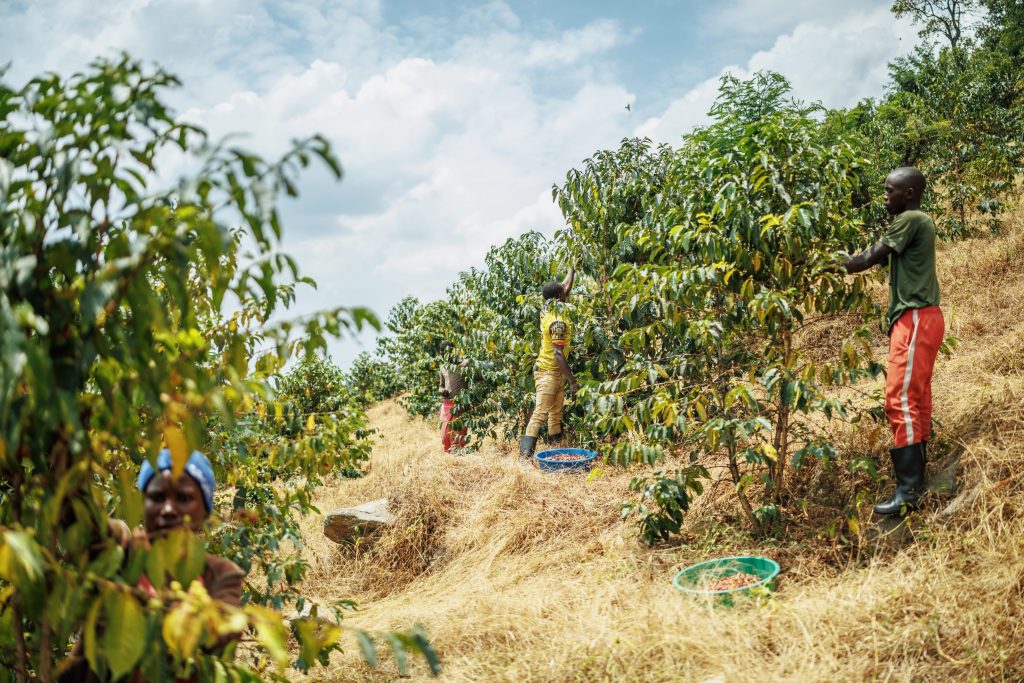
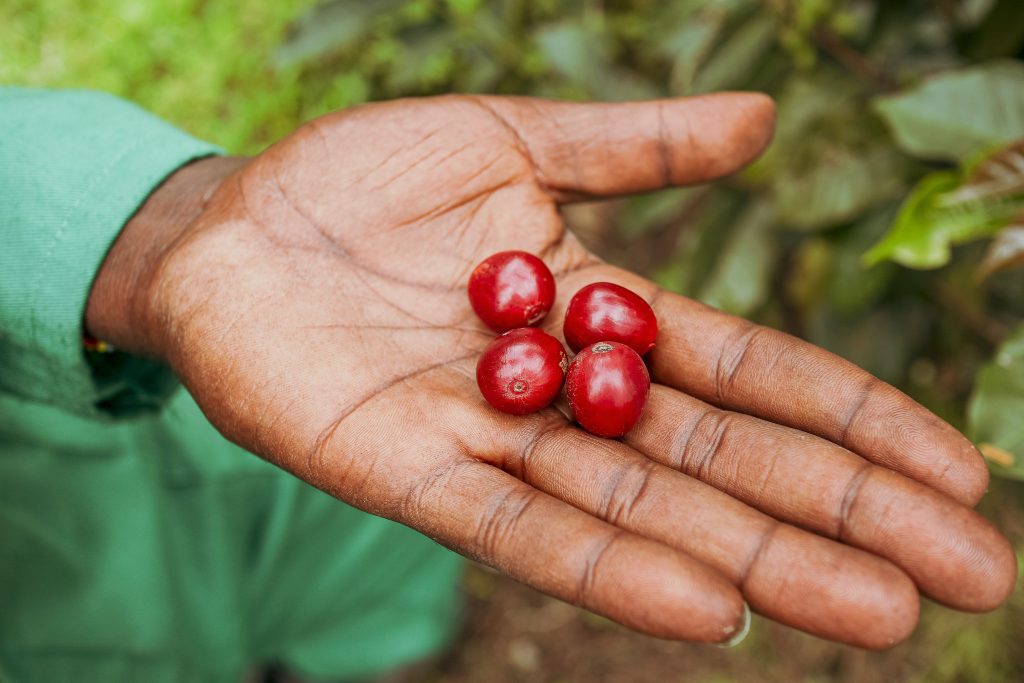
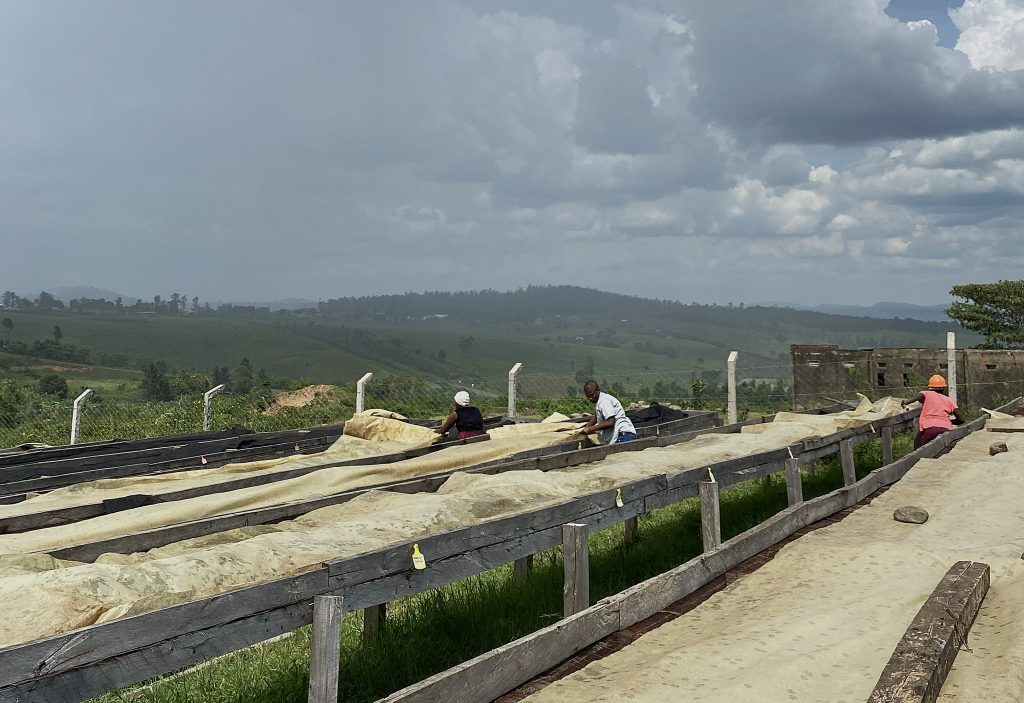
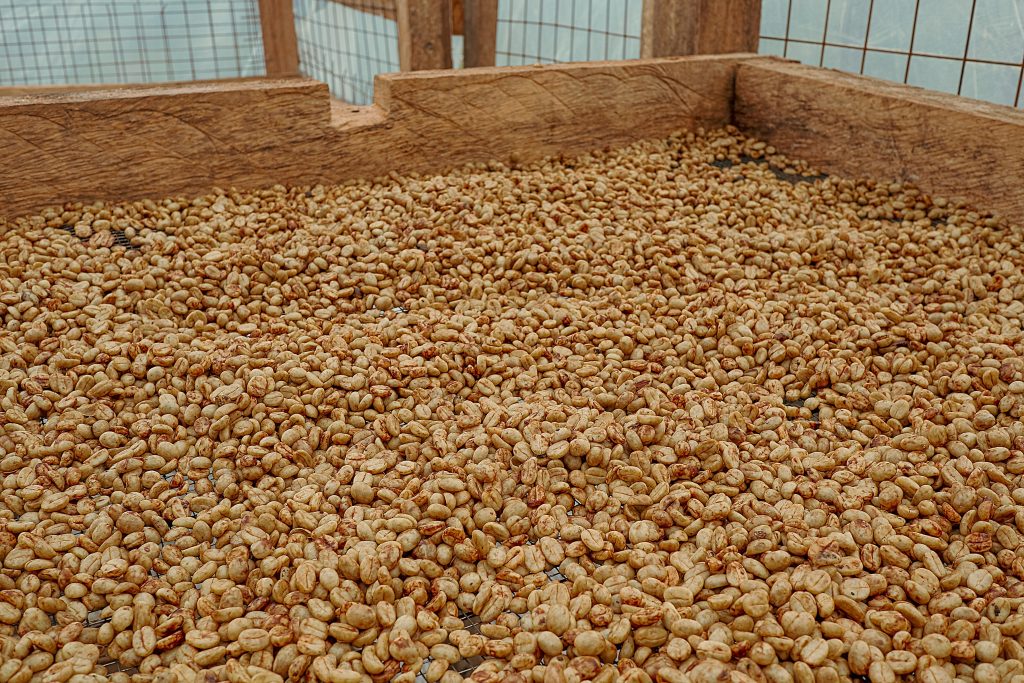
This small lot of coffee was processed as a traditional, low intervention honey, albeit a very meticulous one. Mountain Harvest recruits farmers for specific processing projects, typically by community or by harvest day. In this case, 600 farmers from two communities contributed cherry over a short period of time. Fresh cherry was delivered each picking day, sorted for ripeness and consistency and immediately depulped. Once depulped, the parchment and its full mucilage was moved to a full-sun section of raised screen beds to dry for 2-3 days, allowing a rapid extraction of moisture from the mucilage and seed while limiting the residual fermentation. After this first drying stage the parchment was moved to a different set of beds in full shade, where it was carefully rotated over many days until the moisture content reached 15%. From this stage, the parchment was moved back into full sun to achieve the final 11% moisture content, and then finally to a temperature-controlled warehouse for long-term curing.
Green
Green Analysis by Isabella Vitaliano
Honeys are sort of a rarity from Uganda, and this honey processed coffee is well taken care of from tree all the way to Royal’s warehouse. Screen size is condensed in the 19-16 range, with 35% in the 16 screen size. Density, water activity, and moisture content are all in the ideal ranges. Be sure to check out the roasters notes for more details on how to roast!
SL14 was produced in the late 1930’s by Kenya’s Scott Labs, selected from a single tree labeled Drought Resistant II. Genetic tests have confirmed that it is related to the Typica genetic group. It is a common arabica selection in Uganda.
Loring
Loring Falcon15 Analysis by Doris Garrido
My final roast of the Ugandan coffees from Mountain Harvest was the honey process. I actually did my first attempt on the Diedrich, taking a much more aggressive approach. I figured that since it was a honey process, I could push the drying phase a bit harder and easily manage the rest of the roast. I was wrong. The high temperatures caught up with me, resulting in a roasty finish. Fortunately, I got a second chance at it, especially since this coffee is slated to be one of our espresso offerings here at the Crown.
For my second attempt, I moved over to the Loring Falcon 15 for an 18lb batch. On this machine, reaching the yellowing phase tends to happen a bit faster due to its convection system. To deliberately slow down the drying, I chose a lower charge temperature paired with a short soak, which successfully allowed me to stretch the drying phase to 3:55. I marked the color change at 325°F. I applied 100% power a minute after dropping the beans, right around the turning point, and then made my first adjustments at 350°F, stepping the gas down by 20% increments. I made subsequent drops around 380°F, and a final adjustment at 390°F, leaving me at 40% power at that stage.
The coffee started cracking at 396°F, and I decided to let it develop for 1:49. Just as I was finishing development phase, I noticed a slight uptick in the Rate of Rise, so I dropped the power down to 20% the absolute lowest setting on the Loring. This kept everything in check, and I ended the roast at a final temperature of 410°F. On the cupping table, the coffee performed beautifully, turning out incredibly clean and sweet. It showcases rich notes of raisins, dried cherries, and a creamy texture, balanced by a tangy, plum-like acidity. The sugars caramelized perfectly while preserving the bright fruit flavors, leaving me with a very complex profile of grilled lemon and honey.
Aillio
Aillio Bullet R1 IBTS Analysis by Evan Gilman
We use the RoasTime app and roast.world site to document our roasts on the Bullet. You can find our roast documentation below by searching on roast.world, or by clicking on the link below. Take a look at our roast profiles below, as they are constantly changing!
It’s been a minute since I’ve had my hands on a Ugandan coffee processed any other way but washed or traditional natural techniques. Of course, we know that Mountain Harvest produces reliably delicious coffees from their aerie in the Rwenzori Mountains. I’ve been cupping coffees from this dry mill with Charlie since 2012 (when it was owned by Gumuntindo), and Mountain Harvest since 2017 with the Royal Team. I have never known Mountain Harvest’s coffees to disappoint.
So I knew from both my experience and looking at the green that I would be in for a treat. This is a fairly dense and large-bean coffee that I knew could take some heat – but that’s not the direction I decided to go. I also knew from experience that these coffees could hold some greenish sort of fresh notes, and I decided to start with a low charge temperature, spending as much time in Green/Drying as possible while still giving decent post-crack development. To that end, I started at 446F with P9 power and F1 fan, lowering my vectors to P8 and F2 at turning point.
From these beginnings, I only lowered heat to P7 and increased fan to F3 at peak rate of change, and increased fan further to P4 at about 365F, when I normally begin to see a spike in rate of change. Just before first crack, I lowered heat to P6, then successively increased fan to F5 and F6 throughout crack to abate smoke and prevent a runaway roast. I finished the roast at 391.7F / 9:25.
The result in the cup was more delicate than I was expecting, even for a lighter roast like this one. My first impressions were the deliciously custardy texture and flavor, reminding me of a few memorable puddings. There was some tannic nature here, but it came across as black tea with cream, and a touch of effervescence at the finish of the flavor experience had me coming back for more.
Added mucilage during the drying process really brought out the texture in this coffee, somewhat more than the fruit for my roast, at least. This could pair excellently with many foods, but for some reason it had me wanting sweet corn fritters and some kind of curry. It didn’t taste like these things at all.. But the pairing would be fantastic. It’s a very scrumptious sort of cup, not something I see too often. Super unique, super quaffable!
You can follow along with my roast here at roast.world: https://roast.world/egilman/roasts/3lfpkYQjon3Ue47Fyzdlw
IKAWA
IKAWA Analysis by Isabella Vitaliano
Our current Ikawa practice compares two sample roast profiles, originally designed for different densities of green coffee. The two roasts differ slightly in total length, charge temperature, and time spent between color change in first crack. You can learn more about the profiles here.
A sweet and savory mix, this lovely Ugandan coffee had quite different expressions on the cupping table. On the high-density profile, it had some deep, dark chocolate flavors like Ferrero Rocher and cooked cherries. On the low-density profile, I found more marzipan in the cup, and it had a balanced profile between the acidity and the sweet caramel flavors. I recommend trying out the low-density profile of this coffee, it’s definitely the most expressive version of this coffee.
You can roast your own by linking to our profiles in the Ikawa Pro app here:
- Roast 1: Low Density Sample Roast
- Roast 2: High Density Sample Roast
Brew
Brew Analysis by Castle Victoria
Hailing from a western region of Uganda known for its natural processed coffees, this honey processed coffee comes to us with five years of slow development by Mountain Harvest. Mountain Harvest is a younger group specializing in the empowerment of coffee farmers and steady innovation in coffee processing, leading to a meticulously crafted and equitable cup of coffee.
I found that this coffee really flourished when brewed with a conical brewer, displaying subtle sweetness balanced beautifully with slight floral notes and acidity. A coarse grind with a ratio of 1:15.79 gave me a TDS reading of 1.35. This brew resulted in a light body with delicate notes of honeysuckle and subtle notes of stone fruit.
I loved the first brew but wanted a fuller body and to really bring out those subtle fruit notes I was tasting, so I bumped the dose up a little and ground the coffee at a slightly finer setting, leading me to a brew ratio of 1:15.38 and a TDS reading of 1.44. After making this adjustment, I arrived at a much more complex profile. Maintaining that delicate floral note of honeysuckle, I now had a much juicier body with notes of plum and a lingering, slightly tart, dried fruit finish that made me want more and more.
I would recommend a grind on the coarser side, a slightly higher dose, and a conical brewer to bring out the beautifully complex yet subtle fruity and floral notes of this coffee.
Related Coffee

Berries and cream, lemon, raspberry, red wine, and allspice
Oakland 80 Boxes
Crown Jewel Uganda Anaerobic Natural Kigezi Valley
39620-1 – SPOT RCWHSE
Berries and cream, lemon, raspberry, red wine, and allspice
Spot
80 Boxes
$276.91 per box

Lavender, lemon, strawberry, floral, and berry jam
Oakland 93 Boxes
Crown Jewel Uganda Natural Kigezi Valley
39619-1 – SPOT RCWHSE
Lavender, lemon, strawberry, floral, and berry jam
Spot
93 Boxes
$267.84 per box
Honey, strawberry, toffee, apricot, blackberry
Oakland 22 Boxes
Crown Jewel Ethiopia Anaerobic Natural Banko Chelchele
39056-1 – SPOT RCWHSE
Honey, strawberry, toffee, apricot, blackberry
Spot
22 Boxes
$271.04 per box
Black Tea, caramel, lemongrass, passion Fruit, apricot
Oakland 12 Boxes
Crown Jewel Burundi Honey Peaberry Heza Washing Station
38863-1 – SPOT RCWHSE
Black Tea, caramel, lemongrass, passion Fruit, apricot
Spot
12 Boxes
$255.49 per box