
Crown Jewel Kenya Peaberry Washed Ndiaini Factory
16KE2004 – 39977-1 – SPOT RCWHSE$216.63 per box
Boxes 79
Warehouses Oakland
Flavor Profile Honey, lemon, lime, Arnold Palmer, cherry tomato
Add to your artisan.plus account: 
 Printer Friendly PDF
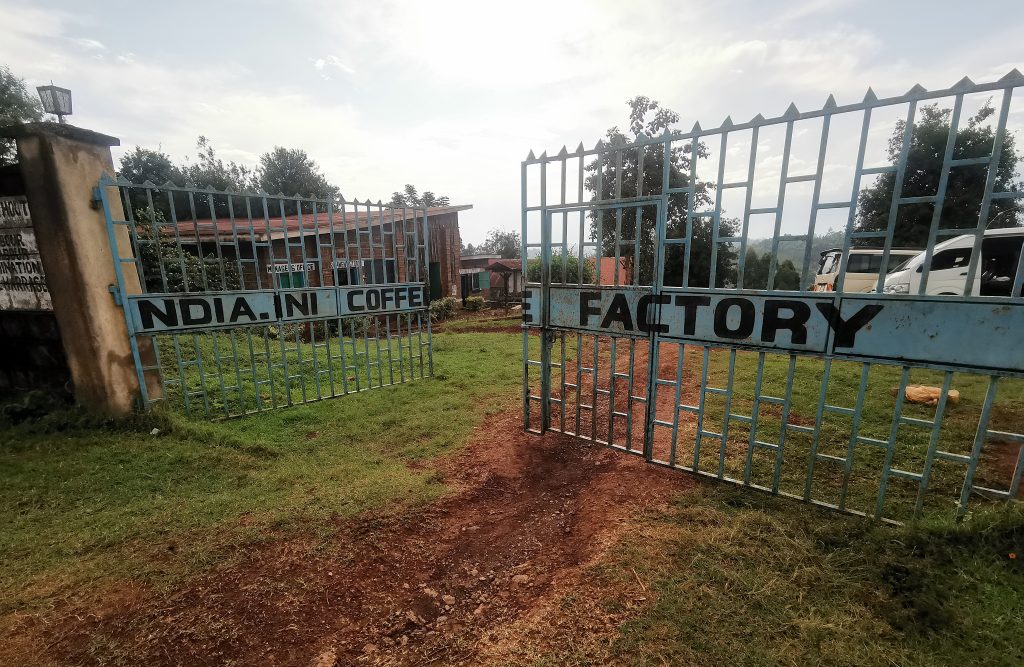
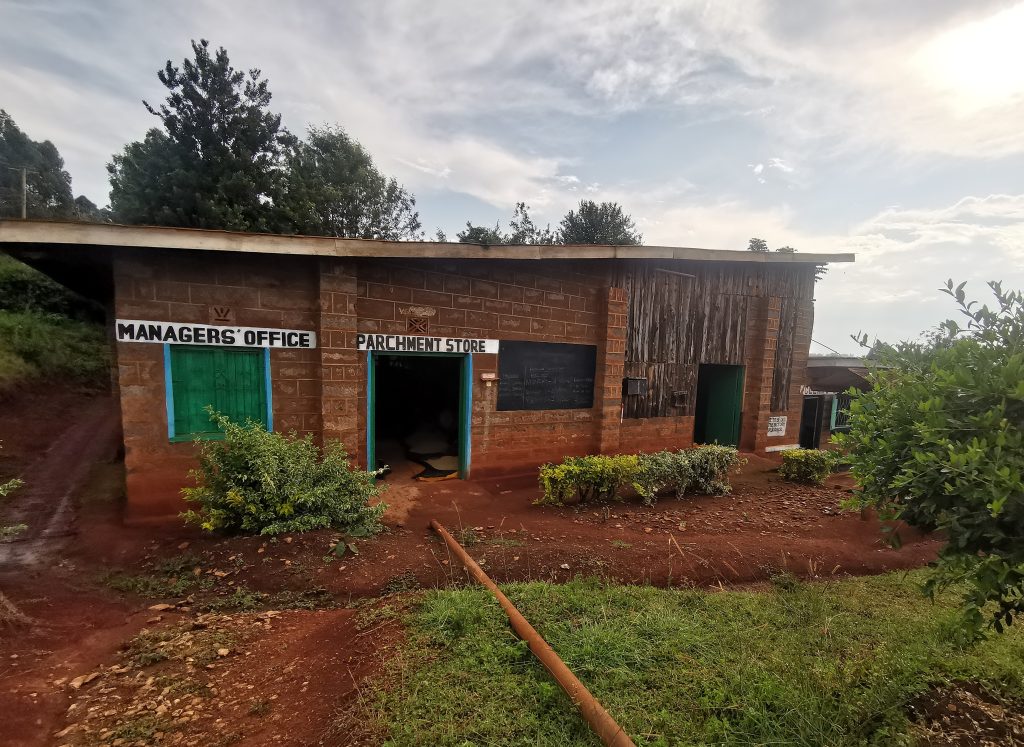
This is a citrusy, sugary and peachy outturn from the Ndiaini factory, a longstanding processing site in Nyeri that was first established in the 1970s.
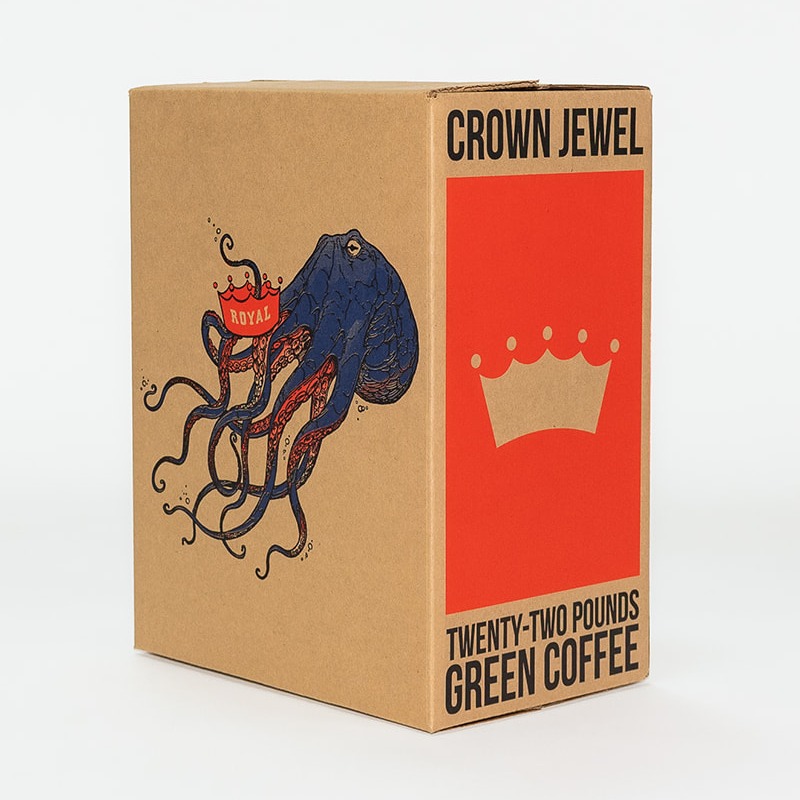
22lb Boxes
Spot

Overview
Overview
This is a moderate intervention washed peaberry coffee from Nyeri, Kenya, produced by 315 smallholder farmer members of the Ndiaini coffee cooperative factory.
The flavor profile is that of an upgraded classic Kenyan archetype – bright and juicy, sweet and savory. We tasted
Our roasters found this Kenya’s intensity called for early, repeated heat pull-backs from turning point through first crack, and the restraint paid off in bright peach, orange creamsicle, and tart hibiscus in the cup.
When brewed, we found favorable cups using a wide variety of methods, but generally preferred moderate doses and slightly coarser grind settings, and slightly longer overall extraction times.
Taste
Taste Analysis by Isabella Vitaliano
Aperol spritz with a citrus twist – we love the twirling flavors of fresh orange, marzipan, bitters and chocolate. Of course, there are classic tomato notes, but present here in a more subtle manner, really letting the tartness of this coffee shine. It’s a signature Kenyan coffee with lots of complexity… bright, juicy, sweet, and subtly savory.
Kenyan coffees have a well-deserved reputation for excellence and this coffee is no exception. We loved its encapsulation of Kenyan flavor archetypes—high acidity, slight savoriness—paired with a soft sweetness that honed its flavor profile rather than blunting its sharpness. It’s a classic, but with the kind of precision you’d expect from a microlot and the added bonus of its peaberry distinction.
This coffee holds a lot of bright tones with the savory notes that are often present in Kenyan coffees. We tasted captivating flavors including carrot cake notes, subtle-but-present florals, and the sweet-tartness of cranberry. Various cuppers also found hints of honey, apple, orange marmalade, dates, and even roasted butternut squash.
While the flavors are often familiar, they are also myriad. Combined with the peaberry sort and the single, small cooperative traceability, this is an incredibly unique Kenya. It’s headed to our bar at The Crown as a light roast drip coffee, and I’m excited to see customers’ reactions – and yours!
Source
Source Analysis by Charlie Habegger
This is a citrusy, sugary and peachy outturn from the Ndiaini factory, a longstanding processing site in Nyeri that was first established in the 1970s. These days Ndiaini is part of Rumukia Farmer Cooperative Society (FCS), a small but well-known producer organization in Nyeri County.
Central Kenya & Nyeri County
Mt. Kenya, at the helm of Kenya’s Central Province, is the second tallest peak on the continent of Africa and a commanding natural presence. The mountain itself is a single point inside a vast and surreal thicket of ascending national forest and active game protection communities. The central counties of Kenya extend from the center of the national park, like five irregular pie slices, with their points meeting at the peak of the mountain. It is along the lower edge of the forests where, in wet, high elevation communities with mineral-rich soil (Mt. Kenya is a stratovolcano) many believe the best coffees in Kenya, often the world, are crafted. Nyeri is perhaps the most well-known of these central counties.
Rumukia FCS and Processing Style
Kenya’s coffee is dominated by a cooperative system of production, whose members vote on representation, marketing and milling contracts for their coffee, as well as profit allocation. Rumukia Farmers Cooperative Society (FCS) is an umbrella organization that represents 8 total factories (centralized wet mills), including ones that Royal has bought from before: Thunguri, Maganjo, Kiawamururu, and Gatura. The cooperative society is headquartered outside the town of Karatina, close to the border with Kirinyaga county.
Of Ndiaini’s 315 contributing farmer members, 96 are women. Farmers average 0.5-1 acre of farmland each, most of whom grow subsistence crops in addition to coffee itself. Regardless of farm diversity, coffee remains the central source of income.
Kenya is of course known for some of the most meticulous at-scale processing that can be found anywhere in the world. Bright white parchment, nearly perfectly sorted by density and bulk conditioned at high elevations is the norm, and a matter of pride, even for generations of Kenyan processing managers who prefer drinking Kenya’s tea (abundantly farmed in nearby Muranga county) to its coffee. Ample water supply in the central growing regions has historically allowed factories to wash, and wash, and soak, and wash their coffees again entirely with fresh, cold river water.
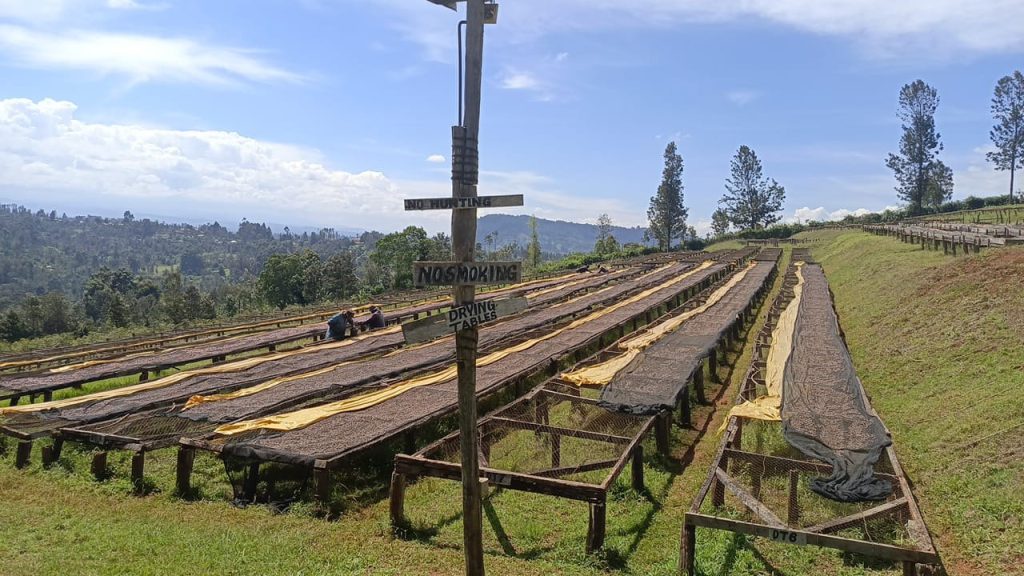
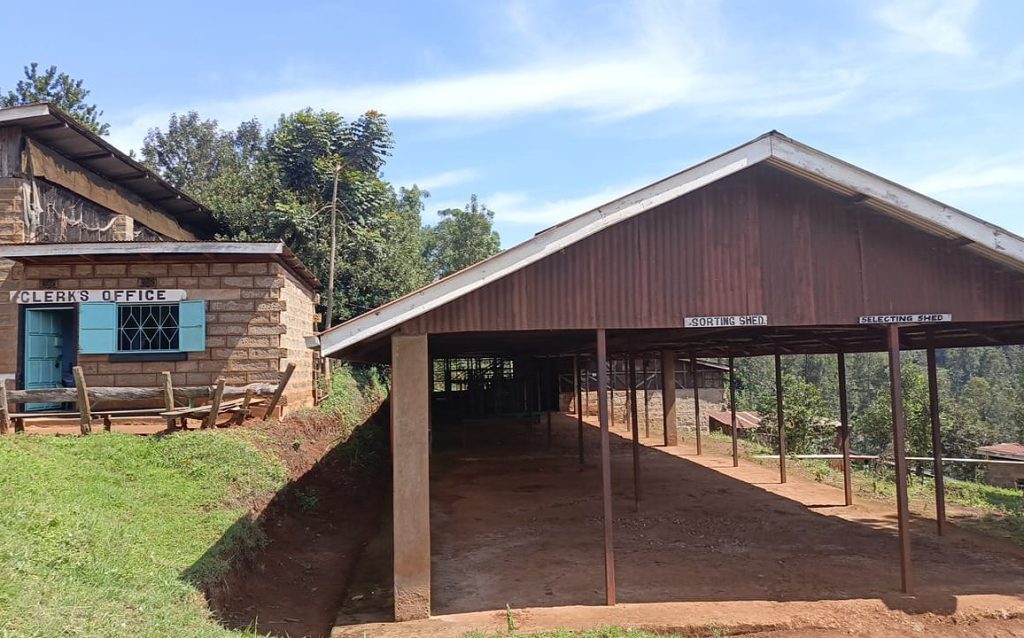
At the factory, Ndiaini collects cherry from members daily throughout the harvest months. The cherry is sorted on arrival for ripeness and consistency and then blended together for processing: coffee is depulped and fermented overnight, washed in fresh water and moved to raised screen tables to dry, a process that takes 2-3 weeks depending on local climate and ambient temperatures.
After drying is complete, the coffee is conditioned in large, perforated bins on site to allow moisture to stabilize, preparing the coffees for transit and a long shelf life. The established milling and sorting by grade, or bean size, is a longstanding tradition and positions Kenya coffees well for roasters, by tightly controlling the physical preparation and creating a diversity of profiles from a single processing batch.
Kenya’s Outturn System
“16KE2004” in the title refers to this coffee’s “outturn” number. Outturn numbers are unique microlot codes that are given to each and every batch of parchment delivered to dry mills from individual factories or estates anywhere in Kenya, and are the units on which Kenya’s entire microlot export system is built. Outturns in Kenya are tracked with a shorthand code that places the specific batch of parchment coffee in time, place, and sequentially with other coffees. Outturns are stylized as an 8 or 9-character code, including a 2-digit “coffee week” number, a 2-letter mill code, and a 3 or 4-digit intake number for the coffee’s delivery. So, this particular lot was delivered in harvest week 16, to the Rumukia Farmers Cooperative Society (FCS) (code “KE”) and was the 4th delivery that week.
Green
Green Analysis by Isabella Vitaliano
Kenyan is well known for high cup quality and a lot of it. This peaberry lot was harvested at 1800masl and after processing and shipping landed at a 9.7% moisture content and 0.543 water activity – both within average ranges. Density is high on this coffee, and it has a slightly wider spread in screen size with almost 90% of the coffee within the 18-16 range.
While peaberries are often marketed for coffee from Tanzania and Kenya, it does not represent a cultivar type – it’s a genetic mutation. While it doesn’t denote specific flavors it is easily identifiable in both shape and size. Regular coffee beans have two flat seeds while the peaberries have just one, this creates this rounded smaller bean you see in the unroasted and roasted coffee. This mutation is present in all coffee production and producers that sell them are just separating them from the current lot. Peaberries make up roughly 5% of the total harvest yield, so unless a producer has a large harvest to work with, there isn’t enough to sell on its own.
The actual cultivars of this coffee are SL28, Ruiru 11 and Batian. SL28 is a well-known cultivar in Africa and has a very good reputation for cup quality and resistance to drought. It does not fare well against major diseases in coffee but for the most part is durable and notable for its rusticity. Scott Agricultural Laboratories initially selected the cultivar from a Tanzanian Bourbon population.
Ruiru 11 is a unique F1 hybrid, a bit of a Frankenstein coffee. Its parent trees are both complex hybrids, with a short stature Catimor hybrid pollen receiving plant, and the pollen donor a tall hybrid of SL28, SL34, Sudan Rume, K7, N39, the Timor Hybrid, and Bourbon. Ruiru 11 relies on hand pollination for mass propagation, a slow and tedious process that limits production. From the 1980’s until the early 2020’s it was the most widely distributed cultivar in the country, created in response to the 1968 coffee berry disease epidemic. It has a poor reputation with specialty cuppers who expect the flavors and sweetness of SL arabicas, but it is wildly popular with growers for its productivity and resistance.
Batian is currently the most-planted tree in the country and is well-adapted for small holders due to its resistance to diseases and pests. Developed in response to Ruiru’s poor international reception, it was released in 2010, and is essentially a reformulation of Ruiru, with single tree selections taken from the fifth generation (F5) and released as a composite of three distinct genetic lines. It is an immensely productive tree with early maturation, often achieving full harvest yields by the second or third year after planting.
Aillio
Aillio Bullet R1 IBTS Analysis by Evan Gilman
We use the RoasTime app and roast.world site to document our roasts on the Bullet. You can find our roast documentation below by searching on roast.world, or by clicking on the link below. Take a look at our roast profiles below, as they are constantly changing!
Roasting Kenyan coffee is always a treat. The generally high density, consistent screen sizes, and intense flavor give an amazing amount of latitude in the roaster, paralleled by almost no other origin. Want to make a roaster happy? Hand them a fresh lot of Kenya.
So it was with a happy heart that I discovered I had one more analysis to complete than I realized. Approaching the Bullet, I knew that I wanted to start with a relatively high charge temperature, and that I would need to ramp down heat significantly in the early stages of the roast in order to slow this coffee’s roll through first crack and beyond.
I started with 473F charge temperature, P9 power, and F2 fan; hefty heat application. At turning point, I stepped back a notch to P8 power and F3 fan, then let the coffee approach yellowing before reducing to P7 power and F4 fan shortly afterward. I generally don’t ramp down heat this early in the roast, but I knew this was, as the old folks say, “a live one.” So I knew what I was getting into, and shortly before first crack, I ramped down further to P6 power and F5 fan. This still wasn’t enough to tame the beast, and I observed divergent trends in the degrees/minute curve from the bean temperature probe and the IBTS probe as a result. I gave the coffee 30 seconds of extra power by reverting to P7 and F4, then came back to the original settings so that I could get this coffee further into post-crack development before finally dropping it into the cooling tray at 9:15 / 397F.
Even coming out of the drum, this coffee smelled phenomenal. In the cup, even more so. Bright peachy notes came through for certain, and continued through to orange creamsicle sweetness, tart hibiscus, and just a touch of savory sage. This is a coffee I know I’m going to blow through very fast, one that I promise I’ll save for a special occasion and completely fail to delay my gratification with.
Chug at will!
You can follow along with my roast here at roast.world: https://roast.world/egilman/roasts/B_xncnV8ztDGiFOTO68Ql
IKAWA
Ikawa Pro V3 Analysis by Isabella Vitaliano
Our current Ikawa practice compares two sample roast profiles, originally designed for different densities of green coffee. The two roasts differ slightly in total length, charge temperature, and time spent between color change in first crack. You can learn more about the profiles here.
The high-density roast of this coffee was really creamy with orange tones, deep cherry and chocolate. On the low-density roast, the flavor was a little bit milder with more tea flavors and chocolate notes. This coffee is really excellent using either the high or low density version, but I strongly recommend trying out the high density roast.
You can roast your own by linking to our profiles in the Ikawa Pro app here:
- Roast 1: Low Density Sample Roast
- Roast 2: High Density Sample Roast
Brew
Brew Analysis by MJ Smith
Anyone who’s known me since the beginning of my time here at the Crown knows how excited I get when we get a new Kenyan coffee coming down the line, so you can imagine my excitement when I heard about this peaberry! Let me tell you, it really lived up to the excitement! It has that classic Kenyan combination of sweet, tangy and savory notes that I love, but something about this one just felt a little more special. To put flavor into feelings, it tastes the way a summer backyard picnic feels, complete with elote and Arnold Palmers (iced tea with lemonade). Let’s get into these brews, shall we?
This first brew was my favorite of the day. We made it on the V60, using a 19g gram dose ground at an 11, and it finished brewing around 3:30. I found notes of fresh homemade tortilla chips, lime zest, sweet tea, lemonade, honey, and nectarine. The rest of the team found some additional notes of caramelized peach, cherry tomato, almond butter, and caramel apple. See what I mean about the backyard picnic vibes??
The next brew was made on a Kalita Wave, using the same dose and grind as the previous brew (19g at 11), and it finished around 4:15. This brew was a little tangier in my opinion, but it also had some really nice sweetness. I was tasting dark chocolate, citrus zest, lemonade, elote (Mexican Street Corn), and sugarcane, while the rest of the team tasted orange, sun gold tomato, honey, peach, and lime.
Overall, I think this coffee works great with a medium dose and a medium-high grind. It’s pretty flexible, so the brew device isn’t as important with this coffee. We tried both cone shaped and flat bottom devices and they both worked fine. To be honest, it’s kind of hard to go wrong with a Kenya Peaberry. You owe it to yourself to get your hands on some. Enjoy!
Espresso
Espresso Analysis by Marie de Courcy
Kenyan coffees are always a treat to work with. This washed peaberry from the Ndiaini factory is a great example of a classic Kenyan profile; juicy, bright, sweet, and a little savory.
I used a classic 1:2 ratio for my first recipe, an 18.5g dose, 38g yield, pulled at 31 seconds. This shot was fairly light in body, brightly citrusy and a little savory. I tasted tomato sauce, lemonade, almond butter, and milk chocolate.
For my second recipe I used an 18.5g dose with a 44g yield, pulled at 30 seconds. This shot was much sweeter and a bit juicier. I tasted notes of peach, cardamom, and orange juice. Stretching the yield brought out a lot of those more subtle sweet flavors and made a shot with a slightly more complex profile.
This coffee is very sweet and aromatic, rich with depth and complexity. For a shot that is a bit more balanced, use a moderate dose and lower yield. For something a bit sweeter and juicier, go high on your yield.
Related Coffee
Chocolate, strawberry, stone fruit, baking spice, and strawberry
Oakland 99 Boxes
Crown Jewel Kenya Natural Ndiaini Factory Nyeri
16TY0014 – 39976-1 – SPOT RCWHSE
Chocolate, strawberry, stone fruit, baking spice, and strawberry
Spot
99 Boxes
$248.35 per box

Black Tea, caramel, lemongrass, passion Fruit, apricot
Oakland 17 Boxes
Crown Jewel Burundi Honey Peaberry Heza Washing Station
38863-1 – SPOT RCWHSE
Black Tea, caramel, lemongrass, passion Fruit, apricot
Spot
17 Boxes
$255.49 per box
Lemon, floral, hibiscus, rosemary, and apple
Oakland 67 Boxes
Crown Jewel Ethiopia Anaerobic Natural Rue Co-ferment Banko Chelchele
40654-1 – SPOT RCWHSE
Lemon, floral, hibiscus, rosemary, and apple
Spot
67 Boxes
$358.51 per box

Caramel, jasmine, floral, milk chocolate, and peach
Oakland 32 Boxes
Crown Jewel Tanzania Washed Simba Neel & Kavita Vohora
Lot 159 – 39894-1 – SPOT RCWHSE
Caramel, jasmine, floral, milk chocolate, and peach
Spot
32 Boxes
$267.56 per box