
Crown Jewel Kenya Natural Ndiaini Factory Nyeri
16TY0014 – 39976-1 – SPOT RCWHSE$248.35 per box
Boxes 113
Warehouses Oakland
Flavor Profile Chocolate, strawberry, stone fruit, baking spice, and strawberry
Add to your artisan.plus account: 
 Download PDF
.
22lb Boxes
Spot

Overview
Overview
This is a high-intervention natural coffee from Nyeri, Kenya produced by smallholder farmers associated with the Ndiaini Coffee Factory and the Rumukia Farmer’s Cooperative Society.
The flavor profile is a graceful harmony of terroir and enhanced processing, with the expected Kenyan brightness and hits of savory flavors paired elegantly with softer, sweeter, fruitier flavors we expect from high-quality naturals.
Our roasters found this natural Kenya can take heavy early heat but needs more time to develop.
When brewed, we preferred a flat-bottomed brewer with a moderate dose and a finer grind.
Taste
Taste Analysis by Isabella Vitaliano
Only recently have we been able to get our hands on natural Kenyan coffees on a regular basis. Often it can be really difficult to find natural coffees of the caliber needed to actually purchase. Securing this coffee was a no-brainer for the team, however.
It’s tart and tangy with sour gummy and rose notes. An amalgamation of mandarin orange, plum, and pomegranate make up some of the fruit flavors in the coffee. The team also got notes of green apple, chirimoya, and apricot — a real medley of fruit flavors happening in the cup. Heirloom tomato is also present with delicate cotton candy and dried green mango.
I had the chance to try Marie’s first shot of this Kenyan coffee and even before she perfected it, it had so much exploding flavor. One of my favorite origin and processing combinations in a while. Be sure to grab it while it lasts!
Source
Source Analysis by Chris Kornman & Charlie Habegger
The Process
Let’s address the elephant in the room—the “anaerobic” in this natural coffee, and why we chose to drop it from the coffee’s title and description.
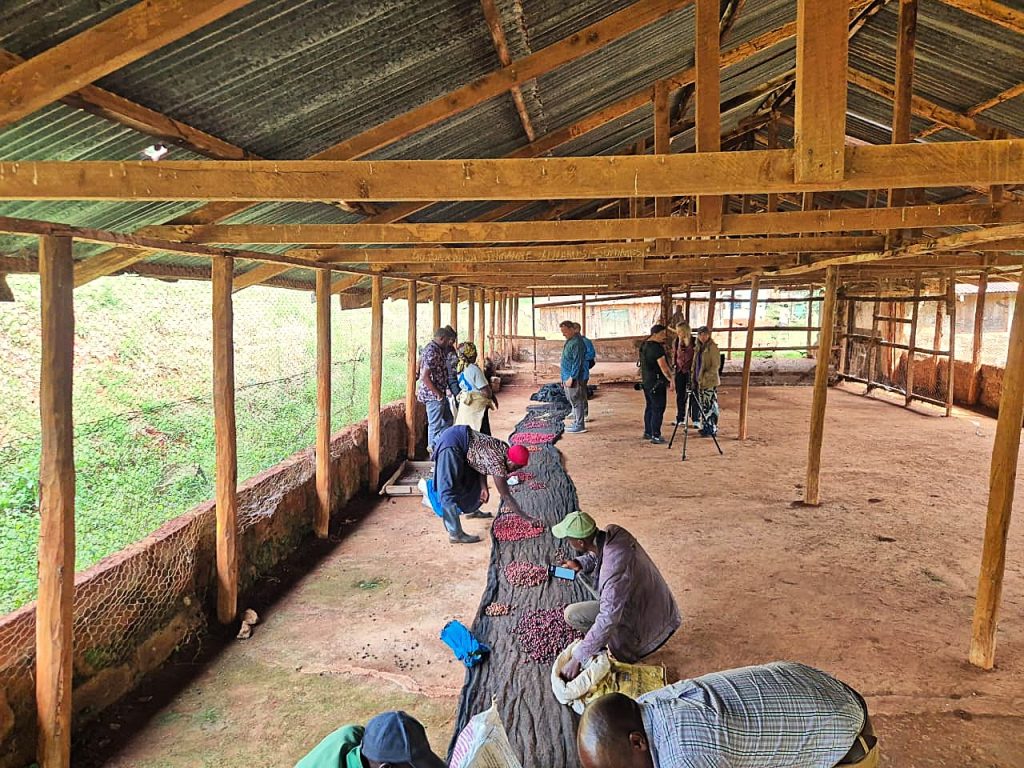
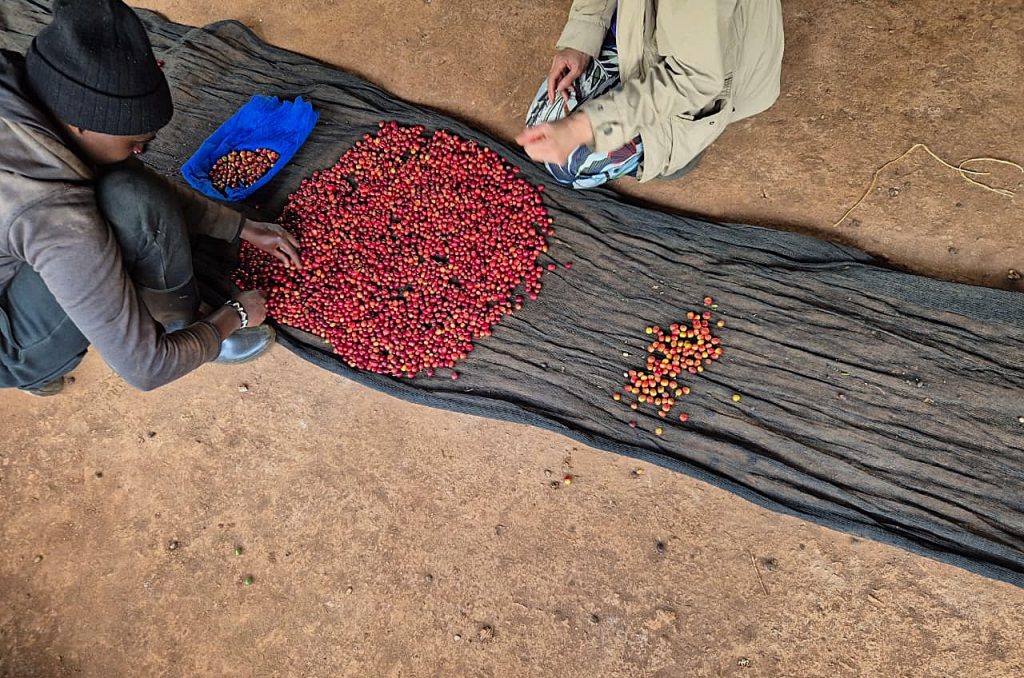
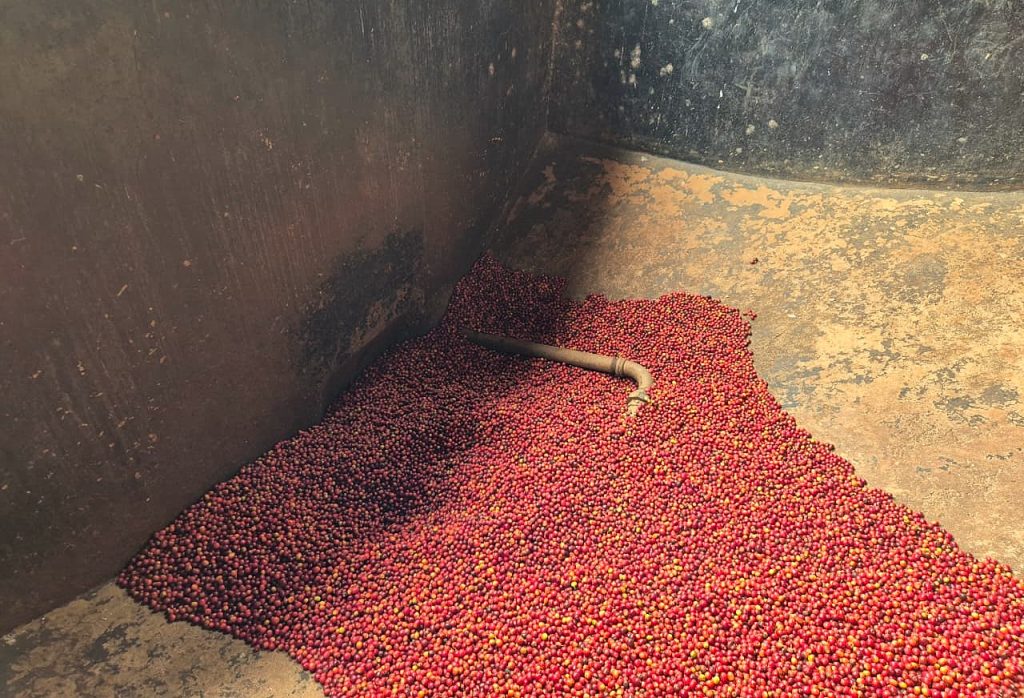
From a processing perspective, this is certainly higher intervention offering than a “traditional” sun-dried coffee. After ripe coffee cherries were picked and delivered to Ndiaini, the central processing site, those coffee cherries were placed in food-grade airtight bags for 24-72 hours, and thereafter dried on raised beds for about a month. While there was undoubtedly some oxygen present when the bags were sealed, as the coffee fermented most (if not all) of it would have been consumed during the metabolic process of converting starches and sugars. The resulting low oxygen environment would have helped select beneficial yeasts and bacteria, allowing for the long fermentation time without the “funk” of overly processed coffee fruit flavor.
Most coffee producers, at least these days, are calling this “anaerobic,” which is indeed what Rumukia communicated to us when we inquired about the specific processing details. But we decided not to use that term, and not because we’re being pedantic about whether or not there was oxygen present during the fermentation process. This choice on our part was more about flavor and expectations. For better or for worse, the term “Anaerobic” has connotations for many coffee roasters and drinkers. Yet this coffee is decidedly not wild or fermented in flavor, and in this regard, it closely resembles a minimal intervention natural. If you’re looking for cartoonishly fruity Kenyan coffee, this is not it. Instead, it is a restrained, and sweetly fruity example of what enhanced processing techniques can accomplish when the goal is a flavor profile that remains both true to terroir and simultaneously compellingly unique.
The Producer
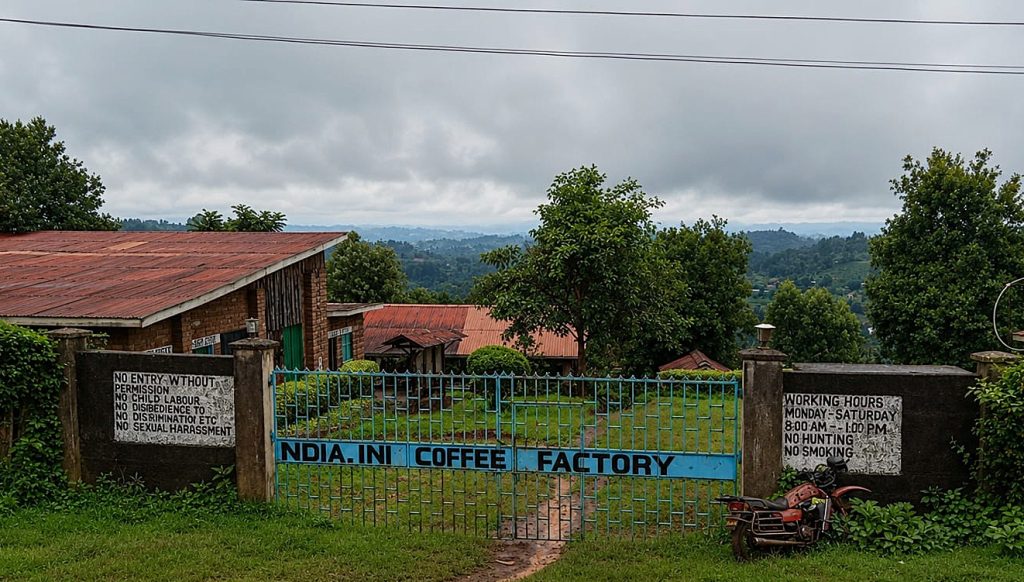
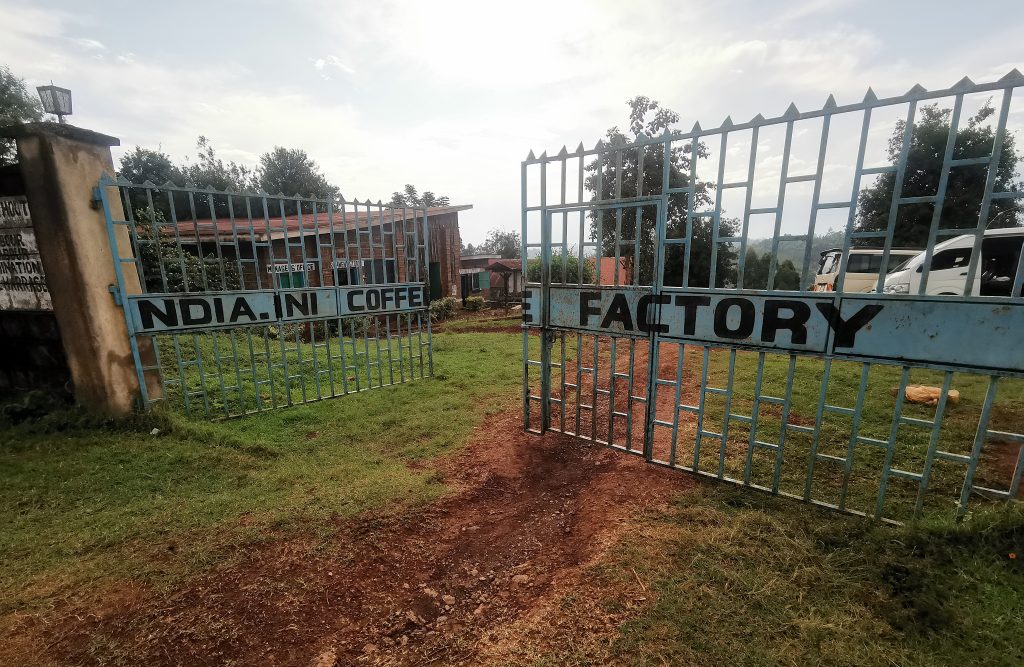
Ndiaini is the name of a “Factory”—the Kenyan parlance for “Washing Station” or “Wet Mill,” and while this coffee was not washed, strictly speaking, it did require central processing. A few hundred contributing farmers bring their freshly harvested coffee to Ndiaini, and from these producers a small quantity was selected for natural processing, as a day-lot.
Ndiaini is one of just a small handful of stations affiliated with the Rumukia Farmer’s Cooperative Society, a relatively small FCS compared to other, larger such unions that exist elsewhere in Kenya, including in the nearby locales of Nyeri.
Rumukia is also one of the region’s oldest societies, beginning their operations in 1979. The cooperative supports hundreds of smallholder farmers through agronomic training, quality assurance, sustainability initiatives, and full traceability.
The Region
Mt. Kenya, at the helm of Kenya’s Central Province, is the second tallest peak on the continent of Africa and a commanding natural presence. The mountain itself is a single point inside a vast and surreal thicket of ascending national forest and active game protection communities. The central counties of Kenya extend from the center of the national park, like six irregular pie slices, with their points meeting at the peak of the mountain. It is along the lower edge of these forests where, in wet, high elevation communities with mineral-rich soil (Mt. Kenya is a stratovolcano) many believe the best coffees in Kenya, often the world, are crafted.
Nyeri is perhaps the most well-known of these central counties. Kenya’s coffee is dominated by a cooperative system of production, whose members vote on representation, marketing and milling contracts for their coffee, as well as profit allocation. The economics of smallholder systems are consistently difficult, and in Kenya in particular the number of individual margins sliced off an export price before payment reaches the actual farms is many, leaving only a small percentage to support coffee growth itself, and most often this arrives many months after harvest. However, Kenya coffees are sold competitively by quality, which means well-endowed counties like Nyeri achieve very high average prices year after year, and the smallholders here with a few hundred coffee trees at the most, plus additional land uses available and local job markets, are widely considered to be middle class.
Green
Green Analysis by Isabella Vitaliano
The density of this coffee is extremely high, with the Sinar sitting at 764 m/L, making it a great candidate for a high charge temperature when roasting. Moisture content and water activity are both in lower than average ranges (a common occurrence for high quality Kenyan beans), with screen size spread in the 19-16 range. These sizes are spread out a little bit, so be sure to watch out for uneven roasting. Overall the specs are in the ranges we expect, and with four cultivars in this lot, the spread in screen size is not unusual. The lot is predominately legacy Scott Lab selections, with a small percentage of newer hybrid varieties included for their disease-resistance and climate-resilience.
SL28 is a well-known cultivar in Africa and has a very good reputation for cup quality and resistance to drought. It does not fare well against major diseases in coffee but for the most part is durable and notable for its rusticity. Scott Agricultural Laboratories initially selected the cultivar from a Tanzanian Bourbon population.
SL34, once thought to be a Bourbon selection, is now known to be a Typica-related tree, first selected by Scott Labs in the 1930’s. It is known for its great cup quality and moderately high yields but is susceptible to diseases and climate change.
Ruiru 11 is a unique F1 hybrid, a bit of a Frankenstein coffee. Its parent trees are both complex hybrids, with a short stature Catimor hybrid pollen receiving plant, and the pollen donor a tall hybrid of SL28, SL34, Sudan Rume, K7, N39, the Timor Hybrid, and Bourbon. Ruiru 11 relies on hand pollination for mass propagation, a slow and tedious process that limits production. From the 1980’s until the early 2020’s it was the most widely distributed cultivar in the country, created in response to the 1968 coffee berry disease epidemic. It has a poor reputation with specialty cuppers who expect the flavors and sweetness of SL arabicas, but it is wildly popular with growers for its productivity and resistance.
Batian is currently the most-planted tree in the country and is well-adapted for small holders due to its resistance to diseases and pests. Developed in response to Ruiru’s poor international reception, it was released in 2010, and is essentially a reformulation of Ruiru, with single tree selections taken from the fifth generation (F5) and released as a composite of three distinct genetic lines. It is an immensely productive tree with early maturation, often achieving full harvest yields by the second or third year after planting.
Diedrich
Diedrich IR5 Analysis by Doris Garrido
My joy while roasting Kenyas is that I can drive the roast with everything I’ve got, pushing hard into Maillard. These beans can hold the heat, and that’s something I love about them. In this case, though, it’s a natural process, which makes it more of a challenge: move fast to Maillard, then slow down to avoid overshooting.
I warmed up the drum to 460°F to drop the beans, using 100% gas from the beginning of the roast, and let the roaster drive until I hit 300°F. At that point I dropped the gas to zero and opened the airflow fully.
Drying fast, clocking in at 3:27 minutes. From there I was able to slow down and stretch the yellowing phase to 3:39 minutes. For development, I aimed for 1:22 and dropped the coffee at 385°F.
On the cupping table, I got great cherimoya acidity, along with apricot, citrus, green apple, plum, and pomegranate. Tart, tangy, exactly the kind of flavor I appreciate in a Kenya. That said, in the first pass, when the coffee was at its hottest, the taste came across a touch underdeveloped – a slightly herbal note – which makes me want to rethink my approach for the next roast of this coffee: a bit less aggressive next time.
On the sweeter side, the coffee shows sweet heirloom tomato and cotton candy, with a delicate sweetness that comes through almost like a slightly sweet rosé wine.
Aillio
Aillio Bullet R1 IBTS Analysis by Evan Gilman
We use the RoasTime app and roast.world site to document our roasts on the Bullet. You can find our roast documentation below by searching on roast.world, or by clicking on the link below. Take a look at our roast profiles below, as they are constantly changing!
My first experience with natural process Kenyan coffee was not so long ago. We were so taken aback by one particular lot that we released it as a Crown Jewel. This is another such standout lot of natural Kenya that will be sure to break the mold for those who have never tried one.
Of course, the first task with a coffee like this is to express the bold fruity flavors without letting it run away at the end of roast, taking all the fruit flavors into BBQ territory and leaving you with a cup of tonkatsu sauce. For me, this meant hitting the coffee with plenty of heat and airflow, and attempting to spend more time in Maillard than in Green/Drying stage. I knew that with proper airflow, this coffee wouldn’t take off too much in post-crack development.
I started with 455F charge temperature, P8 power, and F3 fan speed, only lowering to P7 once peak rate of change was achieved at just under 40F/min (the upper limit of my cringe threshold). I began to add more fan speed to F4, then to F5 about a minute before first crack, concurrently lowering my power to P6 as well. I even lowered to P5 before, then increased fan speed to F6 after first crack for an extra safe draw down.
The result was a finish temperature of 394F at 9:20, and a bright cup of coffee full of fruity expression. Bright Belgian raspberry lambic flavors came through here, with blackberry not far behind. There’s a lot of tart hibiscus and crisp lemon notes in this roast, so if you’re looking for a smoother expression, you might want to draw out the roast just a bit longer than I did. This one is primed for a light and bright pourover.
Taking this roast to at least 9 minutes would be a good idea, at least for a similar batch size – I did 500g here. I didn’t run into inconsistencies in color, but there’s so much available acidity in this coffee, you won’t have trouble maintaining it in a relatively longer roast. There’s also just so much delicious fruit here that it deserves plenty of time in Maillard. I got 45% of my roast in Maillard, which made me a happy camper. Maybe I’ll even take it with me on a camping trip, who knows.
You can follow along with my roast here at roast.world: https://roast.world/egilman/roasts/VpMbDz58fvnhRlZRXcLFx
IKAWA
Ikawa Pro V3 Analysis by Isabella Vitaliano
Our current Ikawa practice compares two sample roast profiles, originally designed for different densities of green coffee. The two roasts differ slightly in total length, charge temperature, and time spent between color change in first crack. You can learn more about the profiles here.
The low-density roast of this coffee had bright flavor, and was zippy; a little bit closer to common savory Kenya flavors. The high-density roast of this coffee was extremely sweet, with savory and sweet notes to complement one another along with some deep cherry notes. Both of them were honestly great roasts; surprisingly, I enjoyed the low-density roast a little bit more. The zippy notes were such a dream.
You can roast your own by linking to our profiles in the Ikawa Pro app here:
- Roast 1: Low Density Sample Roast
- Roast 2: High Density Sample Roast
Brew
Brew Analysis by Tim Tran
Natural processed Kenyan coffees are out of my wheelhouse of familiar coffees to dig into – I was particularly interested in the intersection of strong hallmark Kenyan terroir with the more fruit-leaning processing method. This coffee was fun to brew and across multiple recipes carried lovely fruit acid in spades. I was really mulling over and distinguishing a plethora of different fruit notes that came across my palate.
This coffee proves to be a fairly soluble coffee, with notable extraction percentages almost independent of grind size, and I found a lot of the brews I enjoyed most were the ones that had slightly higher extraction and slightly longer brew times. Many of the brews were quite jam-packed with layered fruit complexity and discerning the relative balance of flavor profiles proved to be a fun flavor journey.
My favorite recipe was brewed with a moderate dose of coffee with a moderately fine grind size, brewed at a 1:16.67 ratio on a flat-bottomed brewer. This brew gave me a TDS of 1.38 with an extraction percentage of 19.4%. The flavor profile of this brew was swimming with ripe red fruit notes, baking spices, and candied orange. Brewing a natural processed coffee at a finer grind size helped lend a richer and silkier texture to the mouthfeel of the coffee that lengthened the sweet fruit finish.
My second favorite recipe was brewed with a moderately low dose of coffee with a coarse grind size, brewed at a 1:17.65 ratio on a flat-bottomed brewer. This brew gave me a TDS of 1.3 with an extraction percentage of 19.8%. Using a lowered dose and opening the grind brought forward a much more notably stone fruit flavored profile, with the primary palate note being of peach pits, with a confectionery sweetness and milk chocolate note rounding out the flavor profile.
This coffee does have the same capacity for high acid that is certainly associated with classically washed Kenyan coffees, although the more rounded flavor profile and slightly muted acidity that I observed in brews on flat-bottomed brewers proved to be my favorite. Ultimately, my recommendation for this coffee is to brew on a flat-bottomed brewer, with a moderate dose, and a finer grind – this is a coffee that certainly would be fun to target high extraction. We hope you enjoy!
Espresso
Espresso Analysis by Marie de Courcy
This natural process Kenya reminds me a lot of the first time I tried coffees from Kenya: bright, juicy, a little savory, and rich with flavor. This coffee leans heavily into those flavors and was very flexible, so I could toy around with different profiles.
My first recipe used a dose of 17.5g, a 41g yield pulled at 27 seconds. This shot was very balanced, smooth, and juicy. I tasted confit tomatoes, peanut sauce, and rose. The savory notes really shone in this recipe, but there was still a sweet black cherry finish.
The second recipe used a dose of 17g, a 36g yield, also pulled at 27 seconds. Slightly lowering the dose and using a much shorter yield made a shot that was lighter in body, with more acidity. This shot tasted clean and zesty, with notes of lemonade, bergamot, and graham cracker.
This coffee is very flexible. For a more savory and balanced profile, use a slightly low dose with a higher yield. For a shot with lighter body and more acidity, lower your yield while keeping a fairly low dose.
Related Coffee

Caramel, jasmine, floral, milk chocolate, and peach
Oakland 33 Boxes
Crown Jewel Tanzania Washed Simba Neel & Kavita Vohora
Lot 159 – 39894-1 – SPOT RCWHSE
Caramel, jasmine, floral, milk chocolate, and peach
Spot
33 Boxes
$267.56 per box

Floral, jasmine, cherry, plum, apricot
Oakland 46 Boxes
Crown Jewel Tanzania Washed Gesha Neel & Kavita Vohora
Lot 156 – 39891-1 – SPOT RCWHSE
Floral, jasmine, cherry, plum, apricot
Spot
46 Boxes
$308.67 per box

Black Tea, caramel, lemongrass, passion Fruit, apricot
Oakland 18 Boxes
Crown Jewel Burundi Honey Peaberry Heza Washing Station
38863-1 – SPOT RCWHSE
Black Tea, caramel, lemongrass, passion Fruit, apricot
Spot
18 Boxes
$255.49 per box
Lemon, floral, hibiscus, rosemary, and apple
Oakland 68 Boxes
Crown Jewel Ethiopia Anaerobic Natural Rue Co-ferment Banko Chelchele
40654-1 – SPOT RCWHSE
Lemon, floral, hibiscus, rosemary, and apple
Spot
68 Boxes
$358.51 per box