
Crown Jewel Kenya Double Fermented & Double Washed Mahiga Factory Mumwe District
17TY0008 – 36864-1 – SPOT RCWHSE
Boxes 0
Warehouses Oakland
Flavor Profile Apricot, juniper, pineapple, lemon, and orange
Out of stock



Overview
Overview
This is a high intervention double fermented and double washed coffee from Nyeri, Kenya, produced by cooperative members of the Mahiga Factory and Othaya Cooperative Society.
The flavor profile is delicately Kenyan, but with amplified sweetness and fruit flavors that veer more tropical than savory. We tasted mango, lime, guava, and honeysuckle.
Our roasters generally used quick and hot drying stage approaches, with excellent results at both quicker and slower approaches thereafter; the coffee is pretty flexible especially for a Kenyan offering. Note the low first crack temperature.
When brewed, the barista team favored moderately finely ground pour-overs brewed in flatbottomed devices, and espresso extractions that slightly exceeded the typical 1:2 dose to yield ratio.
Taste
Taste Analysis by Isabella Vitaliano
Perhaps not as loud as other Kenyan coffees we have offered before, this lot shines where others do not. With extreme clarity and precision this profile leans on the edge of mango, lime, coconut and 7 Up. It’s clean but not sterile in any way and it’s an upgraded take on the classic flavors you can expect from Mahiga. Obviously, tomato is such an identifier for Kenyan coffees but this lot keeps it in the undertones in the form of golden cherry tomato or maybe green tomatillo. On some brews you’ll find notes like jasmine, apricot, cheesecake and blood orange can be extracted from the beans.
Oddly enough, this coffee feels like a Wes Anderson film, with filtered overlays but clean lines and sharp execution. A vision that feels so clear, you know exactly what the Wes Anderson or in this case, 400 producers organized around the Mahiga factory. You tell me what’s more impressive, I think it’s the latter.
As if we are moving from scene to scene, you can distinctly feel the arc of progression in this coffee. Guava syrup to lemon zest, apricot, honeysuckle, Arnold palmer, this list goes on. Not a single note feels disjointed from another. Like your favorite plot, this will take you through a story and end on the sweetest note. In this case, mango, pear and butterscotch.
This narrative is best told on espresso or pour over but no one would be disappointed to find it on batch or cold brew. You’ll find that former options will keep the flavor notes especially sharp.
When I first got into coffee, I had a slight repulsion towards Kenyan coffee. I had a hard time coming to terms with a coffee that was savory. Did I want to drink V8 first thing in the morning? Absolutely not. This coffee is a great display of classic Kenyan flavors but without the volume turned to 10. If you want to ease some of those picky customers towards understanding and better yet, liking Kenyan coffees, this will be a great option for you.
Source
Source Analysis by Charlie Habegger
Mt. Kenya, at the helm of Kenya’s Central Province, is the second tallest peak on the continent of Africa and a commanding natural presence. The mountain itself is a single point inside a vast and surreal thicket of ascending national forest and active game protection communities. The central counties of Kenya extend from the center of the national park, like six irregular pie slices, with their points meeting at the peak of the mountain. It is along the lower edge of these forests where, in wet, high elevation communities with mineral-rich soil (Mt. Kenya is a stratovolcano) many believe the best coffees in Kenya, often the world, are crafted.
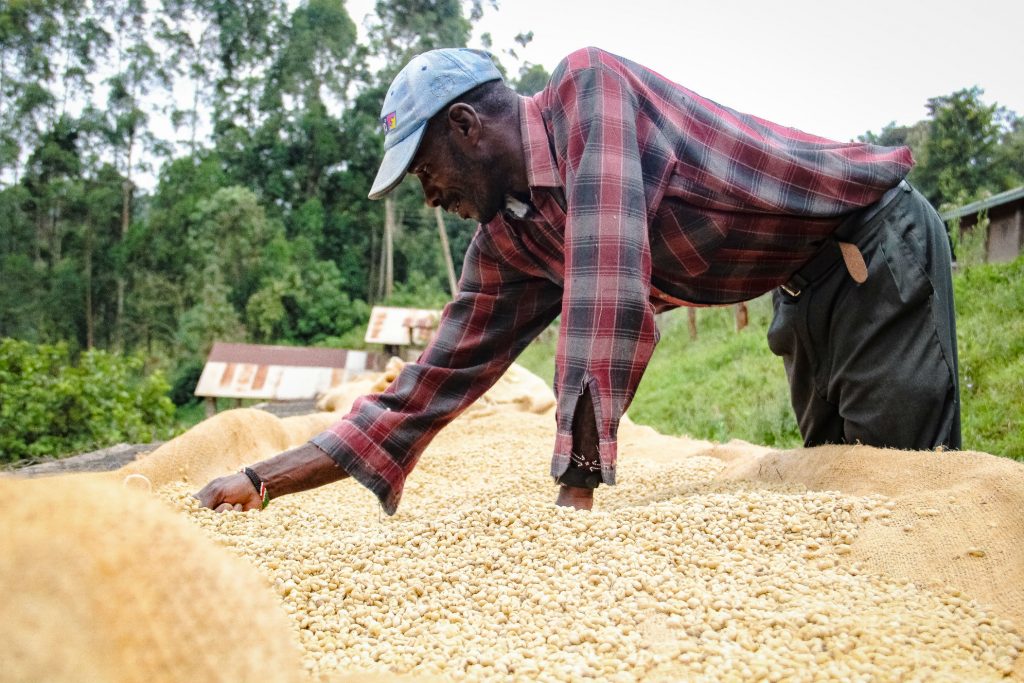
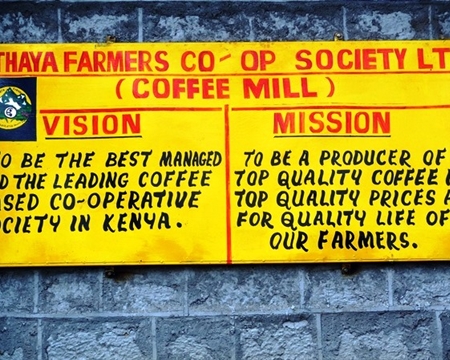
Nyeri is perhaps the most well-known of these central counties. Kenya’s coffee is dominated by a cooperative system of production, whose members vote on representation, marketing and milling contracts for their coffee, as well as profit allocation. Othaya Farmers Cooperative Society, the umbrella organization that includes Mahiga Factory, is one of Kenya’s larger societies, with 19 different factories and more than 14,000 farmer members across the southern Nyeri region. The Mahiga Factory has 400 members actively harvesting and delivering to the processing center. The factory’s total parchment output this past harvest was 152,000 kgs, meaning the average member of Mahiga is farming enough coffee fruit for roughly 11 30kg units of exportable green.
Mahiga Factory’s chairman is Newton Mugai, one of the founding directors of Kenya Cooperative Coffee Exporters (KCCE). KCCE is an historic organization of almost 4,000 individual cooperatives. The group was formed in 2009, with the express goal of managing marketing and exporting operations cooperatively (as opposed to contractually with third parties) and thereby increasing returns to farms. The economics of smallholder systems are consistently difficult everywhere in the world, and in Kenya in particular the number of individual margins sliced off an export price before payment reaches the actual farms is many, leaving only a small percentage to support coffee growth itself. And most often this arrives many months after harvest. KCCE, by managing more of the value chain itself, can capture a greater margin on behalf of the farms. Farmers belonging to Mahiga receive 55 shillings per kilogram of fresh cherry delivered to the factory, the equivalent of $1.40/lb of the green coffee price.
Kenya is of course known for some of the most meticulous at-scale processing that can be found anywhere in the world. Bright white parchment, nearly perfectly sorted by density and bulk conditioned at high elevations is the norm, and a matter of pride, even for generations of Kenyan processing managers who prefer drinking Kenya’s tea (abundantly farmed in nearby Muranga county) to its coffee. Ample water supply in the central growing regions has historically allowed factories to wash, and wash, and soak, and wash their coffees again entirely with fresh, cold river water.
Mahiga typically ferments twice: once under water for 12 hours, and again under fresh water for another 12-36 hours, with a washing in between. Double fermentation is very rare in Kenya, and, based on our experience, the technique is strongly correlated with excellent cleanliness and clarity in the cup (Mahiga’s lots are some of the best and most balanced Kenyas we’ve tasted all year).
After fermentation is complete, the clean parchment soaks for 16 hours, again in fresh water, before it is sorted by density and brought to the tables to dry, which typically takes two weeks. After drying is complete the coffee is stored on site and eventually delivered to the Othaya dry mill for grading and a final density sort. The established milling and sorting by grade, or bean size, is a longstanding tradition and positions Kenya coffees well for roasters, by tightly controlling the physical preparation and creating a diversity of profiles from a single processing batch.
Green
Green Analysis by Isabella Vitaliano
This coffee has larger bean size with screen size somewhere in the 17-19 range. Sl28, SL34 Ruiru 11 and Batian are all popular cultivars in Kenya and this type of green mix is not uncommon to see. Moisture content is in the normal range with water activity in the average range and density in the average range.
Sl28 is a well-known cultivar in Kenya and has an excellent reputation among buyers and producers. In the 1930s Scott Agricultural Laboratories selected and stabilized the cultivar.
SL 34 was also developed by Scott Laboratories and is better known for its high cup quality and moderately high yields.
Ruiru 11, a Frankenstein coffee of sorts, was created as a response to the coffee berry disease epidemic in the 60s. It took over 20 years to develop and release into circulation and once it did, coffee buyers did not have the best reaction to its cup profile. Although coffee buyers aren’t the biggest fan, it is still wildly popular among farmers in the country. It is difficult for the station in Kenya that distributes seeds keep up with mass production and demand by farmers.
Batian was created in response to Ruiru 11 not being as popular with green coffee buyers once released. Along with improving cup quality, plant breeders made sure it was resistant to diseases and pests as well.
Diedrich
Diedrich Roast Analysis Roasted by Doris Garrido, Written by Chris Kornman
This is one of Doris’ signature styles of roasting high density, high acid, Kenya-type coffees, and while I’m sure I had a small influence on her strategy, she’s fully formed her own instinctual take on this type of coffee.
Let me preface this analysis further by noting that one of the remarkable characteristics of coffees coming out of the Mahiga factory, as compared to many other Kenyan type coffees, is that the acidity isn’t necessarily the show-stopping lightning strike that takes your breath away. In a lot of cases (this one included) Mahiga coffees feature complex sweetness, delicate florals, and lush fruity flavors as a result of the unique multi-stage fermentation and washing process. So, while you certainly can roast with a lead foot on the gas, you don’t have to. The coffee’s character will stay true at slower roasts, with more emphasis on body and sweetness than what Doris elected to here. It’s a real “choose your own adventure” type of coffee, with no path necessarily wrong.
For Doris’ coffee, we were pretty ecstatic about the results. The cupping table offered good complexity, lively crisp acids, and a clean, elegant finish. We tasted mango, lime, 7 Up and sweetened and dried cranberries, and fresh coconut.
To achieve this profile, her roast began with a hot charge (450F, bean probe), 100% burner power, and 50% airflow (which she maintained throughout the course of the profile until just after first crack began). The turning point was a warm 200F, and color change began at 4:12. By this point, Doris had already begun incrementally reducing the gas power so that she didn’t completely plow through the Maillard changes (though the time between color change and first crack was a brisk 2:13). In fact, she had built so much momentum and heat that she flicked her burners off before the 6-minute-mark and basically coasted to the finish line.
First crack began at the relatively low temperature of 373F and at just 6:25 in total roast duration. Doris’ final moves were an open airflow at 6:48, and she clicked the burners back on briefly as she sailed to a finish time of 7:56 and a very low end temperature of 385F. The ColorTrack score for the roast reflects the quick roast time and low end temp, with a pretty light 49.4 ground score, a few points lighter than our lightest production roast.
The roast curve looks beautiful—a perfectly straight downward ROR, a deliciously sloped bean temperature, and a very smooth and nearly symmetrical exhaust temperature profile. While I try not to judge a roast by its curve (or color, for that matter) in this case the results were clean, crisp, clear, and bright… basically everything you’d hope for out of a white-knuckle, no holds barred, bat out of hell roast Nicely done, Doris.
Aillio
Aillio Bullet R1 IBTS Analysis by Evan Gilman
We use the RoasTime app and roast.world site to document our roasts on the Bullet. You can find our roast documentation below by searching on roast.world, or by clicking on the link below.
Take a look at our roast profiles below, as they are constantly changing!
Coffee from Mahiga factory is one that I wait for all year ‘round. A few years ago, our colleague Caitlin brought in this coffee after a trip to Kenya, and we’ve carried it every year since. This was an absolute showstopper for its nuance and versatility from the get-go.
As Chris mentions, you don’t have to use a lead foot on the gas pedal for this coffee, and I didn’t. I started with a relatively low charge temperature of 446F, with P8 power and F2 fan (as is usual these days). The change came when I increased power to P9 and fan to F3 after turning point, really pushing this coffee quickly through Green stage (or so I thought) and getting plenty of airflow even from the beginning of roast. At peak rate of change, I tempered the heat to P7 power, and then increased airflow to F4 at yellowing, which came just a touch earlier than normal. That compounded the change, however, and first crack came incredibly early at 7:08 / 375F. This is not out of the ordinary for a Kenya, but did mean that I spent a whopping 26% of my roast time in post-crack development before reaching 397F at 9:41 and dropping the coffee into the cooling tray.
I did play a bit with airflow at the end, keeping the coffee rolling after first crack without adding any power to the burners. There was a little untraditional drop and rise in the rate of change, but dear roasters, that doesn’t always make a broken coffee.
Regardless, the results were simply phenomenal. As always. Pink lady apple, dried peach, and plenty of zesty acidity came through in this cup. There’s a creamy sort of note to this coffee as well, something like homemade caramel. And is that honeydew? This coffee has malic acid for days.
When the Crown first opened, someone wrote “slaps” as a note for this coffee, but I’m here to make the revision after the fact. The word we’re looking for here is Smacks. This coffee smacks!
You can follow along with my roast here at roast.world: https://roast.world/egilman/roasts/hIT8ogAzW1oVIe-oGTVeN
Brew
Brew Analysis by MJ Smith
Every brew I made of this coffee was sensational in its own way, but honestly, I would expect nothing less from the Mahiga Factory. They seem to knock it out of the park year after year, and this lot was no exception. I found that the best cups from today were all done on a flatbottom device, and they all had a grind on the finer end of what we’re used to here at The Crown. Let’s get into these brews, shall we??
The first brew I made today was the only one I made on a cone-shaped brew device, and it was pretty good. Not my favorite from the entire lot, but it really made for a great jumping off point. Kenyan coffees are so clean by nature, so I think the extra cleanliness that comes with the V60 brewer maybe cleaned it up just a bit too much. But again! It was still I good brew. It had a dose of 19g, a grind of 9, and a brew time of 3:30. I picked up notes of Sungold tomato, creme brulee, and lemon. The rest of the team was able to pick up some notes of caramel, orange, raisin, elderflower, and juniper.
The second brew was my favorite of the day…I think… I switched to a flatbottom brew device, the Kalita Wave, which worked perfectly with this coffee. I kept the same recipe from the previous brew so as to not mess with too many factors at once. This one finished around the same time, with a final brew time of 3:35. To me, this one tasted like caramel, candy apples, honey, hot toddy, honeysuckle, and juniper. The honey and honeysuckle notes were picked up by the rest of the team as well, who also had some additional notes of apricot and orange candy.
For my next two brews, I decided to switch to the Saint Anthony F70 brewer, both because it’s my favorite and because I thought it might be a good pairing with this coffee. I nudged the recipe both up and down with these brews, giving me some interesting outcomes. The first F70 brew had an 18g dose, an 8 grind, and finished with a final brew time of 3:40. To me, it had notes of cornflakes, black tea and lemonade, orange blossom, blondies brownies, golden raisin, and apricot. The rest of the team was able to pick up some notes of golden cherry tomato, chocolate, plum, hibiscus, tobacco, and melon. For the final brew, also done on the F70, I bumped the dose up to 20g and the grind up to 9.5, resulting in a brew time of 3:30. Another interesting brew, this one with notes of cheesecake, green gage plum, blood orange, butterscotch, sage, pear, orange zest, and jasmine.
All in all, this is a truly exceptional coffee from a truly exceptional producer. I’m pretty sure you could brew this coffee in a shoe and it would still taste good (although, I have to say, I think there are plenty of other objects that would make for better impromptu brew devices if it really came down to it…) Like I mentioned before, I found the true sweet spot for this coffee was found using a flatbottom brewer with a fine-medium fine grind. The rest is up to you! I hope you enjoy it as much as I do!
Espresso
Espresso Analysis by Marie de Courcy
This double washed and fermented coffee from the Kenyan Mahiga factory is a perfect end of summer addition to the Crown Jewel lineup. Full of flavor that invites your palate to keep tasting new things, this coffee is fun to experiment with different profiles to find a dial that can suit any preference.
The first recipe is fairly standard, a 19.5g dose, 41g yield, and 28 second extraction. This shot extracted well, full bodied with plenty of sweetness and complexity. Notes of rosemary, honeycomb, tomato sauce, and grapefruit were present. This recipe would cut through milk beautifully and stand on its own to be a stellar shot of espresso.
The second recipe had a dose of 18g, 44g yield, and 27 second extraction. This shot was much juicier, lighter in body with more floral notes becoming present. We tasted notes of magnolia, salted caramel, pickled carrot and coriander. This recipe was delicious and really highlights the subtleties of this coffee without sacrificing the depth.
Theres a lot of room to play with profiling with this coffee. For a coffee so clean due to its washing and fermenting it holds much complexity and depth making an enticing shot of espresso however you decide to dial it. For something that is bold and bright go high on the dose with a roughly 1:2 yield. For something a bit juicier and delicate lower your dose and go higher on your yield.
Related Coffee

Black Tea, caramel, lemongrass, passion Fruit, apricot
Oakland 40 Boxes
Crown Jewel Burundi Honey Peaberry Heza Washing Station
38863-1 – SPOT RCWHSE
Black Tea, caramel, lemongrass, passion Fruit, apricot
Spot
40 Boxes
$255.49 per box
Orange blossom, ruby red grapefruit, cherry juice, bright, clean
Oakland 9 Boxes
Crown Jewel Rwanda Washed Rwamiko Washing Station
Lot 1 – 38183-1 – SPOT RCWHSE
Orange blossom, ruby red grapefruit, cherry juice, bright, clean
Spot
9 Boxes
$204.39 per box
Caramel, fig, raisin, apricot, baking spice
Oakland 27 Boxes
Crown Jewel Brazil Natural Red Catuai Paulo Alexandre Fernandes
39722-1 – SPOT RCWHSE
Caramel, fig, raisin, apricot, baking spice
Spot
27 Boxes
$249.71 per box
Green apple, jolly rancher, apple, mojito, apple cider
Oakland 22 Boxes
Crown Jewel Colombia Carbonic Honey Green Apple Co-Ferment Edwin Noreña
38642-1 – SPOT RCWHSE
Green apple, jolly rancher, apple, mojito, apple cider
Spot
22 Boxes
$368.24 per box