
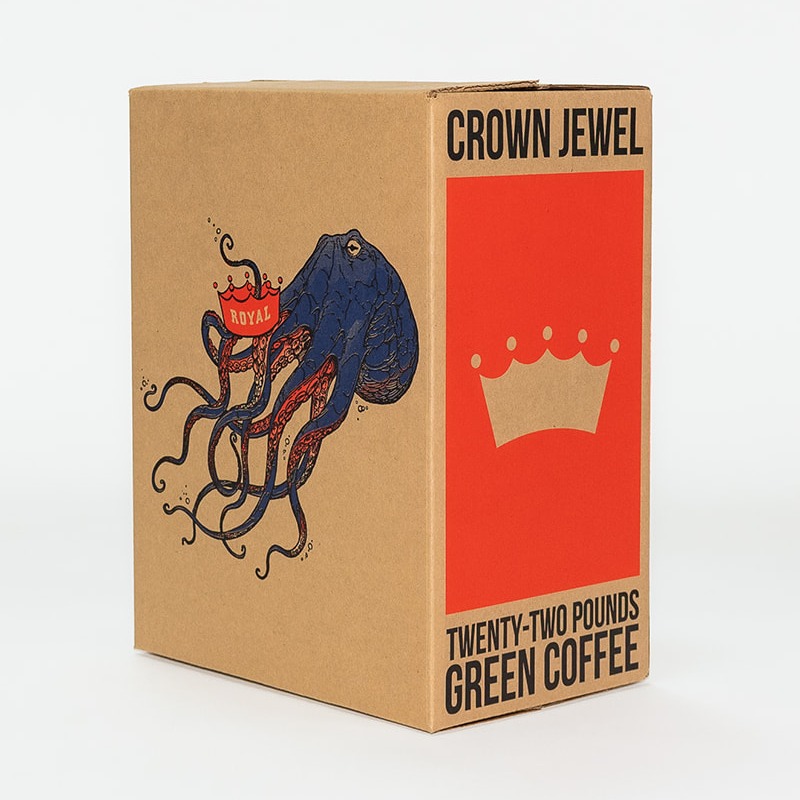
Crown Jewel Colombia La Argentina Juliana Guevara & Wbeimar Lasso Washed Gesha
34631-1 – SPOT RCWHSE
Boxes 0
Warehouses Oakland
Flavor Profile Apricot, floral, orange, apple, and caramel
Out of stock

Overview
Overview
This is a traditional washed Gesha cultivar coffee from Huila, Colombia, produced by Juliana Guevara and Wbeimar Lasso on their estate, La Terraza.
The flavor profile is classically Gesha-like, with floral notes of lemongrass, rose, and orange blossoms complimented by sweet apple and apricot, tart bergamot, and warm caramel sweetness.
Our roasters found the coffee performed best with gentle heat approach and plenty of airflow to bring out the clean, sweet floral notes.
When brewed, we were particularly fond of coarser grinds in conical pour-overs. We will also briefly feature this coffee as an espresso option in our Tasting Room.
Taste
Taste Analysis by Chris Kornman
“What’s in a name? That which we call a rose by any other name would smell as sweet;” Juliet opines in Shakespeare’s play as she attempts to convince Romeo to give up his title, implying that the essence of a thing – a person in this case – is what’s true and real, and that labels are arbitrary and meaningless at best, and at worst restrictive and deceitful.
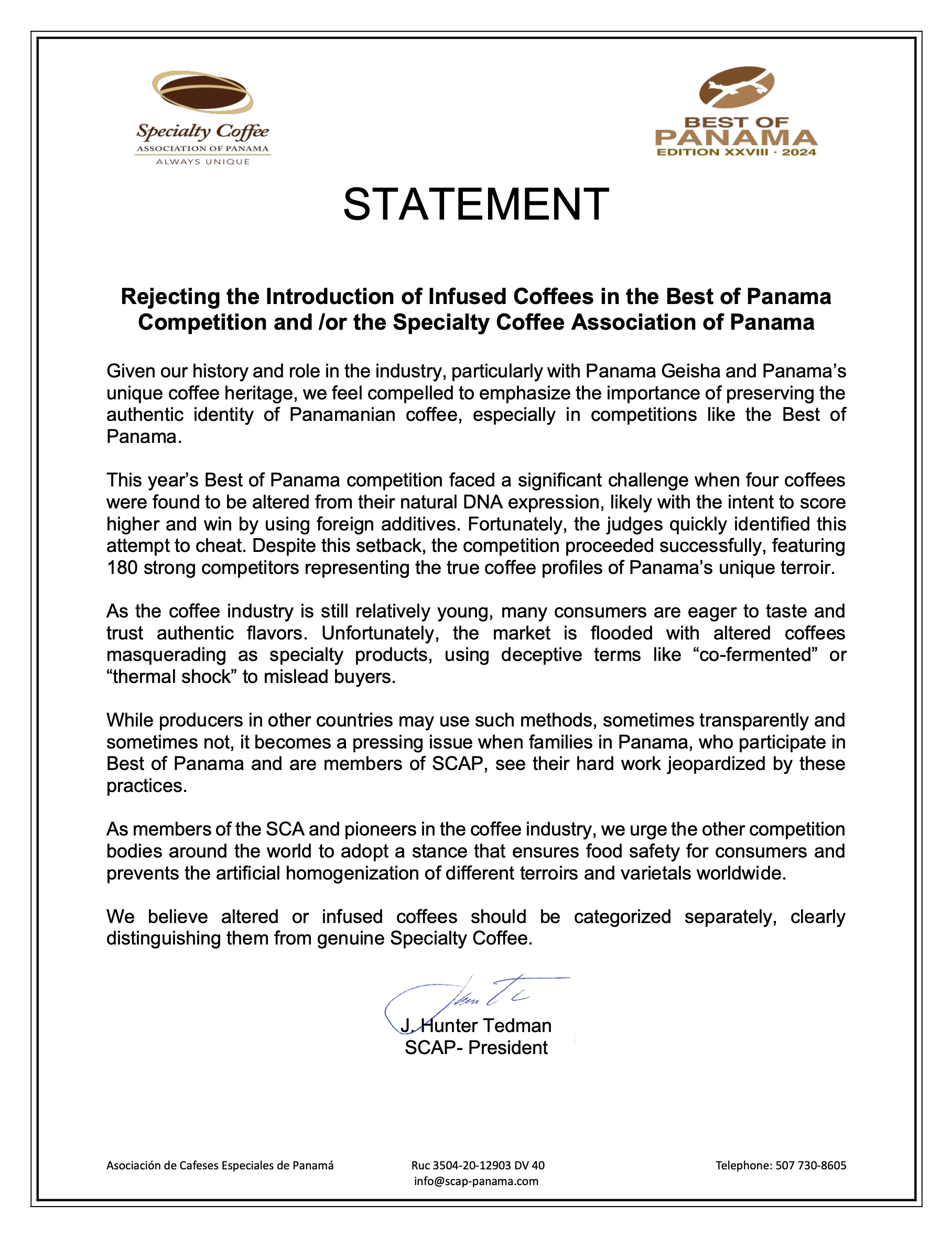
There’s been a lot of discourse over the last year around Crown Jewels that come with “label baggage,” “anaerobic” maybe being the most egregious of these terms – an imprecise linguistic tool, arbitrarily wielded by the most histrionic of coffees to the chagrin of milder, cleaner, more universally enjoyable iterations of unconventional processing methods. “Not all anaerobics,” they might say.
Gesha, with or without the “i,” remains a bright bauble in the coffee buyer’s collection, a signifier no less shiny in 2024 than it was in 2004’s Best of Panama competition (where it made its cup-quality debut). That the precious tree is now cultivated worldwide simply gives us more options, and cheaper, than the jaw-dropping records constantly set in Central America’s southernmost country.
But Gesha, the name, carries history and connotation beyond how it’s spelled and pronounced and celebrated at competitions. There’s a legacy of flavor, of theft and colonization, of innovation and neglect, all lending to the mystique of a coffee tree – perhaps the most prominent, if not the first – that could borrow the taste of Ethiopian coffee without requiring its roots be inhumed in Abyssinian soils. And if that sounds a little extractivist to you, well, you’re not wrong.
What if Gesha, rather than finding itself pigeonholed into what some have recklessly described as a “true coffee profile of… unique terroir” were allowed to taste how it tastes when it’s grown where it’s grown, without expectation beyond excellence? What if, as we carelessly utter about so many other coffees, we let the cup speak for itself?
If this lengthy preamble has frightened you into thinking that the coffee I’m supposed to be convincing you to purchase is less than stunning and doesn’t taste like sweet ripe stone fruits and flowers, I’m slightly sorry. It’s not that I meant to imply that this delicious, Crown-worthy offering isn’t show-stopping and delicate and chuggable and worth salivating over, and (as described by my colleague Charlie Habegger, “exemplary arabica genetics in their fully washed, unadulterated splendor”). It’s just that I was hoping we could all consider, for a moment, the implication of expectations and how they twist our experience into something less than appreciation for beauty when it presents itself in unexpected forms. I’m as guilty as anyone of letting bias and overexposure grift both my conscious and subconscious into apathy and dispassion. But I know I’m better than that, and that this coffee – and by extension the lives of those who made it possible – are worth more than callous indifference not because of their name, but because of their essential nature.
Anyway, if you’re still with me, this coffee tastes like apricots and lemongrass, like Riesling grapes and orange blossoms, like butter cream icing and fresh fennel and poached pears and hibiscus and mango and almonds and white peaches and green grapes and lilac. I love drinking it. Doris had a blast roasting it. We’ll be serving it as espresso at The Crown; if you’re in the neighborhood swing by for a taste of what all the hype is about.
Source
Source Analysis by Chris Kornman
Almost exactly a year ago, we picked up our first washed Gesha from Wbeimar and Juliana, humbly offered almost as an afterthought during a sourcing project that included coffees with much louder flavor profiles.
This year, however, the Terraza Gesha was offered proudly and with confidence, and our approval process was about as simple as it gets. A beauty of repeat business and trust-building (a two-way street) is that it tends to open new possibilities even as it reinforces consistency, and we’re looking forward to even more upcoming coffees from the impressive project this husband-and-wife team have built in Huila.
Terraza is the name for the farm owned and managed by Juliana Guevara and Wbeimar Lasso – the duo behind Terra Coffee. It’s basically a variety garden, and while we’ve contracted their Pink Bourbon, Typica, and Sidra cultivars for future shipments, we figured we could go big with the entrance.
Wbeimar Lasso, a Colombian Cup Tasters Champion, agro-industrial engineer and third generation coffee producer, is also a bit of a tinkerer with processing – notoriously responsible for multi-fermentation stages coordinated across small farms in Huila – delivering us some of our most unique and interesting coffees with consistency and regularity.
So, it came as a bit of a surprise to me that this is a very traditionally washed coffee. No particular idiosyncrasies in processing required, other than care and precision. Coffee cherries are depulped, fermented 36-48 hours, and dried – mostly in the shade – for 20-30 days.
We’re thrilled to be showcasing this new, intimate and innovative project from Terraza Coffee Estate, and can’t wait to see what comes next from the creative team at Terra Coffee.
Green
Green Analysis by Isabella Vitaliano
Wbemiar Lasso, a man of many talents, has taken on coffee production and excelled at it with the help of exporting partners, MasterCol. Gesha is often a slightly larger bean size and you see that reflected in the screen size condensed around the 17-19 range. The density is a little bit below average, which is normal for coffees from this region. Be sure to look at the roasting analysis to get the most out of the florals from this coffee. On the green you might notice some chipped, foxy and insect damage on the beans. This is normal for the coffee and does not impact cup quality.
Potentially to your surprise, Gesha was not initially sent to Panama from Ethiopia. Costa Rica received the seed in the 50s at a research station called CATIE project, but it was abandoned because it was not rust resistant. Once it failed in Costa Rica the seed was then sent to Panama in 60s and by 2004 the Peterson family won Best of Panama auction using the Gesha cultivar.
You may be confused as to whether you should use the spelling Gesha or Geisha, as they are often interchangeably. Check out Jenn’s article here to learn more.
Diedrich
Diedrich IR5 Analysis by Doris Garrido
Originating from the Gesha region of Ethiopia in Africa and named after it, this cultivar first spread to Kenya, Tanzania, Costa Rica and Panama gaining popularity through the renowned finca la Esmeralda in Panama captivating people by its unique and complex flavor profile, this coffee offers a sensory experience that transcends the ordinary.
Now, many countries have been producing it, and we have the opportunity to work on another Gesha cultivar from Juliana Guevara and Wbeimar Lasso, from La Argentina region of Huila in Colombia. Last year I roasted it for the first time, and I must say, this coffee fascinates me. It’s a beautiful washed Gesha, a great representation of the cultivar and the producer’s work. This time my roast highlighted remarkable botanicals, a hint of lemon zest, tangy mango, sweet and tasty bergamot that reminded me how oranges taste in the border of Mexico and Belize where I come from. Floral notes reminiscent of fresh and citrusy orange blossoms, and on the sweetness this coffee showed a deliciated honey and I cannot agree more with Chris K. on his note of poached pear!
To roast this coffee, I used a very soft and delicate approach. Using 50% of the roaster capacity, I aimed for 400F as a charge temperature and started with 70% gas added just before the first minute of roasting. After a long 5-minute drying phase, I marked the color change at 300F. I reduced the gas to 30% at 337F around the 6 minutes mark. At this point I used full airflow and waited for the coffee to start cracking, which occurred at 382F. The cracking was very quiet but noticeable on the expansion of the beans. For this type of cultivar, I would develop it for just over a minute to maintain its juiciness. During development I noticed the rate of change wasn’t dropping as I expected, so I decided to drop the pilot and finish the roast at 400F in 1 minute and 13 seconds.
With a total roasting time of 9 minutes and 35 seconds, I was very pleased with the delicate fruity notes and subtle orange blossoms. This coffee will be featured on The Crown tasting room menu as espresso next week. Stop by and enjoy!
Aillio
Aillio Bullet R1 IBTS Analysis by Evan Gilman
Unless otherwise noted, we use both the roast.world site and Artisan software to document our roasts on the Bullet. You can find our roast documentation below, by searching on roast.world, or by clicking on the Artisan links below.
Generally, we have good results starting our 500g roasts with 428F preheating, P6 power, F2 fan, and d6 drum speed. Take a look at our roast profiles below, as they are constantly changing!
Always a thrill to roast a Gesha coffee, and one from Juliana Guevara and Wbeimar Lasso is certainly welcome back on the menu at any time. What a way to finish off the year!
Sometimes, Gesha coffee gets the reputation of being difficult to roast. But as Doris has mentioned above, a gentle approach will frequently get you past any hurdles you might encounter with these coffees. They’re not always a super-dense and small bean like you’d find in their Ethiopian homeland, and in fact this one in particular has a decent spread of medium-to-large screen sizes. A sign to move forward gently, once again.
So I started with a charge temperature of 446F, P8 power and F2 fan speed until the peak of my rate of change. I wanted to keep my rate of change below 40F/min and I was successful in this regard. At 38F/min, I reduced heat to P7 and increased fan to F3. At 6 minutes, I increased fan to F4, then lowered power to P6 a minute later. Just after first crack, I made the final fan speed adjustment to F5… and that was it! A very minimal roast, as far as making adjustment to airflow and heat application. The result was a nicely declining rate of change and 12.9% roast loss at my final time and temperature of 9:09 / 397F.
Even in a specialty coffee era where the ostentatious has become commonplace, there’s room for flavor notes bordering on the esoteric. If there’s no place for flights of fancy in this most storied coffee of our time, where then do we relegate our imaginations? Yes, I want to be relatable and to communicate the quality of this coffee well to those who haven’t had the opportunity to have a taste. But I also want to tell you it tastes of sweet tea and Twainian scuppernongs, the fruits of summer, thick brugmansia blossom on the warm night air.
It’s a beautiful coffee, and if beautiful things don’t spark your imagination, dear reader, I can’t help you. Just have a nice cup of this coffee and take in the world, you’ll find something you enjoy! Take it easy, man, but take it!
by Evan Gilman
Unless otherwise noted, we use both the roast.world site and Artisan software to document our roasts on the Bullet. You can find our roast documentation below, by searching on roast.world, or by clicking on the Artisan links below.
Generally, we have good results starting our 500g roasts with 428F preheating, P6 power, F2 fan, and d6 drum speed. Take a look at our roast profiles below, as they are constantly changing!
Always a thrill to roast a Gesha coffee, and one from Juliana Guevara and Wbeimar Lasso is certainly welcome back on the menu at any time. What a way to finish off the year!
Sometimes, Gesha coffee gets the reputation of being difficult to roast. But as Doris has mentioned above, a gentle approach will frequently get you past any hurdles you might encounter with these coffees. They’re not always a super-dense and small bean like you’d find in their Ethiopian homeland, and in fact this one in particular has a decent spread of medium-to-large screen sizes. A sign to move forward gently, once again.
So I started with a charge temperature of 446F, P8 power and F2 fan speed until the peak of my rate of change. I wanted to keep my rate of change below 40F/min and I was successful in this regard. At 38F/min, I reduced heat to P7 and increased fan to F3. At 6 minutes, I increased fan to F4, then lowered power to P6 a minute later. Just after first crack, I made the final fan speed adjustment to F5… and that was it! A very minimal roast, as far as making adjustment to airflow and heat application. The result was a nicely declining rate of change and 12.9% roast loss at my final time and temperature of 9:09 / 397F.
Even in a specialty coffee era where the ostentatious has become commonplace, there’s room for flavor notes bordering on the esoteric. If there’s no place for flights of fancy in this most storied coffee of our time, where then do we relegate our imaginations? Yes, I want to be relatable and to communicate the quality of this coffee well to those who haven’t had the opportunity to have a taste. But I also want to tell you it tastes of sweet tea and Twainian scuppernongs, the fruits of summer, thick brugmansia blossom on the warm night air.
It’s a beautiful coffee, and if beautiful things don’t spark your imagination, dear reader, I can’t help you. Just have a nice cup of this coffee and take in the world, you’ll find something you enjoy! Take it easy, man, but take it!
ikawa
Ikawa Pro V3 Analysis by Isabella Vitaliano
Our current Ikawa practice compares two sample roast profiles, originally designed for different densities of green coffee. The two roasts differ slightly in total length, charge temperature, and time spent between color change in first crack. You can learn more about the profiles here.
A multitude of versions come from this sweet little (but actually, slightly large) bean.
The body was a bit thin in the low density roast of this coffee, very similar to a lemon water type texture. On the high density roast there was lots of limoncello, jasmine, juniper and watermelon rind.
I highly recommend trying out the high density version of this coffee, there is so much to enjoy in the fuller expression of this coffee.
You can roast your own by linking to our profiles in the Ikawa Pro app here:
- Roast 1: Low Density Sample Roast
- Roast 2: High Density Sample Roast
Brew
Brew Analysis by Alisha Rajan
While going about the brew analysis the words of one of my favorite poets, Pablo Neruda, echoed in my head: “I love you simply, without pretense or pride: I love you in this way because I know no other way of loving but this.” And so I love this beautiful Gesha by Juliana Guevara and Wbeimar Lasso. Belied by the simplicity of its production is the undeniable florality of orange blossom and rose, the creaminess of custard, and the brightness of stonefruit. In a climate inundated with talk of multi-step fermentation processes and show-stopping co-ferments (i.e. a world of pretense), the essence and simplicity of this traditionally washed jewel stands alone with quiet strength.
I performed six brews for the analysis. I began with a moderately high dose of 19.0g and a finer grind setting for both the V60 and Kalita wave, yielding brews reminiscent of mango ice cream and caramel apple. Since the TDS was quite high, I decided to lower the dose to 18.5g and coarsen the grind for the subsequent brews.
My absolute favorite brew came in at an 18.5g dose, grind setting of 11, and a V60 brewer. This iteration retained the best attributes of the previous brews but presented with a supremely sweet and floral twist. Apricot and gala apples danced atop a silky body of maraschino cherry and tea-like sweetness tied together with a bow of florals. This, along with an extraction percentage of 18.5% and a TDS value within the desired range, indicated that she was the one.
My second favorite brew came in at an 18.5g dose, grind setting of 11, but this time brewed with a Kalita wave. I enjoyed the more exaggerated florality of this brew. Rose, lavender, plum, and lemongrass all shone brightly. With a slightly higher TDS than the last, this one was also very, very good.
Overall, I recommend a moderate dose and coarser grind size and a conical-style brewer to achieve the most balanced cup. Supremely sweet and stunning in its simplicity, I hope you come to love this Gesha as much as I do.
Related Coffee

Black Tea, caramel, lemongrass, passion Fruit, apricot
Oakland 7 Boxes
Crown Jewel Burundi Honey Peaberry Heza Washing Station
38863-1 – SPOT RCWHSE
Black Tea, caramel, lemongrass, passion Fruit, apricot
Spot
7 Boxes
$255.49 per box
Banana Bread, plum, rosemary, cocoa Nib, and toffee
Oakland 38 Boxes
Crown Jewel Yemen Anaerobic Natural Sharqi Haraz Cooperative
39818-1 – SPOT RCWHSE
Banana Bread, plum, rosemary, cocoa Nib, and toffee
Spot
38 Boxes
$710.39 per box
Orange blossom, red wine, baker's chocolate, and black tea
Oakland 16 Boxes
Crown Jewel Yemen Washed Sharqi Haraz Cooperative
39817-1 – SPOT RCWHSE
Orange blossom, red wine, baker's chocolate, and black tea
Spot
16 Boxes
$580.58 per box
Lemon, floral, hibiscus, rosemary, and apple
Oakland 55 Boxes
Crown Jewel Ethiopia Anaerobic Natural Rue Co-ferment Banko Chelchele
40654-1 – SPOT RCWHSE
Lemon, floral, hibiscus, rosemary, and apple
Spot
55 Boxes
$358.51 per box