
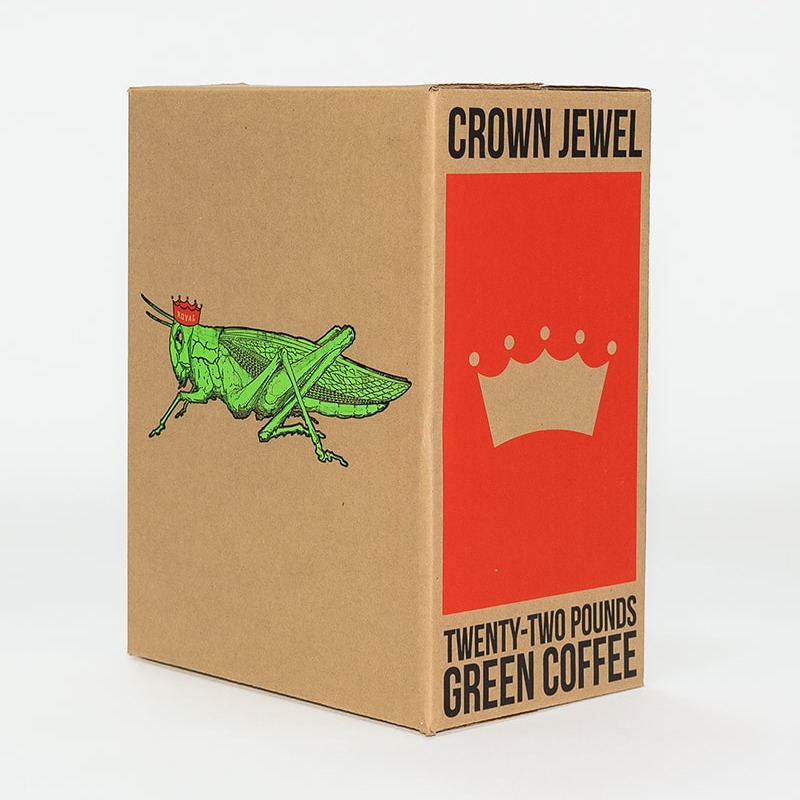
Crown Jewel Tanzania Karatu Vohora Family Washed SL-28
33231-1 – SPOT RCWHSE
Boxes 0
Warehouses Oakland
Flavor Profile Orange, grapefruit, lemongrass, and cherry
Out of stock
Overview
Overview
This is a traditional washed SL-28 cultivar coffee from Karatu, Tanzania, produced by the Vohora family on their farm Finagro, located on the Ngorongoro caldera.
The flavor profile is sweet, herbal, and a little bit savory. We tasted orange, grapefruit, lemongrass, and cherry, with hints of heirloom tomato, guava, and sage.
Our roasters found this coffee to be quite responsive to heat adjustments, requiring careful management of energy and airflow throughout the roast.
When brewed, we liked higher extraction percentages in our pour-overs, and will feature the coffee on The Crown’s espresso bar.
taste
Taste Analysis by Chris Kornman
SL-28 has become synonymous with quality, frequently associated with Kenyan coffees but now grown globally – it’s a cultivar with the unique ability to transcend terroir and leap off the cupping table as recognizable and unique.
It caught our attention when we first sampled it for its sweetness, reminding us of candied almonds and perfectly caramelized sugars. Its tart stone-fruit-like acidity and herbed-honey and salted toffee flavors lent a complexity nodding to the uniqueness of the cultivar selection.
While those flavors largely carry into the cup, its expression as a production roast some months after final milling and shipping has shifted into a more fully realized expression, in some ways reminding us more of the Kenya-esque vibes SL-28s often give off.
We picked up an array of interesting fruit flavors, from guava to green banana, red apple, and orange. There’s a lovely toasted almond sweetness that mingles in the finish with notes like lemongrass, coconut sugar, and ripe heirloom tomato.
The cup is distinctive, not simply because of the cultivar, or its location on one of the world’s most beautiful coffee farms in northern Tanzania, but because it’s imbued with the unique care and attention of the people and processes who’ve nurtured it, including both the producers and the roaster, in whose hands the beans will shade readily towards, sweet or savory, herbal or fruity depending on technique, preference, and a little serendipity.
source
Source Analysis by Chris Kornman
Under the watchful guidance of sibling team Neel and Kavita Vohora, the Edelweiss and Finagro farms have begun to blossom from well-managed estate farms, spanning 1000 acres across multiple ridges of the Ngorongoro caldera in northern Tanzania, into an innovative and genre-defying coffee enterprise. I’ve worked with Neel and Kavita, and the coffees from the farms for nearly 15 years and I can definitively say that their most recent harvest is the most exciting I’ve ever tasted.
Among the family’s favorite cultivar selections are the SL-28s, coffees descended from some of the earliest Arabica selections made in Africa outside of Ethiopia. Tanzania was among the first colonial coffee cultivated on the continent – Bourbon trees from Réunion were delivered to the Bagomoyo mission as early as 1868. From this expanding population of C. arabica var. Bourbon a selection was made in the early 1930s by a now-extinct British agricultural breeder called Scott Labs. SL-28 is Tanzanian stock, chosen for its drought resilience almost 100 years ago, and it found its home primarily in Kenya (where the lab was based) and earned a reputation with growers for bountiful harvests and large screen sizes and with cuppers as a bastion of cup quality. The Vohora’s SL-28s thrive on the farms as productive trees (if susceptible to diseases like berry fungus), and frequently top the siblings’ cup rankings in their lab.
Vohora’s farms continue to innovate in processing methodology as well. Rather than resting on the laurels of tradition, nearly all of their coffee (including the commercial volumes of larger lots) goes through a cherry maceration period prior to processing. For microlots, like this SL-28, the timeframe for whole cherry “pre-fermentation” is determined specifically by cultivar, through a trial-and-error process that’s been honed into precise protocols to bring out the best in each variety. In this case, the SL28 harvest will macerate in whole cherry on raised beds under protective tarps for a few days prior to depulping and then fermenting in tile-lined fermentation tanks. Afterwards, it is washed and dried down the hill on Finagro’s extensive raised bed network. Recently implemented protocols to “skin dry” — that is, initially dry-washed parchment under shade for 24 hours – helps protect the delicate coffee from too much sun before completing the 2-3 week drying process. After this is finished, parchment is stored in GrainPro until it can be milled in Vohora’s facility back in Arusha.
Ngorongoro, the world’s largest unbroken caldera, looms over a verdant landscape, the shell of an ancient, ruptured volcano. Inside its walls, a wildlife conservation area cut off from much access to the outside world, is home to hordes of zebra, eland, gazelles, wildebeests, two prides of lions, hyenas, hippopotami, and scores of other local birds and mammals, including a small population of black rhino. The Maasai, among the region’s more visible residents with distinctive red flannel robes and unchanged traditions of nomadism, are frequent visitors, passing through the crater with their goat and cattle herds in tow. The caldera’s wildlife are no strangers to the farms, either. Native forest corridors on the estates allow freedom of movement for the animals as they migrate, but it’s fairly common to find damage to the coffee trees; the most frequent offenders being elephants and water buffalo.
The Vohora’s estates are nestled into the caldera’s outer ridges, bordering the park. Since 1971, the Vohoras have owned about 1000 acres of farmland on the southern exterior slopes near the town of Karatu. Neel’s grandfather arrived from India, first working for the British colonists as a farm manager prior to the nation’s independence. Neel’s father, Ajai, heads the export business from nearby Nairobi, and Kavita runs the milling and sampling operations back in Arusha.
You can read more about the farms in a recent blog.
green
Green Analysis by Isabella Vitaliano
This lot has a larger size with a compact screen size in the 18-19 range, indicative of even roasting. Cultivar selection SL28, a Bourbon relative, stands for Scott Labs that was selected based on climate and disease resistance.
Despite moderate density coupled with high water activity; you can push the heat a bit on this one in the roaster. In its best form, it has developed quite a bit of sweetness to accompany the herbaceous and savory character of the profile.
Diedrich
Diedrich IR5 Analysis by Doris Garrido
I have undertaken this roast analysis, being this coffee the first roast of the day, a wash SL28 from Tanzania. The roaster barrel had been warming up for a bit prior to this roast and it means that the coffee may take the higher energy. I need it to sense how the coffee would take the energy during the first minute, so I loaded the beans and started the roast at 402F. As I observed it getting close to the turning point, I started the gas at 100%. The turning point was marked at 178.2F / 1:32 minutes. With all that push and considering this was a lower density coffee, I went ahead and lowered the gas to 60% at the 3 minutes of roasting. I was able to spend 5 minutes on the drying. The color started changing at 300F.
From here, my next movements were decided based on the rate of change. Observing the roast dropping I got to catch a jump of energy and lower the gas to keep the pace I was having to 30%, then I followed the airflow using the same principle but also to help on the caramelization since I was there at this point of the roast.
The cracking started at 381.8F with a rate of change of 15 degrees per minute. Development continued for 1:42 minutes. This was the first Tanzania I roasted from this year’s arrivals. Given that, I decided to go by looking at the bean’s color and aroma looking for the sweet spot. The end temperature was marked at the end at 400F which may be slightly low from the actual temperature since I took the trier out interfering with the sensor reading. On the Diedrich roaster the sensor is placed close to the trier.
From the first arrival samples I have tasted before, I was more than pleased with the taste of this roast. The sweetness had a noticeable complexity of caramel or caramel, coconut sugar, marshmallow, praline, with a very tasty roasted almonds, butter, cashew, red apple, ripe heirloom tomatoes, and rose. It also gave me some tasty Kenyan vibes! This coffee was chosen to be served as espresso here at the crown tasting room, and in a week, I’ll be moving this profile to the Loring Falcon15, and it’s going to be available for everyone to taste some fresh and awesome Tanzanians!
Aillio Bullet R1
Aillio Bullet R1 IBTS Analysis by Evan Gilman
It’s not often that I get to taste this legendary cultivar all by itself. While SL-28 is easier to find in Kenyan coffees, I was excited to try it from the Vohora family’s estate all by its lonesome. Clearly they’re doing something right, because this one came out incredibly consistent and delicious.
I did notice the higher moisture content and density on this coffee, and decided the beans were telling me to hit em with 212 beats per minute and a super crunched out… wait a moment, that’s something else. Must have been a dream I had. They were telling me to use a slightly higher charge temperature of 473F with P9 power, and generous airflow throughout the roast. I started with F2 fan, but ramped up to F3 at turning point, with an accompanying reduction of heat to P8. My peak rate of change was 36.5F/min, and at Yellowing I reduced heat further to P7. I hit F4 at 365F to begin pulling more smoke out of the drum, and let this coffee ride out until crack, where I reduced heat and increased airflow somewhat reactively due to a spike in rate of change when all the moisture was escaping the beans at crack. My end temperature was 403F, and the smell of this coffee coming out of the roaster was just like honey.
My initial tasting of this coffee left me underwhelmed, but let me tell you… letting it rest for 5 days was a real eye opener. Huge forest honey (just like in the fragrance of the freshly roasted coffee), juicy navel orange, and some complex herbal notes came through in the cup of filter drip I treated myself to. My roast was a bit on the light side, so I highly recommend letting this one rest for a few days before brewing. You’ll be sweetly rewarded!
You can follow along with my roast here at roast.world: https://roast.world/egilman/roasts/Y3NYtNMII69qZ8dtdGrzz
Ikawa
Ikawa Pro V3 Analysis by Isabella Vitaliano
Our current Ikawa practice compares two sample roast profiles, originally designed for different densities of green coffee. The two roasts differ slightly in total length, charge temperature, and time spent between color change in first crack. You can learn more about the profiles here.
A classic Tanzania through and through we got flavors of salted caramel, sage, lemongrass, coconut sugar and ripe heirloom tomato.
On the low density roast of this coffee I got lots of toasted sesame, soy sauce, honeycomb and a roast that leaned a bit roasty. The high density profile was round and full with notes like orange, marshmallow and dark caramel.
With the light density roast leaning towards a roasty and dry tasting edge; the high density roast is a significant improvement with fuller sweetness and round flavors of praline, pepper and vanilla. I highly recommend trying the high density profile for this coffee!
You can roast your own by linking to our profiles in the Ikawa Pro app here:
Roast 1: Low Density Sample Roast
Roast 2: High Density Sample Roast
Brew
Brew Analysis by Tim Tran
SL-28 is a cultivar of coffee known for producing fruit with rich flavor complexity and we were excited to delve into this harvest from the Vohora family. Our various brews gave us interesting, clean cups with a pleasant flavor profile and consistent cups across different brew profiles.
We started our brew analysis at a moderate grind setting with a 1:16.67 brew ratio on a flat bottom brewer. Our initial brew yielded a very full-bodied coffee, with a TDS of 1.34, with rich cacao notes, a sesame-forward nose, and slightly smokier notes. The flavor density in this initial brew was highly packed and trended towards a more savory profile.
To open the coffee further and provide ample space for the flavors to shine in a more balanced way, we moved the grind coarser while maintaining the same ratio. Interestingly, the coffee had a very similar TDS to the initial brew, coming in at 1.35, but was more pronounced on the sweetness coming through from the chocolate notes. The coffee still proved to be quite rich in body with a good mouthfeel and provided notes of soft citrus and sesame to complement the chocolate forward flavor.
The grind felt appropriate at a moderately coarse setting, but we wanted to explore the impacts of coffee dose on the resulting brew. To start this, we moved to a lower dose, at a 1:17.65 ratio. At this ratio, the coffee began trending towards slightly hollow. The brew still carried some more savory notes though, with tastes of tobacco, a touch of graham cracker, and some subtler herbaceous notes.
At a higher dose, with a ratio of 1:15, the citrus notes stood out more and the brew yielded a slightly more acidic sweetness. The coffee carried notes of currant and citrus mixed with chocolate and sesame, while boasting a very full body.
This coffee proved to have similar extraction across the many brews but showed a dynamic flavor that centered around cocoa and a nutty body. We recommend a moderately coarse grind setting at a moderate ratio. We enjoyed this coffee at higher extraction percentages.
Related Coffee
Tomato, caramel, orange, lime, and tropical fruit
Oakland 22 Boxes
Crown Jewel Kenya Washed Ngomano Factory
45KF0153 – 38302-1 – SPOT RCWHSE
Tomato, caramel, orange, lime, and tropical fruit
Spot
22 Boxes
$207.57 per box

Orange blossom, ruby red grapefruit, cherry juice, bright, clean
Oakland 33 Boxes
Crown Jewel Rwanda Washed Rwamiko Washing Station
Lot 1 – 38183-1 – SPOT RCWHSE
Orange blossom, ruby red grapefruit, cherry juice, bright, clean
Spot
33 Boxes
$204.39 per box

Lime, raspberry, peach tea, honey, sweet, clean
Oakland 27 Boxes
Crown Jewel Rwanda Natural Busanze Washing Station
Lot 3 – 38186-1 – SPOT RCWHSE
Lime, raspberry, peach tea, honey, sweet, clean
Spot
27 Boxes
$206.66 per box
Strawberry, lemon, rosemary, blueberry, dark chocolate
Oakland 24 Boxes
Crown Jewel Burundi Natural Bavyeyi IV
Lot 13N1 – 38691-2 – SPOT RCWHSE
Strawberry, lemon, rosemary, blueberry, dark chocolate
Spot
24 Boxes
$226.79 per box