
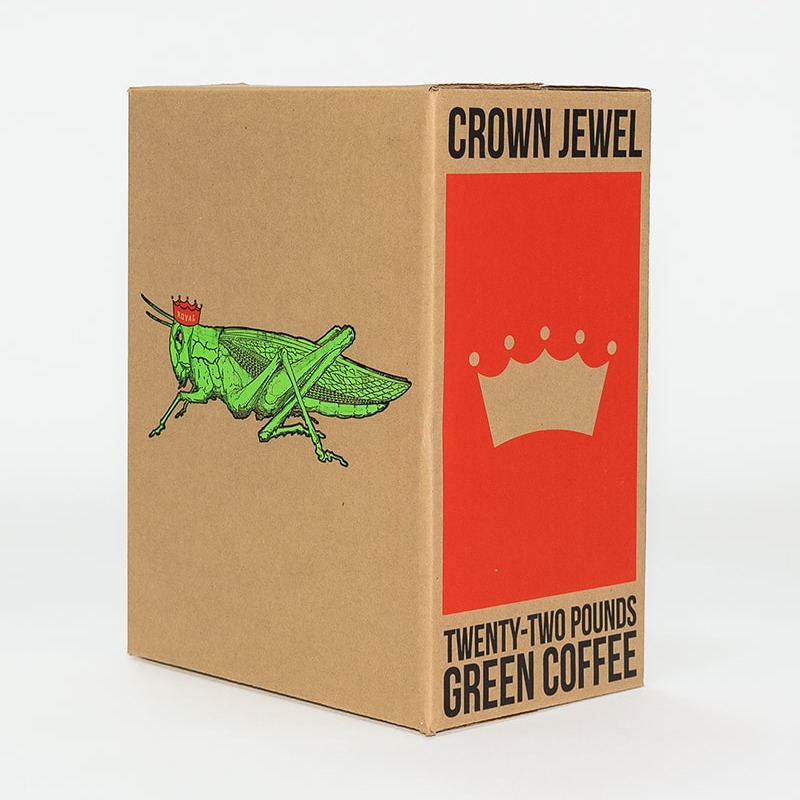
Crown Jewel Tanzania Karatu Vohora Family Natural SL-28
33230-1 – SPOT RCWHSE
Boxes 0
Warehouses Oakland
Flavor Profile Blueberry, strawberry cheesecake, ripe cantaloupe, and dark chocolate
Out of stock

Overview
Overview
This is a traditional natural SL-28 cultivar coffee from Karatu, Tanzania, produced by the Vohora family on their farm Finagro, located on the Ngorongoro caldera.
The flavor profile is layered and fruit forward with notes of blueberry, strawberry cheesecake, ripe cantaloupe, and dark chocolate.
Our roasters found the coffee capable of absorbing heat quickly and caution that a gentle approach might bring out the best of its fruit flavors.
When brewed we were surprised at how effortlessly delicious the coffee was at multiple parameters on both a conical and flat-bottomed pour-over device, and plan to serve it as such at The Crown soon!
taste
Taste Analysis by Isabella Vitaliano
We were lucky to get our hands on an impressive display of cultivar type and processing method executed by the Vohora family from Tanzania. A family business since the 70’s, they have had the experience and time to hone on processing techniques designed for cultivar type, a lengthy and extensive process. Dedication has paid off, and we are thrilled to showcase their work from this SL-28 cultivar type.
We tasted strawberries galore in the form of strawberry cheesecake, jam, shortcake – the works. The fruit is amped up while still being clean. This combination is reminiscent of the pinnacle of gateway naturals of the late aughts, the flavors are enough to make anyone a natural convert.
You’ll discover layers of peach, blueberry, cane sugar, ginger, ripe cantaloupe and lemon curd. Obviously fruit forward, it still has a multifaceted quality that keeps you going back for more.
My favorite form of this coffee is seeing it on espresso; a fruity cortado is my ideal weekend drink. The flavors translate well to any brewing form. From pour-over, drip, espresso, cold brew or even a fruity dark roast (yum) you’ll have endless options for your menu.
If you are experiencing Ethiopia shipping delays much like the rest of us, this is a great alternative to hold you over until the delays are remedied. Grab a box while it lasts!
Source
Source Analysis by Chris Kornman
Under the watchful guidance of sibling team Neel and Kavita Vohora, the Edelweiss and Finagro farms have begun to blossom from well-managed estate farms, spanning 1000 acres across multiple ridges of the Ngorongoro caldera in northern Tanzania, into an innovative and genre-defying coffee enterprise. I’ve worked with Neel and Kavita, and the coffees from the farms for nearly 15 years and I can definitively say that their most recent harvest is the most exciting I’ve ever tasted.
Among the family’s favorite cultivar selections are the SL-28s, coffees descended from some of the earliest Arabica selections made in Africa outside of Ethiopia. Tanzania was among the first colonial coffee cultivated on the continent – Bourbon trees from Réunion were delivered to the Bagomoyo mission as early as 1868. From this expanding population of C. arabica var. Bourbon a selection was made in the early 1930s by a now-extinct British agricultural breeder called Scott Labs. SL-28 is Tanzanian stock, chosen for its drought resilience almost 100 years ago, and it found its home primarily in Kenya (where the lab was based) and earned a reputation with growers for bountiful harvests and large screen sizes and with cuppers as a bastion of cup quality. The Vohora’s SL-28s thrive on the farms as productive trees (if susceptible to diseases like berry fungus), and frequently top the siblings’ cup rankings in their lab.
Vohora’s farms continue to innovate in processing methodology as well. Rather than resting on the laurels of tradition, nearly all of their coffee (including the commercial volumes of larger lots) goes through a cherry maceration period prior to processing. For microlots, like this SL-28, the timeframe for whole cherry “pre-fermentation” is determined specifically by cultivar, through a trial-and-error process that’s been honed into precise protocols to bring out the best in each variety. In this case, the SL-28 harvest will macerate in whole cherry on raised beds under protective tarps for a few days prior completing the 2-3 week drying process on raised beds in whole cherry. After this is finished, the dried coffee is stored in GrainPro until it can be milled in Vohora’s facility back in Arusha.
Ngorongoro, the world’s largest unbroken caldera, looms over a verdant landscape, the shell of an ancient, ruptured volcano. Inside its walls, a wildlife conservation area cut off from much access to the outside world, is home to hordes of zebra, eland, gazelles, wildebeests, two prides of lions, hyenas, hippopotami, and scores of other local birds and mammals, including a small population of black rhino. The Maasai, among the region’s more visible residents with distinctive red flannel robes and unchanged traditions of nomadism, are frequent visitors, passing through the crater with their goat and cattle herds in tow. The caldera’s wildlife are no strangers to the farms, either. Native forest corridors on the estates allow freedom of movement for the animals as they migrate, but it’s fairly common to find damage to the coffee trees; the most frequent offenders being elephants and water buffalo.
The Vohora’s estates are nestled into the caldera’s outer ridges, bordering the park. Since 1971, the Vohoras have owned about 1000 acres of farmland on the southern exterior slopes near the town of Karatu. Neel’s grandfather arrived from India, first working for the British colonists as a farm manager prior to the nation’s independence. Neel’s father, Ajai, heads the export business from nearby Nairobi, and Kavita runs the milling and sampling operations back in Arusha.
You can read more about the farms in a recent blog.
Green
Green Analysis by Isabella Vitaliano
As one would expect form East African coffee, we have a well above average density with sinar reading in at 734 g/L. With years of practice, they have their drying practices down to a science with ideal moisture content in the average ranges.
This lot has a larger size with a compact screen size in the 18-19 range, indicative of even roasting. Cultivar selection SL28, a bourbon relative, stands for Scott Labs that was selected based on climate and disease resistance.
The green on this coffee is highly fragrant and perfume-like. You might be confused if it is a medley of berries in a jute bag, or green coffee. Happy roasting!
Diedrich
Diedrich IR5 Analysis by Doris Garrido
To roast this SL28 Natural from Tanzania I have gone very gently from the initial stages of roasting through the Maillard, caramelization, and mostly carefully managing the airflow throughout. The results were exceptionally satisfying.
I initiated the roast with a charge temperature of 402F and introduced 50% of the airflow right away. In the first minute, I applied 70% gas which I later reduced to 60% just after the turning point. This adjustment was necessary as I observed that the coffee was absorbing heat quite rapidly.
The color change started it exactly at 300F and I marked it at 4 minutes and 43 seconds. At the 5-minute mark, I decreased the gas to 30% and closely watched the rate of change until the coffee cracked at 389F, at 9 minutes and 16 seconds.
During the caramelization phase, I decided to use all the airflow to ensure a gentle landing of the coffee into the first crack.
Throughout the development stage, I watched closely for sudden spikes in the rate of change. As soon as I detected a slight jump, I closed the pilot. I was close to a minute in this stage, let it run to 1:23 seconds and finished the roast at 407.7F. Overall I have found that this coffee in particular has yielded its best results with a slow and delicate roast profile. On the cupping table, this coffee exhibited a complex flavor profile with notes of strawberry shortcake. Lindt milk chocolate truffles, tart berries, cotton candy, hazelnut chocolate, sweet melon, honeycomb, ginger, peach, and pinot noir. Notably this roast did not have a boozy characteristic but instead had a pleasant wine-like touch.
Aillio Bullet R1
Aillio Bullet R1 IBTS Analysis by Evan Gilman
Berries for days. I don’t know if they have Himalayan blackberries in Tanzania (and I wouldn’t wish those noxious weeds on them), but the flavor here is straight out of the brambles. If you’re a berry fan, this coffee should be in your plan.
The moisture content and density were a bit lower in comparison to its washed counterpart, and that difference made itself felt in the roaster. While I started at the same moderately high 473F with P9 power, I ended up introducing higher airflow much earlier in the roast than with the washed SL-28. My peak rate of change was 43F/min, pushing the limit of my comfort zone, but I was able to temper this with a reduction in power to P7 and hefty airflow of F4 after yellowing. An even draw-down of power and increase of airflow really allowed this coffee to develop nicely until its drop at 8:35 / 404F. This coffee was very well behaved indeed, even after First Crack and into post-crack development.
The result in the cup was a smorgasbord of berry. Smorgasberry. Strawcuterie. Name a berry and it’s in here. Beyond that, plenty of milk chocolate sweetness, creamy texture, and pleasing sweet aftertaste are present, and I couldn’t imagine being unsatisfied with this coffee – if you’re a fruit lover like me, that is.
Give this one a shot, a filter, or a percolator. You’ll be in a world of pure imagination.
You can follow along with my roast here at roast.world: https://roast.world/egilman/roasts/hTOxLvsY5VOTXqsEnXxUw
Ikawa
Ikawa Pro V3 Analysis by Isabella Vitaliano
Our current Ikawa practice compares two sample roast profiles, originally designed for different densities of green coffee. The two roasts differ slightly in total length, charge temperature, and time spent between color change in first crack. You can learn more about the profiles here.
This natural coffee from the Vohora family excited all of us at the cupping table, approval was an easy and unanimous decision to become a Crown Jewel.
On the high density roast we got more tropical notes like lime, mango and guava. Hints of raw honey and strawberry kombucha were embedded throughout the experience. The mouthfeel was slightly thin with a dryer aftertaste.
In comparison, the low density roast was lush with blueberries, strawberry shortcake, ice cream and mandarin orange. Fruit fully on display with impeccable sweetness, this is obviously a natural coffee in the best way.
Both forms are incredible versions of this coffee. I highly recommend trying out the low density roast and exploring the high density roast as well to see the different versions of this coffee.
You can roast your own by linking to our profiles in the Ikawa Pro app here:
Roast 1: Low Density Sample Roast
Roast 2: High Density Sample Roast
Brew
Brew Analysis by Taylor Brandon
Everybody, say it with me, “no bad brews”! I conducted three test brews for this coffee, two with the Kalita Wave and one with the V60 dripper. Audience, each brew was delicious! Off top, the roasted whole beans smelled like fresh baked brownies. The good kind; artisanal brownies made with high quality cocoa powder.
Each brew was conducted with a bloom of 50 grams of water for 40 seconds, a second pulse to 200 grams of water and a final pulse to 300 grams (about 10.58 oz) of water. We used the EKS43 for all grinds and a water temperature of 201 degrees Fahrenheit.
The first brew was also my first time smelling the aroma of the ground coffee. I quickly got the fresh baked brownies, accompanied by berries and florals. I chose a 9 grind and a dose of 18.5 grams of coffee which yielded an extraction rate of 25.74%. Despite the extraction rate being on the high side, the taste was quite delicious. My colleagues referenced notes of juicy blackberry, tangerine, chocolate chip cookies and lilac. I stuck with the Kalita Wave for the second brew and wanted to make sure to tone down the extraction rate. I accomplished this by changing the grind to 10 and keeping all the other variables the same. I achieved an extraction rate of 20.62, and this brew impressed with an additional layer of caramel, butter and milk chocolate. I completed the last brew using the V60, a dose of 19 grams of coffee and a grind size of 9. Croissant, blueberry compote and lemon zest were some of the exciting tasting notes explored by my colleagues. It was a great note to end on, and with each brew we found ourselves enjoying the coffee more and more. “This is a really good coffee”, could be heard on the tasting room floor as everyone took their slurps. Excitedly anticipating when this coffee makes its way to the bar!
Related Coffee

Lime, raspberry, peach tea, honey, sweet, clean
Oakland 27 Boxes
Crown Jewel Rwanda Natural Busanze Washing Station
Lot 3 – 38186-1 – SPOT RCWHSE
Lime, raspberry, peach tea, honey, sweet, clean
Spot
27 Boxes
$206.66 per box

Strawberry, lemon, rosemary, blueberry, dark chocolate
Oakland 24 Boxes
Crown Jewel Burundi Natural Bavyeyi IV
Lot 13N1 – 38691-2 – SPOT RCWHSE
Strawberry, lemon, rosemary, blueberry, dark chocolate
Spot
24 Boxes
$226.79 per box
Tomato, caramel, orange, lime, and tropical fruit
Oakland 22 Boxes
Crown Jewel Kenya Washed Ngomano Factory
45KF0153 – 38302-1 – SPOT RCWHSE
Tomato, caramel, orange, lime, and tropical fruit
Spot
22 Boxes
$207.57 per box
Orange blossom, ruby red grapefruit, cherry juice, bright, clean
Oakland 33 Boxes
Crown Jewel Rwanda Washed Rwamiko Washing Station
Lot 1 – 38183-1 – SPOT RCWHSE
Orange blossom, ruby red grapefruit, cherry juice, bright, clean
Spot
33 Boxes
$204.39 per box