
Crown Jewel Colombia Buesaco Huver Castillo Inoculated Anaerobic Fermented
33514-1 – SPOT RCWHSE
Boxes 0
Warehouses Oakland
Flavor Profile Vanilla, candy, rose, and honey
Out of stock
Overview
Overview
This is an experimental anaerobic coffee from Nariño, Colombia, produced by Huver Castillo on his farm Finca el Paseo.
The flavor profile is strikingly vanilla like, super sweet and candy-like, with hints of cherry and citrus acidity and floral notes like rose and orange blossom, and a candied walnut finish.
Our roasters encourage a gentle approach with the flame, particularly in early roasting stages.
When brewed, we felt that a finer grind and flat-bottomed brewer were ideal for pour-overs, allowing longer brew times to produce cups with balanced body and sweetness and good flavor complexity.
Taste
Taste Analysis by Isabella Vitaliano
On the cutting edge of innovation and discipline, Huver Castillo and his family have created a captivating coffee that we are excited to share with you all. In the green coffee and on the cupping table what first caught our attention was the intense vanilla bean aromatics and taste.
Interestingly, the inoculated fermentation technique has manifested into some flavors similar to a dry white wine or rosé. While vanilla is what you will likely notice first, there are interesting layers to be explored under that: florals like day lily and chamomile texturize the profile while a more botanical aftertaste of juniper lingers on the palate. The dryness of the wine-adjacent flavors and florals play together in an enticing way.
Accompanying these flavors you’ll also find notes like dried raspberry, candied walnut and unsweetened acai, rounding off the experience in such a way that will make you think “what just happened?”.
The flavors on pour-over mellow out compared to the cupping table in a pleasant way. You get an approachable cup, yet one that any coffee drinker could notice something special about.
You might think this coffee as an espresso would turn bombastic but Alisha discovered that although it was highly distinctive it was still amiable. The vanilla flavor was especially amped up and the team particularly enjoyed it with milk. Vanilla latte without the vanilla, anyone?
The dimensions of this coffee are meant to be played with and explored in the much same way as the producer explored processing on the farm – limits to be pushed and palates to be expanded. This is an uncommon coffee, and we hope you enjoy this cutting-edge take on processing by the Castillo family.
Source
Source Analysis by Chris Kornman
Huver Castillo got into specialty coffee production as a crisis response. The second-generation farmer recognized his family’s work was becoming unsustainable as global coffee prices cratered in 2014.
“It was then that we began to incorporate protocols into post-harvest handling that would allow us to improve the organoleptic characteristics of our coffee,” he says. “Perseverance and discipline were our watchwords.”
His family and farm went through years of trial and error before their first exportable harvest of specialty quality coffee in 2018. That year’s success led them down a path of further experimentation with processing… and what a wild, winding path it has turned out to be!
To call this fermentation and processing style “experimental” is an underservice. It’s completely innovative and its results are stunning and unexpected. We’ve summarized it as “Inoculated Anaerobic Fermentation” but it’s quite a bit more complex than that name implies. Huver Castillo generously provided us with a detailed description of the undertaking, which I’ve attempted to translate for you here.
After harvesting, the coffee cherries are floated for separation and disinfected with a 2% saline solution followed by a 36-hour fermentation in whole cherry at an average temperature of just below 80F (26C). You might rightly call this a ripening or maceration, Huver Castillo calls it “oxidizing,” to indicate that this initial transformation includes oxygen present in the environment.
Following this short maceration period, the cherries are depulped just enough to remove the fruit but retain a decent amount of the gooey, partly fermented mucilage (Castillo calls this “baba,” which translates as slime). The sticky mucilage-covered parchment goes into a stainless-steel tank with a lactic acid bacteria inoculation and a backslop of coffee extract and microbes cultivated from the runoff (Castillo uses the term “lixiviados,” or “leachates”) of the first, whole cherry fermentation stage. This second, inoculated anaerobic fermentation lasts between 10-12 days, controlled and monitored closely using pH, Brix, and cationic exchange capacity measurements, as well as microscopic observations to count bacteria population and viability.
When the fermentation is deemed complete, the coffee (which could be considered honey processed, as there is no final washing step) is dried mechanically at temperatures below 100F (38C).
The team at The Crown cupped this offering and selected it from a large group of microlot samples offered through the FNC (Federación Nacional de Cafeteros de Colombia, or Colombian National Coffee Growers’ Federation), who sourced the coffee from a community-based association, “Noscoffees,” which counts Huver Castillo among its leaders.
While the FNC is many things, including an institution for education, marketing, research, and development, it is not often seen as a source of exceptional microlot coffees with the high degree of transparency and innovation we have here. Specialty coffee, particularly experimental and unconventional methods like those undertaken by Huver Castillo, will always be an uphill battle. In Castillo’s words, Noscoffee’s partnership with the FNC “allows us to obtain a fair price and recognition for our work as Colombian coffee growers who are passionate about producing quality coffee.”
If you’d like to learn more about processing innovations and their impact on a coffee’s taste, check out our ebook “The Coffee Flavor Fermentation Continuum.”
Green
Green Analysis by Isabella Vitaliano
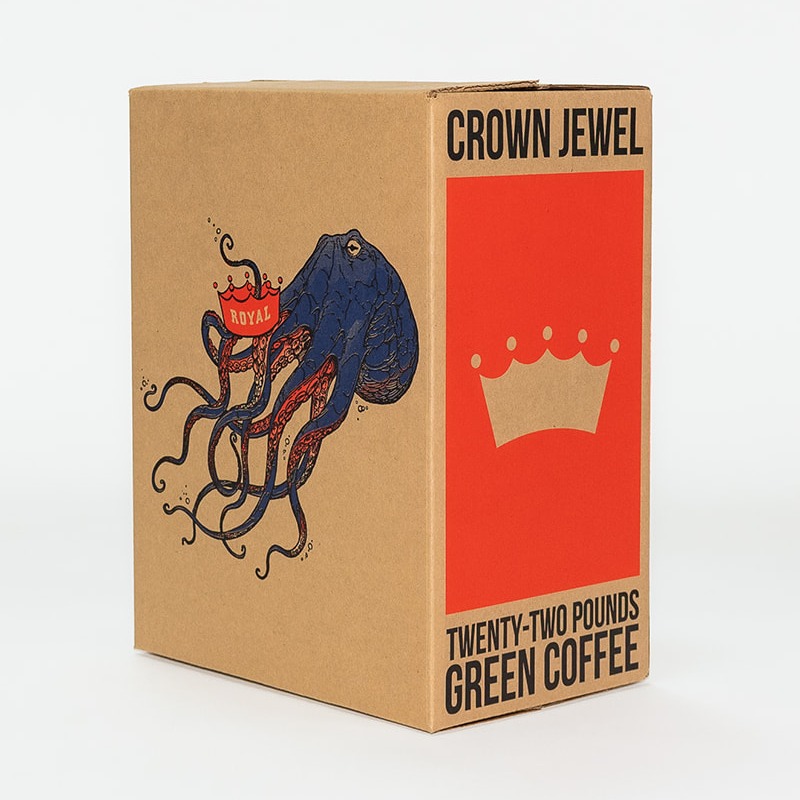
When you finally receive this green coffee the first thing you’ll notice is the fragrant vanilla aroma coming from the Crown Jewel box. This multi-staged fermented coffee is on the edge of innovation and quality excellence which is evident in the green specs and in the cup quality.
Castillo varieties can be seen as an improved Colombia-style Catimor with leaf-rust resistant attributes. Screen size is densely packed in the 19-16 range with a total moisture content hitting normal ranges and a water activity that is slightly above average. Thankfully, nothing too wild happened during roasting despite the avant-garde processing methods. Doris’ only comment to this was to make sure to “push the heat” a little.
Diedrich IR5
Diedrich IR5 Analysis by Doris Garrido
There is a particular flavor profile that I enjoy a lot on Colombian Coffees, and I tend to focus on the drying stage of roasting to either enhance these flavors or diminish them. Generally, they tend to remain within the medium density range. Owing to this, I typically initiate with a gentle start – not exactly a soak but rather a mild charge with air. With this inoculated coffee I have discovered that starting with an even gentler approach leads to a better result. In this case I did try soaking and here are my findings.
Initially, I preheated my roaster and charged the coffee at 411°F, utilizing 50% of the airflow. Despite this low charge temperature and airflow, the turning point ended up being high, at 186°F. At two minutes I increased my gas to 85% and let it run for 5 minutes and 30 seconds, and then lowered to 30% when the temperature reached 317.5F. Midway through the yellowing phase, I push the airflow to 100%.
The first crack started at 9 minutes and 4 seconds with a temperature of 382.9°F. For development, I gave it 1 minute and 30 seconds, dropping the coffee at 397°F.
The sweetness was a significant enhancement in this roast, the inoculated coffee exhibited a noticeable vanilla flavor, hazelnut chocolate and a pronounced hot cocoa taste, complemented by a silky body and rounded out with a buttery flavor! I am just waiting to taste this coffee on espresso as a cortado, I have a hunch it’s going to be incredible.
IKAWA
Ikawa Pro V3 Analysis by Isabella Vitaliano
Our current Ikawa practice compares two sample roast profiles, originally designed for different densities of green coffee. The two roasts differ slightly in total length, charge temperature, and time spent between color change in first crack. You can learn more about the profiles here.
What a silly little coffee this is! Silly in the cup but certainly not lacking in quality in any form. This coffee is for the adventurous, as many experimental-style microlots are. Lots of cotton candy flavors come out on the cupping table along with almond paste, bubble gum, melted ice cream, and nougat.
You might notice a baker-like chocolate aroma during the roasting process, something the team noticed from the IKAWA roasts: our lab turned into a bakery for a brief second.
The high-density roast presented a really nice acidity in the form of lemon, and limoncello, coupled with peanut butter cookie, miso, and gelato. This mix makes for quite the rollercoaster in the cup.
On the light-density roast, I got more notes of vanilla bean powder, melted ice cream, and Oreos. Vanilla was in full form in this profile, fuller in body, buttery, and played into the silliness of the profile a bit more.
I recommend checking out the light-density profile on this coffee! I enjoyed how vanilla forward this roast but no matter the direction you take it, this coffee is one that will be fun to explore.
You can roast your own by linking to our profiles in the Ikawa Pro app here:
Roast 1: Low Density Sample Roast
Roast 2: High Density Sample Roast
Brew
Brew Analysis by Taylor Brandon
I first experienced this coffee on the cupping table and was a bit intimidated by my lack of knowledge of the inoculation process. My hesitation was met with ease as I experienced a clean cup with a savory citrus depth and gorgeous milk chocolate notes. This brew likes to stew so stick with a flat bottom brewer. My favorite brews were with the Kalita Wave and I find that a conical brewer like the V60 did not allow the grounds enough time to marinate with the water. My first brew was my absolute favorite! An 18.5 dose of coffee and 9.5 grinds on the Kalita Wave delivered a stellar extraction rate of 20.16%. My colleagues and I experienced notes of rose, candy corn, lemongrass, almond, orange blossom, and Cadbury eggs. I also thought the body had a nice weight that was able to carry the depth of flavor. I would stop here but in the spirit of experimentation, I facilitated three more brews. Brew number two was cute and I simply changed the grind from 9.5 to 8. The finer grind delivered a higher concentrated flavor and an extraction rate of 22.73%. The flavors were bold; graham cracker, honey, maple syrup, and apple pie with sharp cheddar cheese! Wow, wow, welcome to flavor town! By this point, I wanted to see what the softer side of this coffee was made of, and I switched to the V60 dripper. The V60 brews were too light in body for my taste but still solid. The first of the two was a dose of 19 grams of coffee at a 9.5 grind. My extraction rate was off the charts at 26.62% – not ideal but not terrible. I got more lime citrus in this brew as well as Swiss miss chocolate, cherry, and pear hard candy. The last brew took the dose to 18 grams of coffee and a grind of 9 on the EK43 grinder. This zesty brew presented notes of nougat, caramel, soy sauce, and tomato. Again, for a great, fun, and zesty cup, a flat-bottom brewer is a must. I would also suggest a finer grind for more fun. All in all, a fun and clean coffee.
Espresso
Espresso Analysis by Alisha Rajan
Huver Castillo’s seemingly circuitous experimentation with this standout anaerobic Castillo cultivar is as intriguing as it is flavorful. From the initial “oxidative” maceration step to the anaerobic stage post-inoculation monitoring, I was taken by the attention to detail that Huver had to maintain throughout the process. Considering the aforementioned wine-like character of this coffee, I am curious as to whether the inoculation was a direct cause of this. After all of that work, creating something less than exceptional was out of the question, and the espresso analysis allowed me to arrive at the same conclusion. Unmistakable vanilla bean character mingles with candied walnut and bright berries to present a coffee that is distinctively sweet and highly palatable, with or without milk.
The first recipe of note came in at a moderately high dose of 18.5g with a 35.8g yield extracted in 32 seconds. Presenting an ideal ratio of sweetness to brightness, this was undeniably my favorite recipe. Notable flavors included candied cherry, sweet walnut, and an amaretto-like finish. The characteristic vanilla was present from start to finish, a gentle base on top of which the other flavors sat comfortably.
My second favorite recipe came in at a higher dose of 19.0g with a 38.8g yield extracted in 34 seconds. Although the vanilla flavor was present throughout, this recipe highlighted a much more complex and full bodied candied walnut flavor. Concentrated nuttiness and pistachio marzipan yielded to a minty and herbaceous finish.
All in all, this offering surpassed my ideas and expectations of what a yeast inoculated coffee could taste like. Although I would not characterize it as mild by any standard, it was “punchy” in all the right ways while maintaining its approachability. What I’m most intrigued with, however, is the seemingly paradoxical situation of such innovative production methods yielding such classic and nostalgic flavors like vanilla ice cream and candied walnut. This is certainly a testament to the knowledge and skill of the producer. Dialing this in was a truly rewarding journey, delicious from start to finish.
Related Coffee

Coconut, piña colada, mango, upside down pineapple cake, floral
Oakland 17 Boxes
Crown Jewel Colombia Carbonic Honey Mango/Coconut Co-Ferment Pedro Nel Salazar
38870-1 – SPOT RCWHSE
Coconut, piña colada, mango, upside down pineapple cake, floral
Spot
17 Boxes
$392.02 per box
Floral, vanilla, brown sugar, honey, apricot
Oakland 11 Boxes
Crown Jewel Colombia Honey Gesha Juliana Guevara & Wbeimar Lasso
38869-1 – SPOT RCWHSE
Floral, vanilla, brown sugar, honey, apricot
Spot
11 Boxes
$277.59 per box
Cherry, grapefruit, apricot, floral, and lime
Oakland 43 Boxes
Crown Jewel Colombia Washed SL-28 Juliana Guevara & Wbeimar Lasso
38868-1 – SPOT RCWHSE
Cherry, grapefruit, apricot, floral, and lime
Spot
43 Boxes
$259.91 per box
Peach, jasmine, peach black tea, grapefruit, and peach nectar
Oakland 41 Boxes
Crown Jewel Colombia Carbonic Honey Peach Co-Ferment Edwin Noreña
38644-1 – SPOT RCWHSE
Peach, jasmine, peach black tea, grapefruit, and peach nectar
Spot
41 Boxes
$351.23 per box