
Article Summary
Coffee grows throughout Colombia, with fresh harvests available nearly year-round. More than half a million coffee producers contribute to the country’s status as third in global export volume. Farmers grow traditional varieties, engineered hybrids, and even bespoke “discovered” coffee plants, and demonstrate uncommon innovation in production, processing, and fermentation.
Introduction & Production Statistics
Colombia is responsible for more coffee production than almost anywhere else in the world, perennially third in volume behind Brazil and Vietnam, earning a cool $3.6 billion in 2024 and projected to break production records in the 2025-2026 marketing year by the USDA’s Foreign Agricultural Service at 13.8 million bags, up 10% over previous year, with exports projected at 12.5 million bags.
It’s unsurprising, given the annual tonnage, the complex topography, and the approximately 550,000 coffee producers, that the country is decidedly not a monolith, but rather a vast network of diverse regions and people, as well as varied styles and flavors of coffee grown.
Coffee trees thrive from north to south in the country, generally planted along the slopes of the Andes’ foothills as the mountains trace their course through the country, splitting into as many as three distinct ranges, riven by the enormous valleys of the Magdalena and Cauca river systems.
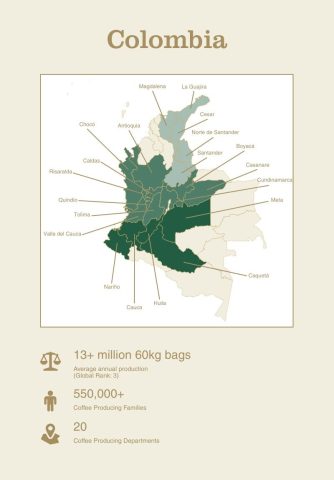
Often grouped into three distinct zones, coffee regions can be classified as either from the North, Central, or Southern sectors.
Check out the National Federation of Coffee Growers’ interactive harvest map.
The Northern Zone
The Northern Zone contains coffee producing farms in the departments of Santander, Norte de Santander, La Guajira, Magdalena, and Cesar. These tend to be least familiar to specialty coffee roasters, with higher temperatures and lower elevations resulting in less distinctive profiles. However, high quality potential remains throughout these areas, particularly in the mountainous Sierra Nevada de Santa Marta mountains in Magdalena’s northern reaches, close to the Caribbean Sea.
The north’s less variable climate produces a single harvest season, typically lasting from September through December. Coffee grown in the far south of Santander may occasionally get a small secondary harvest (or fly crop, also called mitaca), picked in April and May.
The Central Zone
Coffees grown in the Central Zone fall into Colombia’s administrative departments of Valle del Cauca, Antioquia, Boyacá, Caldas, Risaralda, Quindío, Cundinamarca, and Tolima, with traces of spillover into Casanare in the east, and Chocó in the west. Substantial annual volume contributions from these regions, particularly Antioquia and Tolima, make them familiar names to many roasters, while other smaller departments like Quindío and Valle del Cauca contain well-established estates, often with histories of coffee cultivation measured in familial generations.
Much of the Central Zone has two harvest cycles, with the more northerly regions typically harvesting main crop from September through December, whereas the more southerly sectors trend towards a March to June primary harvest. Fly crops vary regionally in the off-season.
The Southern Zone
The Southern Zone consists primarily of the departments Cauca, Huila, and Nariño, each of which have made a name for themselves in specialty coffee roasting circles for excellence. Pockets of outgrowth and newly developed coffee fields are present in Meta and Caquetá as well.
High elevations, proximity to the equator, and cooler average temperatures contribute to favorable growing conditions for high quality cup profiles, particularly notable for bright acidities and complex sweetness. Cauca and Nariño predominantly harvest only one cycle starting March and lasting through June, but Huila has strong regional variations in harvest with much of the department’s trees capable of a fly crop in the off-season. Per the Coffee Growers’ Federation, the only months when coffee isn’t harvested in Huila are January-February and July-August.
Variety and Cultivar Introduction and Development
Colombia’s coffee growers are supported by a large and well-recognized organization called the Federación Nacional de Cafeteros de Colombia (National Federation of Coffee Growers) often abbreviated as Fedecafé or the FNC. The FNC is a marketing agency (ever hear of Juan Valdez or seen the triangle logo with the coffee producer and mule?), and a support structure providing assistance such as agronomic education and variety research, as well as operating an export branch and roasting and instant coffee brands. According to the FNC, nearly 40% of Colombian coffee qualifies as specialty, and it is the country’s third largest export commodity.
The FNC’s research branch, Cenicafé, has been responsible for developing many of the country’s iconic coffee varieties and cultivars. Historically, Typica trees would have been first introduced in the 18th century, likely taken from Venezuela by Jesuit priests, and Bourbon trees would have swept through many of the traditional coffee growing regions in the late 19th century. Many coffee producers also grow classic dwarf Arabica variants, particularly Caturra and Catuaí, introduced in the latter half of the 20th century.
In the race toward rust resistance, Cenicafé took the classic Catimor hybrid recipe and began developing bespoke variants for Colombian coffee growers, first releasing an F5 Catimor called “Colombia” in 1982. This was followed by Tabi, which replaced the Caturra ingredient in the Catimor recipe with a Typica-Bourbon hybrid (in the style of Mundo Novo) in 2002.
However, the most widely grown and notorious Colombian cultivar is Castillo, first released in 2005. In subsequent years, sixteen regional versions of Castillo have been released. Not only is Castillo a hardy F5 hybrid, it also contains multi-line composition meaning that the seeds from a single bag of Castillo are not genetically identical, providing greater resistance to disease across the fields wherein they are planted. Coffee cuppers initially turned their noses up at Castillo, worried its genetic Canephora legacy would taint the cup quality of a country celebrated for deliciousness. However, Castillo held its own in cup competitions, and the distinctive benefits for farmers of high yields plus disease resistance make it a difficult tree to resist growing.
Cenicafé continues developing new cultivars including an eponymous variety released in 2017, yet another iteration of the tried-and-true Catimor recipe, with a higher percentage of Supremo grade beans (the largest, most valuable size classification in the Colombian export system).
Colombia also has more than its fair share of happy accidents and foreign introductions of unique cultivars in recent years. Numerous spontaneous “discoveries” of varieties have proven to be related directly to Ethiopian landrace selections, likely smuggled beans cultivated in secrecy for years before they were accepted as distinct. These include varieties known as Wush Wush, Chiroso, and even Pink Bourbon. Grouped into this class of Ethiopian-related trees, we can also include Gesha, whose provenance is well-documented. Colombia was the first nation outside of Panama to cultivate it in its modern era.
With estates throughout the country (such as notable Royal Coffee Crown Jewel suppliers Wbeimar Lasso and Juliana Guevara of Terraza, and Edwin Noreña of Finca Campo Hermoso) developing experimental test plots, it is possible to find an endless variety (see what I did there?) of cultivated coffee trees, including rare selections like Sudan Rume and Laurina, and even alternate species such as Eugenioides. In some cases, producers are even developing distinct varieties in their own gardens rather than cultivating trees from extant seed stock.
Fermentation and Processing Styles and Flavors
Colombia’s innovative producers’ expertise extends beyond cultivation, and into processing and fermentation styles. The country and its coffee producing families are on the cutting edge of processing revolutions, regularly engaging in experimental methods such as multi-stage fermentation, carbonic maceration, and of course co-fermentation.
It might surprise coffee roasters to learn that prior to 2016, exporting any processing style other than classic washed coffee as a specialty grade was banned by the FNC. While there were producers experimenting with alternative processing styles and finding direct buyers, the unsolicited production of any experimental or non-standard method was effectively an economic dead end, which makes Colombia’s position at the vanguard of fermentation development even more impressive.
Colombia’s reputation on the global stage for excellence was supported by a longstanding “clean washed coffee” profile for decades, and these types of coffees still represent the dominant flavor profile in the nation, from the northern zone’s full-bodied chocolatey iterations to the nuanced micro-lots with bright citric acidities flowing from small producers in the south.
However, increasingly, Colombia continues to remind us that it cannot be pigeonholed into a single national profile, whether that is defined by regional seasonality, coffee cultivar selections, or even processing methods and flavor profiles. Roasters are learning to expect the unexpected, and embrace both tradition and experimentation from producers throughout one of the world’s most well-recognized and celebrated coffee producing nations.

Latest Articles by Chris Kornman
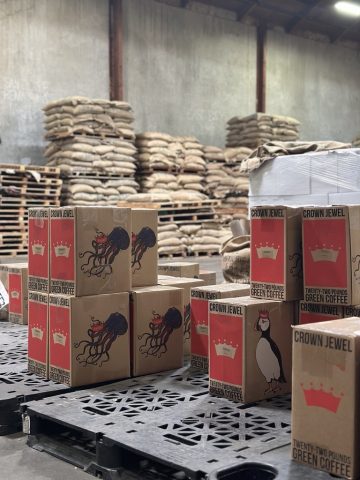
Crown Jewel Outlook: September-December 2026
Get an early look at the Crown Jewel coffees arriving through the end of 2026, from Ethiopian naturals and rare Guatemalan cultivars to Colombian co-ferments and new origins in Asia.

Why We’re Temporarily Reducing Our Coffee Drink Prices
We’ve long maintained that tariffs were not just a tax on U.S. businesses, but on the American people. We’re finding creative ways to try and pay back that debt to our customers at The Crown. What? ...
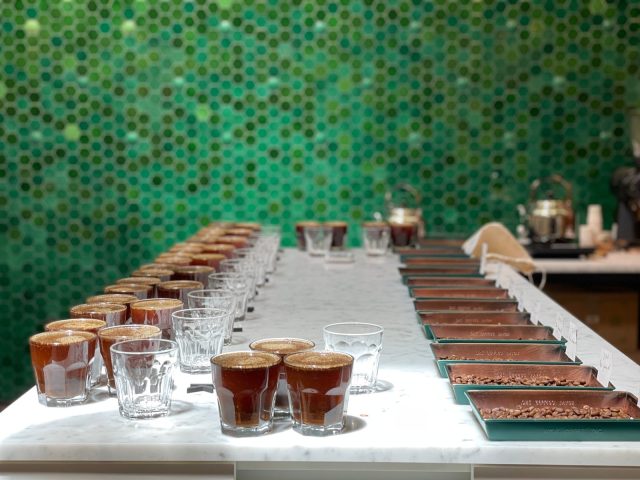
Notes Between Cups, Volume 3
Chris Kornman on the hidden biases shaping every coffee cupping: how context, neighboring cups, and ritual influence sensory evaluation — and where the SCA CVA falls short.