
Crown Jewel Tanzania Natural SL-28 Neel & Kavita Vohora Karatu District
36523-1 – SPOT RCWHSE
Boxes 0
Warehouses Oakland
Flavor Profile Plum, orange , blackberry, lemongrass, and caramel
Out of stock


Overview
Overview
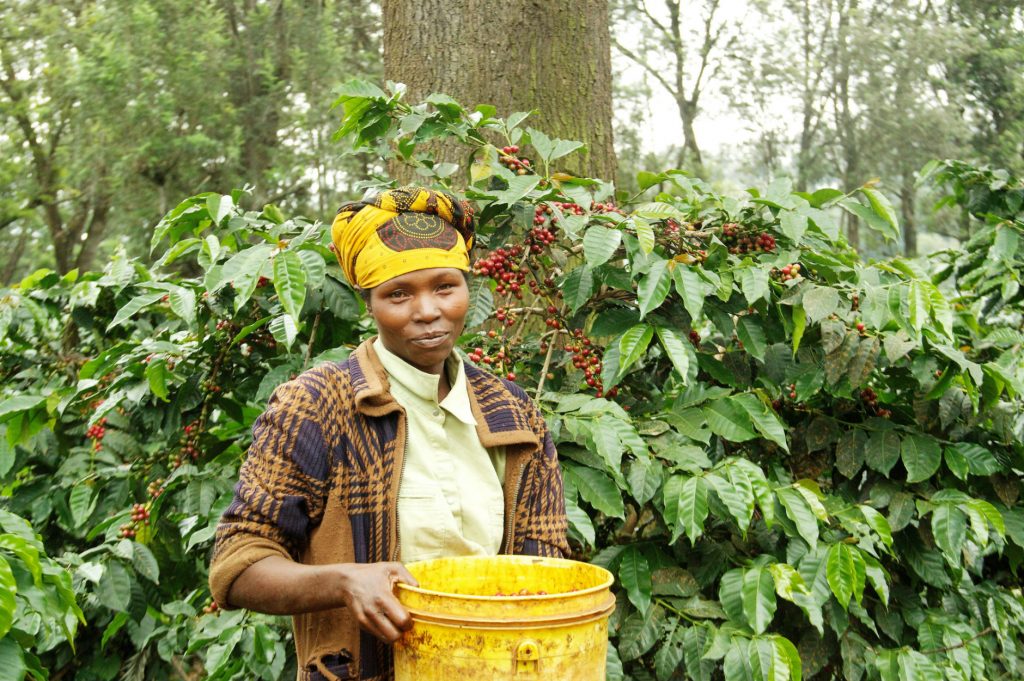
This is a fermented natural SL-28 variety coffee from Karatu, Tanzania, produced by siblings Neel and Kavita Vohora on their Gaia Farm.
The flavor profile is a remarkable and delicious combination of Kenya-like acidity, process-driven fruitiness, and Tanzanian terroir. We taste blackberry, plum, orange, fig, lemongrass, and caramel.
Our roasters encourage an unhurried pace in Maillard reactions and noted a soft first crack.
When brewed, our baristas noted the coffee was a “joy to work with.” We preferred coarsely ground conical pour-overs and middle-of-the-road specs for espresso shots.
Taste
Taste Analysis by Isabella Vitaliano
I find that some natural coffees either can overpower in processing flavor or make the origin profile a little bit subdued. This coffee is a really interesting, layered experience and expression of cultivar, regionality, and processing. You can see hints of all aspects without the natural processing overtaking the profile. Zippy, lime zest and lemon juice are expressions of common east African flavors. The cultivar has notes of jasmine, fig, mint, and white tea. And the processing contributes elements like marmalade, mango, white grapes and candy like sweetness.
There are four total lots from the Vohora family and I know I shouldn’t have favorites, as a paternal figure shouldn’t, but I do. I think I am particularly fond of this coffee because while teaching a class the other day I used this coffee as an example of natural processing when featuring three other East African coffees and it perfectly displayed what I was trying to teach. Everyone in the group got exactly what I was trying to explain when describing the three elements that contribute to this flavor profile. A natural coffee for washed lovers. In the brew analysis Josh and Tim explored flavors like marshmallow, stone fruit and turbinado sugar. Stunning as a pour over and enchanting as espresso you can’t beat this exemplary display of cultivar and processing by Kavita and Neel.
Source
Source Analysis by Chris Kornman
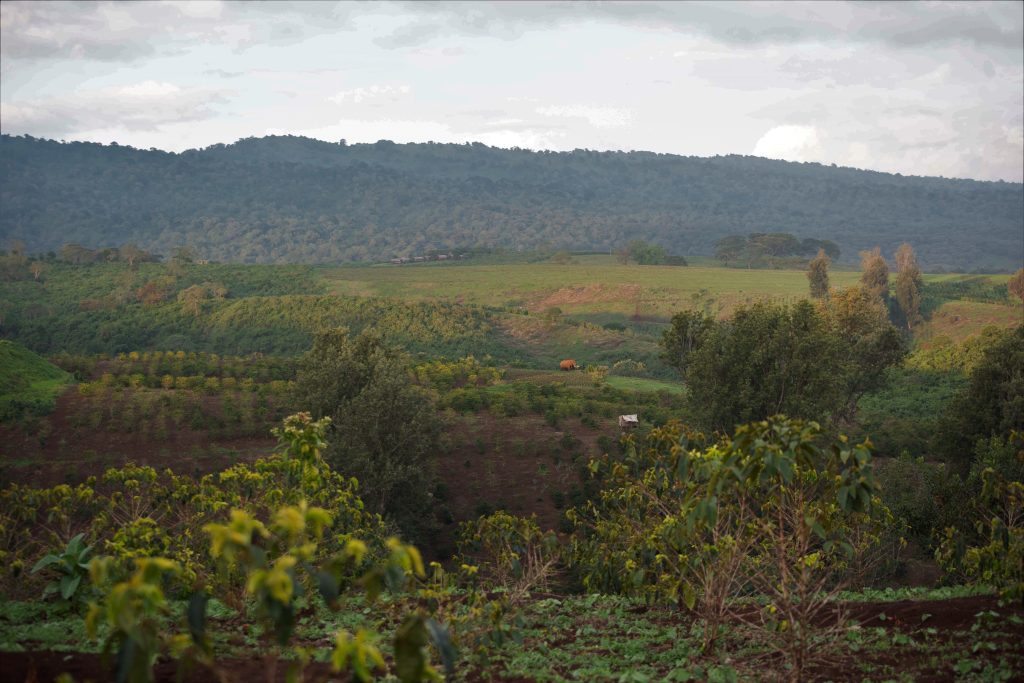
Under the watchful guidance of sibling team Neel and Kavita Vohora, the Edelweiss and Gaia farms have begun to blossom from well-managed estate farms, spanning 1000 acres across multiple ridges of the Ngorongoro caldera in northern Tanzania, into an innovative and genre-defying coffee enterprise. I’ve worked with Neel and Kavita, and the coffees from the farms for 15 years and I can definitively say that their most recent harvest is the most exciting I’ve ever tasted.
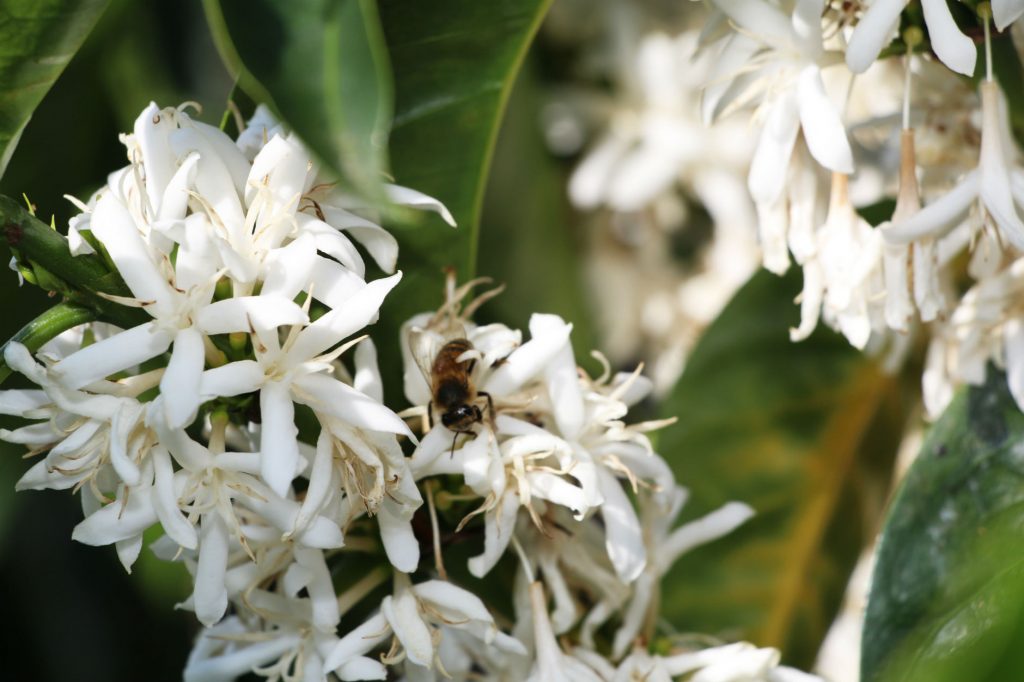
Among the family’s favorite cultivar selections are the SL-28s, coffees descended from some of the earliest Arabica selections made in Africa outside of Ethiopia. Tanzania was among the first colonial coffee cultivated on the continent – Bourbon trees from Réunion were delivered to the Bagomoyo mission as early as 1868. From this expanding population of C. arabica var. Bourbon a selection was made in the early 1930s by a now-extinct British agricultural breeder called Scott Labs. SL-28 is Tanzanian stock, chosen for its drought resilience almost 100 years ago, and it found its home primarily in Kenya (where the lab was based) and earned a reputation with growers for bountiful harvests and large screen sizes and with cuppers as a bastion of cup quality. The Vohoras’ SL-28s thrive on the farms as productive trees (if susceptible to diseases like berry fungus) and frequently top the siblings’ cup rankings in their lab.
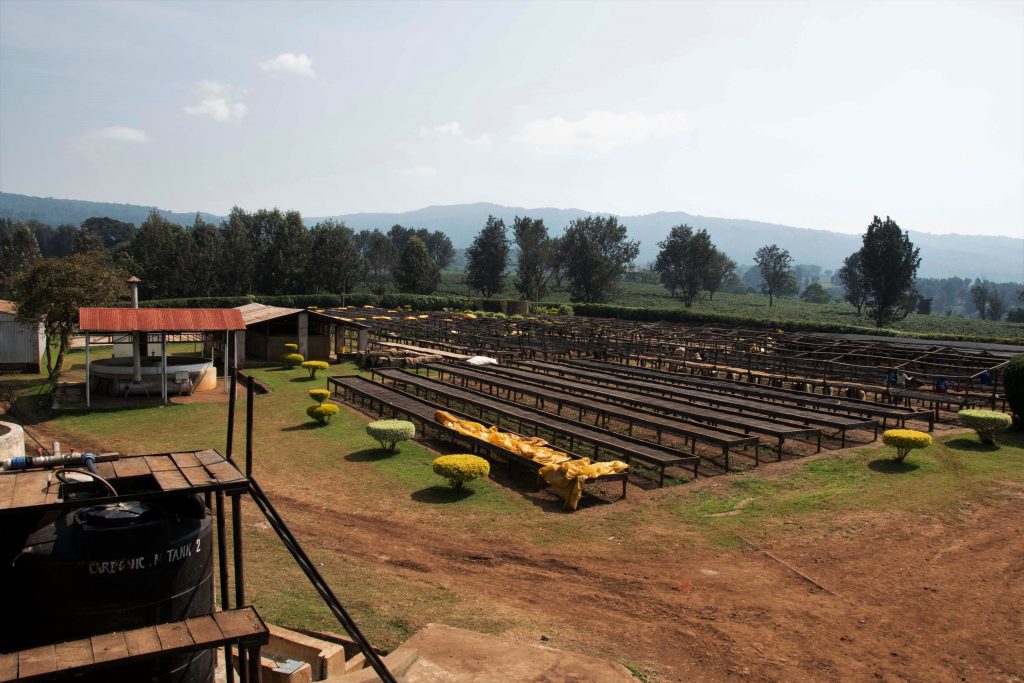
The Vohoras’ farms continue to innovate in processing methodology as well. Rather than resting on the laurels of tradition, nearly all of their coffee (including the commercial volumes of larger lots) goes through a cherry maceration period prior to processing. For microlots, like this SL-28, the timeframe for whole cherry “pre-fermentation” is determined specifically by cultivar, through a trial-and-error process that’s been honed into precise protocols to bring out the best in each variety. In this case, the SL-28 harvest will macerate in whole cherry on raised beds under protective tarps for four days prior to completing the nearly 4-week drying process on raised beds in whole cherry. After this is finished, the dried coffee is stored in GrainPro until it can be milled in Vohora’s facility back in Arusha.
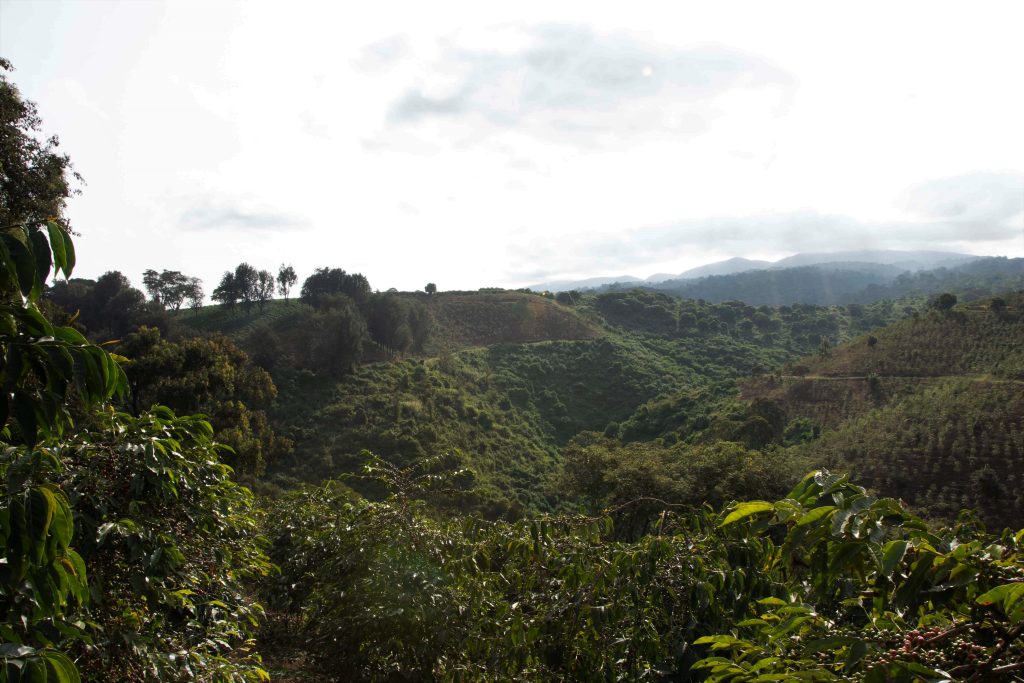
Ngorongoro, the world’s largest unbroken caldera, looms over a verdant landscape, the shell of an ancient, ruptured volcano. Inside its walls, a wildlife conservation area cut off from much access to the outside world, is home to hordes of zebra, eland, gazelles, wildebeests, two prides of lions, hyenas, hippopotami, and scores of other local birds and mammals, including a small population of black rhino. The Maasai, among the region’s more visible residents with distinctive red flannel robes and unchanged traditions of nomadism, are frequent visitors, passing through the crater with their goat and cattle herds in tow. The caldera’s wildlife are no strangers to the farms, either. Native forest corridors on the estates allow freedom of movement for the animals as they migrate, but it’s fairly common to find damage to the coffee trees; the most frequent offenders being elephants and water buffalo.
The Vohora’s estates are nestled into the caldera’s outer ridges, bordering the park. Since 1971, the Vohoras have owned about 1000 acres of farmland on the southern exterior slopes near the town of Karatu. The siblings’ grandfather arrived from India, first working for the British colonists as a farm manager prior to the nation’s independence, and their father founded and ran the export business from nearby Nairobi.
Today, Neel manages the farms, including overseeing more than fifty full-time employees and nearly eight hundred seasonal workers during the peak of harvest. He’s also at the forefront of processing innovations and cultivar selections. Kavita helms the export business from Arusha and is the lead cupper and licensed Q-grader at the dry mill. Her daughter, Nicolene, is learning to taste coffee… the family’s fourth generation, now in training.
You can read more about the farms in a recent blog.
Green
Green Analysis by Isabella Vitaliano
The water activity is slightly below average in this case with free settled coffee at 678 which is indicative of a coffee with a slightly below average density. Moisture content is in the ideal range and this coffee has a very wide spread of screen sizes between 19-16 with roughly 84% of the green coffee in this range. This makes for an ideal roasting and a delicious cup. Sl-28 was originally bred by Scott Laboratories in Kenya but was initially found in Tanzania around the 1930’s. Scott Laboratories is no longer in existence but because of their work SL-28 is very popular in East Africa but especially in Kenya.
Diedrich
Diedrich IR5 Analysis by Doris Garrido
Across harvest and origins, the SL-28 from the Vohora family has proven to be a truly exceptional coffee this year. It’s a natural processed coffee, yet it presents the clean profile of a beautiful, washed coffee, offering a sweet, full bodied, and tangy taste. But that’s not all – its aftertaste brings forth that distinct “natural process” characteristic. And I am personally thrilled by some hints of Kenya I got, that make it taste simply complex to me.
I took a very straightforward approach to the roast. I started the batch with the drum preheated to 400F, charged the coffee, and applied gas before the first minute of the roast. I maintained this heat setting for about 5 minutes, beginning to drop it after noting the color change. At the 6-minute mark, I was at my lowest gas setting of -30% and opened the airflow in full. The first crack slowly occurred at 8:29 minutes, and I finally dropped the coffee at an end temperature of 400F. I deliberately avoided applying high heat during this roast, aiming for wider caramelization. This resulted in only 3 minutes and 29 seconds in the yellowing phase, which, in the cup, translates to smooth lemon juice acidity with a touch of floral notes, and I am more than happy with it.
Regarding the sweetness, this coffee offers a candy-like, clean, and crisp sweetness, reminiscent of perfectly ripe Muscat grapes and fig jam, almost cider-like. It finishes delicately, leaving a soft lime zest aftertaste and a reminiscent of mango on the finish.
Aillio
Aillio Bullet R1 IBTS Analysis by Evan Gilman
We use the RoasTime app and roast.world site to document our roasts on the Bullet. You can find our roast documentation below by searching on roast.world, or by clicking on the link below. Take a look at our roast profiles below, as they are constantly changing!
Often we’ll get a mix of cultivars in any given selection, and after my recent visit to Indonesia, it’s clear that it’s a very difficult proposition to keep all the different trees separated and to keep coffee breeding true if seeds are taken straight from the plant. No matter where I was, there was a smattering of both bronze and green shoots, uplifted and drooping branches, short and long internodal spacing – clearly many different types mixed together. So, to get a straight SL-28 is something special and interesting, no doubt about it.
The approach on this one was something I wasn’t completely confident with, but the green metrics looked fairly approachable with nothing setting off alarm bells. The water activity was a touch low, so I did want to focus on getting some decent, unrushed time in Maillard to get some nice texture.
I started with 455F charge temperature, P8 power, and F3 fan just as soon as I’d dropped the coffee into the roaster. At 310F / 3:05, I dropped power to P7, and increased fan to F4 to reduce heat in the roaster. At 348F / 5:20 I increased fan further to F5 as this coffee was retaining more heat than expected and I wanted to spend a bit more time in Maillard before approaching First Crack. Then at 370F / 6:45 a decrease of power to P6 before First Crack, and further to P5 just after. I took the extra step of increasing fan to a whopping F6 at the same time, and was able to spend 1:22 in post-Crack development as a result.
I spent percentages of 45 / 39 / 15 in Green, Maillard and post-Crack respectively, and finished the roast by dropping at 394F / 9:00. I’m not sure if this coffee would have been a touch brighter if I had dropped a bit sooner, but I knew I wanted a decent amount of time after crack to really develop the sugars as I’ve known SL-28s in general to be brightly acidic – I wasn’t too worried about the acid expression here.
Turns out the gambit worked, for the most part. I got tart and tangy acidity up front, with clean caramelized sugar that I think Doris noted as hard candy sweetness (I agree wholeheartedly). There’s a heartiness here that I think dwells in the background, and though it presented as rye-like when the coffee was an hour or so off roast, it mellowed out into a nice Guinessy maltiness as the coffee offgassed. Truly a drinker’s coffee.
Honestly, I’d love to see this one as an espresso, or even as a French press. Just give me all the particulate matter, if you can. It’s heavier than I expected in the cup, and my ideal vision of this is on top of some vanilla ice cream as an affogato. Dense. Sweet. Yum.
You can follow along with my roast here at roast.world: https://roast.world/egilman/roasts/0vISCkjrImaA8VBi20rNf
IKAWA
Ikawa Pro V3 Analysis by Isabella Vitaliano
Our current Ikawa practice compares two sample roast profiles, originally designed for different densities of green coffee. The two roasts differ slightly in total length, charge temperature, and time spent between color change in first crack. You can learn more about the profiles here.
The SL-28, Tanzania, natural processing intersection seems to be a holy trinity for me. Kavita and Neel, the brother and sister duo behind the Vohora operation have done an excellent job here.
On the low density roast this coffee felt a little bit flat to me with very sharp lemon flavors and brown sugar sweetness. The high density roast felt more expressive with apricot, plum and a balanced brightness in the cup.
Although the density of this coffee is on the below average side, I really enjoyed the high density roast version of this coffee. It felt complete, and an overall better manifestation of the three elements that make up this profile. Happy cupping!
You can roast your own by linking to our profiles in the Ikawa Pro app here:
- Roast 1: Low Density Sample Roast
- Roast 2: High Density Sample Roast
Brew
Brew Analysis by Josh Wismans and Tim Tran
The Vohora family has provided consistently high-quality coffee and it is off the back of strongly positive reputations that we excitingly dive into this naturally processed SL-28. And this coffee provided flavor in spades!
Our favorite brew was our first dig into this coffee – as to whether this is a testament to how well this coffee performs in the cup or whether we happen to be coffee professionals capable of striking lightning every once in a while, we’ll leave that up to you. Our first recipe was a 1:16.22 ratio at a coarse grind brewed on a conical brewer. This coffee gave incredibly sweet, ripe stonefruit notes, with some accents of turbinado sugar and an almost marshmallow decadence. The initial brew provided very high clarity and this is something we observed across each of our brews. The extraction proved to be on the lower side, at 17.3% with a TDS of 1.2, but this did not stop the coffee from tasting great.
At higher doses of coffee, the flavor density improved, as expected, but stayed fairly balanced all throughout the brews. We found higher doses on a v60 to present brews with more caramel forward profiles, with notable citrus flavors.
Moving to a flat-bottomed brewer, the coffee presented a rounder flavor profile, and our second favorite brew was a moderately high dose of coffee at a coarse grind. This brew gave plenty of berry jam sweetness, with a pleasant navel orange citrus acidity, and some herbaceous lemongrass and rosemary notes. The flavor profile of this coffee provided a long and sweet finish. The extraction proved to be a touch lower, with a 16.79% extraction and 1.31 TDS.
This coffee provided a fun dive into how clarity can present for a beautiful cup, when the notes expressed prove to be poignant, flavorful, and easily discernible. To best enjoy this coffee, we recommend targeting a slightly lower extraction for a clean expression. We recommend a moderate dose at a coarse grind on a conical brewer. We hope you are able to enjoy this coffee as much as we enjoyed brewing!
Espresso
Espresso Analysis by Asha Wells
Such a special coffee, truly superb. All at once, juicy, aromatic, deep, and possessing a quiet nuttiness that struck me as quite charming. This coffee was very easy to work with, the first shot I tasted was literally incredible (RARE), and just a couple minor adjustments led me to my second recipe. At first glance, I knew this coffee was ‘my type.’ I love naturals from this region, but I wasn’t prepared for just how much I’d love this coffee! On the nose, I was catching sumptuous waves of marzipan and buttered popcorn. While those notes were still present on the palate, I was astonished at how juicy and floral it could be while still maintaining such harmony.
This first recipe, with a moderate dose of 18.5g, yielding 37g, and taking a total of 26 seconds, was silky and dripping with intrigue, slight nuttiness from the jump, with a crema that reminded me of a Guinness. Further into sipping, I was delighted to experience a more zippy and expressive side of this coffee, with top notes of passionfruit, and lemonheads (a childhood favorite of mine). There was also a lingering florality that tasted just like grass jelly to me. I loved this shot so much.
My second dial, with a lower dose of 17.5g, yielding 38g, and ran 27 seconds. This shot had more defined sweetness and offered a lighter bodied experience, still buttery, but here felt more akin to buttercream. Fragrant and floral, this shot was drenched in marigolds, and cardamom. Also very fruity and sassy, we’re talking cherry soda, kiwis and margaritas.
This coffee was truly a joy to work with, and I love her.
Related Coffee
Honey, apricot, baker's chocolate, black tea, and peach
Oakland 8 Boxes
Crown Jewel Tanzania Natural Gesha Neel & Kavita Vohora
Lot 157 – 39892-1 – SPOT RCWHSE
Honey, apricot, baker's chocolate, black tea, and peach
Spot
8 Boxes
$360.07 per box

Black Tea, caramel, lemongrass, passion Fruit, apricot
Oakland 34 Boxes
Crown Jewel Burundi Honey Peaberry Heza Washing Station
38863-1 – SPOT RCWHSE
Black Tea, caramel, lemongrass, passion Fruit, apricot
Spot
34 Boxes
$255.49 per box
Lemon, floral, hibiscus, rosemary, and apple
Oakland 89 Boxes
Crown Jewel Ethiopia Anaerobic Natural Rue Co-ferment Banko Chelchele
40654-1 – SPOT RCWHSE
Lemon, floral, hibiscus, rosemary, and apple
Spot
89 Boxes
$358.51 per box
Plum, caramel, graham cracker, cranberry, green apple
Oakland 45 Boxes
Crown Jewel Tanzania Karatu Vohora Family Washed SL-28
Lot 158 – 39893-1 – SPOT RCWHSE
Plum, caramel, graham cracker, cranberry, green apple
Spot
45 Boxes
$257.28 per box