
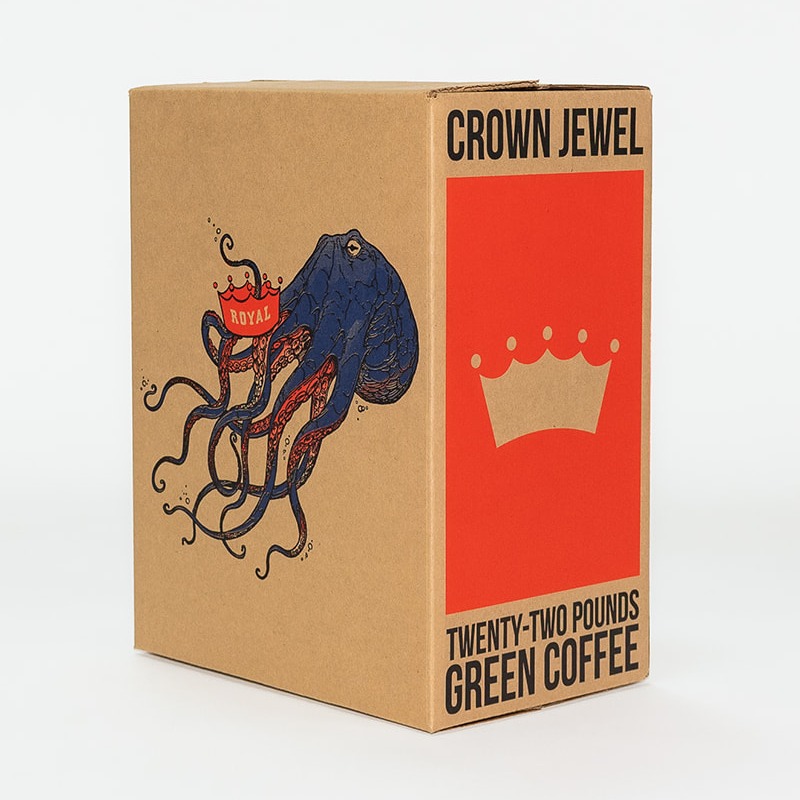
CROWN JEWEL ETHIOPIA ORGANIC HALO HARTUME NATURAL
33327-1 – SPOT RCWHSE
Boxes 0
Warehouses Oakland
Flavor Profile Blackberry, cherry, molasses, orange, and caramel
Check out our Guide to Ethiopian Coffee Grades
Out of stock
Overview
Overview
This is a low intervention natural coffee from the Halo Hartume smallholder farming community and cooperative washing station, produced in coordination with the Yirgacheffe Coffee Farmers’ Cooperative Union.
The flavor profile is sweet, fruity, and perfectly clean with hints of florality. We tasted blackberry, cherry, molasses, orange, and caramel.
Our roasters found a balanced approach worked best, and while the coffee can take heat, like most naturals, it requires a steady hand at first crack.
We liked hearty doses and finer grind settings, resulting in expressive pour-overs.
Taste
Taste Analysis by Isabella Vitaliano
A medley of berries, stone fruit, dark chocolate and grape candy make up some of the pleasures to be found in this recent Crown Jewel release. On the edge of the southernmost district of the Gedeo zone, the Worka region is famous for its terroir and history. Often, the coffees from this region will have bright flavors and perfume-like florals emanating from the cup.
The team found notes of ripe mandarin, while the thick creaminess of the body presents as blackberry reduction and tootsie roll and cools even better than the first sip. Not bombastic by any means, you can gulp it down as your first cup of coffee of the day with no problem. Molasses supports the fruit notes of this coffee with hints of cherry cola. Reminiscent of a sweet pastry with cherry compote, you’ll keep going back for more of this coffee!
Source
Source Analysis by Charlie Habegger
Worka is a large municipality in the Gedeb district, the southernmost district of Ethiopia’s famous Gedeo zone. Nearly all of Gedeb is known for its gifted processing climate and experienced growers. Washed and natural coffees alike from this area tend to be dense and fruit-forward, ranging from sparkling clean acidic fruits to jammy or herbal concentrated sweetness. Halo Hartume is a small municipality very close to the city of Gedeb and is one of the most recently established individual cooperatives that make up the storied Yirgacheffe Coffee Farmers Cooperative Union (YCFCU).
Gedeb and Its Coffee
Gedeo zone is a narrow section of Ethiopia’s southern highland plateau dense with savvy farmers, a famous terroir, and high competition for cherry. Gedeo as a whole is frequently referred to as “Yirgacheffe”, after the zone’s most famous central district. Gedeb, however, is a terroir, history, and community all its own that merits unique designation in our eyes. Coffees from this district, much closer to Guji zone than the rest of Gedeo, are often the most explosive cup profiles we see from anywhere in Ethiopia. Naturals tend to have perfume-like volatiles, and fully washed lots are often sparklingly clean and fruit candy-like in structure.
The Gedeb district is a remote but impressively industrious area for coffee production. Half of its territory is planted with coffee. The city of Gedeb itself is a is a bustling outpost that links commerce between the Guji and Gedeo Zones, with an expansive network of processing stations who buy cherry from across zone borders. The communities surrounding Gedeb reach some of the highest growing elevations for coffee in the world and are a truly enchanting part of the landscape.
Halo Hartume Cooperative and Processing
Halo Hartume was established in 2016, very recent compared to many Ethiopian cooperatives in Gedeo zone. The cooperative began with just 88 member farmers; today there are over 300 farmers spanning 512 hectares of coffee production—under 2 hectares apiece on average. These are quintessential Gedeo family farms: small and forested, whose production is often divided between spacious, lofty coffee trees, other fruits or legumes, and enset, a fruitless cousin of the banana plant whose pulp is packed into cakes, fermented underground, and then toasted as a staple starch. This common pair of crops satisfies unique and separate needs: coffee for economic livelihood, and enset for nutrition.
Naturals at Halo Hartume are very straightforward. Freshly picked cherry is sorted by hand upon delivery for density and imperfections, and then taken directly to raised screen beds to dry in full sun. During the drying stage, which takes an average of 21 days, the cherry is regularly rotated and raked to ensure even air and sun exposure, and to allow for further cherry inspection and removal. Once fully dried, the cherry is de-husked in a local milling warehouse and then stored until ready for shipment to Addis Ababa, where the final milling and packing for export takes place.
The Yirgacheffe Union
Worka is one of the primary cooperatives that together make up the Yirgacheffe Coffee Farmers Cooperative Union (YCFCU). The Union, first established in 2002, has more than 45,000 individual farmer members and 28 different cooperatives across Gedeo Zone, almost all of which are Fair Trade certified. (Gedeo, while tiny compared to neighboring Sidama and Guji zones, is one of Ethiopia’s most densely populated areas after Addis Ababa.) The members of each primary cooperative elect their own executive committee which makes decisions about investments like new equipment and tree maintenance, but also creates plans for member social services, school support, public health, infrastructure, and how to structure payments to the coop members. YCFCU also appoints professional managers for each primary cooperative to oversee harvest and processing procedures, who are accountable to the members and the executive committee.
Green
Green Analysis by Isabella Vitaliano
YCFCU has their systems and processes dialed in like no other. With managers overseeing processing and harvesting procedures, you can be sure that this coffee has been carefully watched and tested for quality control. Lower screen sizes and higher density marks are typical for the region, and this coffee is highly compacted in the 14-16 screen size. Even screen size is a good indicator of even roasting. While it checks the box off for screen size, the density sits a bit in the below average territory. Check out the Bullet and Diedrich analysis on how best to approach this in the roaster.
Diedrich
Diedrich IR5 Analysis by Doris Garrido
Machine: Diedrich IR5
Batch Size: 3.4 lbs.
For this roast analysis I only got 3.4 lbs. of coffee, which is approximately 30% of the drum capacity of the roaster I am using. I am roasting an Ethiopian coffee, a small and dense bean, but also natural, which means that I have to be careful with my gas inputs. This was my third roast of the day; the drum was warm and stable. At 390F I charged the coffee watching the temperature drop, and started adding 70% of the gas around the turning point, exactly at the first minute. The gas ran for 4 minutes and 20 seconds before I decided to drop it to 30% as I observed the exhaust rate rising. I do this to notice the coffee will start jumping in temperature, which I need to catch before yellowing. Every roaster is different, but Diedrich takes some time to respond, which led me to make decisions before it was too late.
The gas change worked perfectly, allowing me to manage the yellowing phase well, and the coffee cracked at 380F without any issues. I kept an eye on the rate of change of both bean and exhaust temperatures and noted another jump starting to form during the development phase. I stopped this by turning the pilot off, keeping the remaining energy in the drum to finish the last few seconds of the roast.
The roast lasted 8 minutes and 46 seconds, ending at 405F.
Cupping this roast, I noted a slight toastiness in the aftertaste. I may have needed to turn the pilot off earlier to avoid this, but this coffee has an inherent zestiness, which led me to think that if I am looking for a cleaner finish I’m going to need to watch for the last phases of the roast carefully to keep temperatures in control.
Overall, the natural process of this coffee came out perfectly, with its Ethiopian floral notes that I appreciate a lot, mixed with sweet plum, truffle chocolate, pomegranate, rhubarb jam, tart grape and zesty finish. This is a bright and floral coffee with the sweetness of the finest chocolate. I am more than pleased with the results of this roast, and as I mentioned, just watch for the end when roasting to keep it in control.
Aillio Bullet R1
Aillio Bullet R1 IBTS Analysis by Evan Gilman
Unless otherwise noted, we use both the roast.world site and Artisan software to document our roasts on the Bullet. You can find our roast documentation below, by searching on roast.world, or by clicking on the Artisan links below.
Ethiopia season has finally arrived! Natural selections usually come in a bit later than their washed counterparts, but this one is on the early side of natural. And it’s a great way to ease into the season as well. The soft berry character here had all of us coming back for more sips.
I had a smaller sample of this coffee to work with, so I tried my hand at a 250g roast rather than my usual 500g. Accompanying that, I used a lower charge temperature of 437F, P6 power until turning point, D4 drum speed, and F2 fan. At turning point, I increased heat to P8, ramping down to P7 and eventually P6 at peak rate of change; I remained there for most of the remainder of the roast. Alongside these changes, I slowly ramped up fan speed from F3 to F7 (wow!) as I approached first crack. At first crack, I did reduce heat to P5, and was able to achieve a nice drawdown in rate of change with the strong airflow.
There was a little jumpiness in rate of change just before first crack, but this roast resulted in a very juicy cup. Mellow cocoa and soft berries prevailed, but lime leaf aromatics and hibiscus/cherry juiciness finished off each sip.
I would honestly recommend this for nearly any preparation, but especially espresso (if you’re into the fruity espressos). The mellowness of the fruits within will definitely play well under pressure, and over the past week I’ve made some very complementary blends with this coffee at home. Brew with confidence, Halo Hartume has rung in the season!
Follow along with my roast here at roast.world: https://roast.world/egilman/roasts/Vd3WsaHm5PbQ6M_xj1Vei
IKAWA
Ikawa Pro V3 Analysis by Isabella Vitaliano
Our current Ikawa practice compares two sample roast profiles, originally designed for different densities of green coffee. The two roasts differ slightly in total length, charge temperature, and time spent between color change in first crack. You can learn more about the profiles here.
Think berry compote, purple grape, paloma, orange blossom and jasmine. The botanical florals welcome you into a world you didn’t know existed. Fruity without being too forward, this is the perfect gateway natural for those who are hesitant to try. I often have difficulty drinking natural coffees first thing in the morning, this coffee is the exception to that rule.
On the low-density profile, the cup was full of strawberries, purple grapes, paloma and plums. The high-density profile was overall more complete, round with pronounced floral flavors like jasmine and orange blossom. You still get a bit of those strawberry and raspberry notes in the cup as well.
I recommend trying out the high-density roast for a more cohesive version of this coffee.
You can roast your own by linking to our profiles in the Ikawa Pro app here:
Roast 1: Low Density Sample Roast
Roast 2: High Density Sample Roast
Brew
Brew Analysis by Alisha Rajan
This highly anticipated minimal-intervention Ethiopian natural from Gedeb reveals the unbridled sweetness of jammy berry fruits and syrupy molasses with every sip, an unsurprising yet pleasant revelation during the brew analysis. I truly enjoy coffees that spark the imagination as well as the tastebuds, and this one was no exception. For those of us that are more synesthetically or visually oriented, the tasting experience may evoke hues ranging from delicate pink to deep maroon. It certainly did for me. Eliciting a certain dreaminess, it left me captivated and eager to explore its range.
I began the brew analysis with a standard recipe on the Kalita wave, dosing at 18.0 grams at a medium fine grind setting for a yield of 300 grams. Coming in at just under four minutes with an extraction percentage around 20%, this one was full bodied and punchy. Perhaps the booziest of the group, I was getting strong cherry cola and blueberry notes. My strategy from here was to coarsen the grind to extract some more delicate fruit flavors. The next Kalita brew at a slightly coarser grind yielded syrupy and caramel/molasses flavors, but I was left desiring some more fruity brightness.
The next phase of the brew analysis was done using the V60 brewer. Retaining the specs from the first brew (18.0g dose, 9 grind, 300g yield), this one brought forth more of that brightness and sweetness that I was after, most notably a larger than life strawberry and lemon-lime candy. Increasing the dose further proved to be fruitful (pun intended). My favorite recipes on the V60 came in at 19.0g and 19.5g doses ground at 9 and 9.5 respectively, resulting in a higher TDS of 1.53 for both. These last two brews were punchy yet delicate in all the right places. A soft Bing cherry/raspberry medley sang alongside warm molasses and maple-like sweetness, striking the perfect balance of flavors. I had found the one!
As the first natural Ethiopia of the season, this beautiful coffee could not have arrived soon enough. With its vibrant yet delicate fruit character underlined by the sweetness of caramel and molasses, it is sure to be universally appreciated. I would recommend dosing a little higher and using a fine to medium-fine grind setting on a conical brewer to extract some of the more delicate stonefruit and raspberry notes. As we welcome the colder months, it is sure to be a welcome treat for any morning.
Related Coffee

Lime, raspberry, peach tea, honey, sweet, clean
Oakland 14 Boxes
Crown Jewel Rwanda Natural Busanze Washing Station
Lot 3 – 38186-1 – SPOT RCWHSE
Lime, raspberry, peach tea, honey, sweet, clean
Spot
14 Boxes
$206.66 per box

Orange blossom, ruby red grapefruit, cherry juice, bright, clean
Oakland 17 Boxes
Crown Jewel Rwanda Washed Rwamiko Washing Station
Lot 1 – 38183-1 – SPOT RCWHSE
Orange blossom, ruby red grapefruit, cherry juice, bright, clean
Spot
17 Boxes
$204.39 per box
Apricot, caramel, lemongrass, raw sugar, agave
Oakland 23 Boxes
Crown Jewel Madagascar Washed Soavinandriana
38888-1 – SPOT RCWHSE
Apricot, caramel, lemongrass, raw sugar, agave
Spot
23 Boxes
$256.15 per box
Black Tea, caramel, lemongrass, passion Fruit, apricot
Oakland 47 Boxes
Crown Jewel Burundi Honey Peaberry Heza Washing Station
38863-1 – SPOT RCWHSE
Black Tea, caramel, lemongrass, passion Fruit, apricot
Spot
47 Boxes
$255.49 per box