
Crown Jewel Sumatra Slow Dry Natural Burni Telong
40336-1 – SPOT RCWHSE
Boxes 0
Warehouses Oakland
Flavor Profile Chocolate, herbal, jasmine, lemongrass, blueberry
Out of stock


Overview
Overview
This is a low intervention natural coffee from Burni Telong on the island of Sumatra in Indonesia, produced by smallholder farmers organized around the Central Sumatera Coffee company.
The flavor profile is dense and mesmerizing, with invigorating fruit character and botanical depth. We tasted raspberry, cacao nib, jicama, and lemongrass.
Our roasters found the coffee benefited from a short soak early in roasting, followed by acceleration out of drying and into an extended color change stage.
When brewed, our baristas tended towards a coarser grind with an average-to-higher dose. It is in service as a single origin espresso here at The Crown.
Taste
Taste Analysis by Isabella Vitaliano
Bergamot and black tea collide first, florals bouncing against tannin tea notes. An invigorating experience, there are unapologetic notes of pink grapefruit, cranberry and raspberry. Tangled up in the heart of the coffee are notes of sweet croissant, pink peppercorn, hibiscus and frangipane. While there is an almost infinite amount of flavor notes to explore, this coffee is still direct and precise with what it’s trying to say.
Arabica coffee production in Indonesia makes up only 40% of the total production, so it can be hard to get coffees like these out of the country. More and more coffee drinkers in coffee growing regions are gaining access to the higher end coffee their country produces. This is true for Indonesia as well as other countries like Colombia. Not only are higher end coffees more popular, but this flavor profile – bombastic florals and berry notes – is all the rage. While a slow dried natural is certainly not the flashiest processing style these days, we find this coffee to be mesmerizing and indulgent.
Source
Source Analysis by Evan Gilman
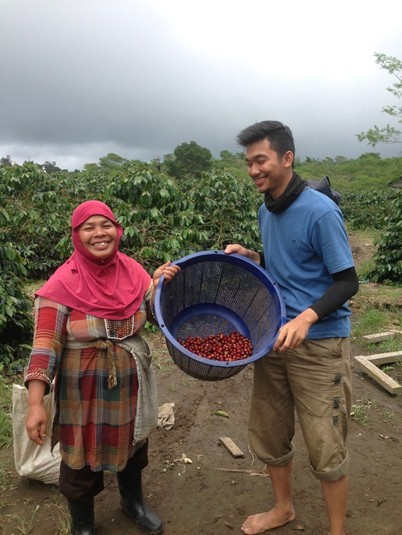
This is a coffee from Aceh Province, Sumatra’s most famous and prolific production area for specialty wet-hulled profiles. Unlike most coffee in the area, which is traditionally grown by hundreds of smaller farmers and gradually consolidated through processing and milling, Central Sumatera Coffee works directly with a small producer group to source this coffee in cherry state, bringing it down from the furthest reaches of Burni Telong and Burni Geureudong mountains, just West of Bener Meriah.
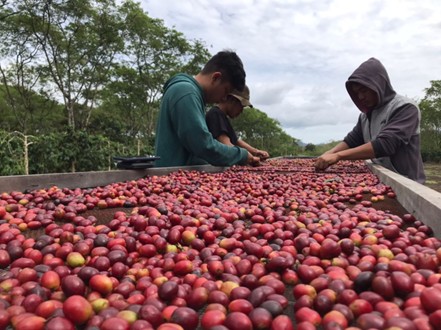
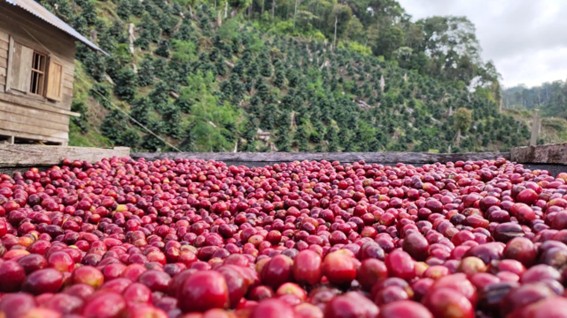
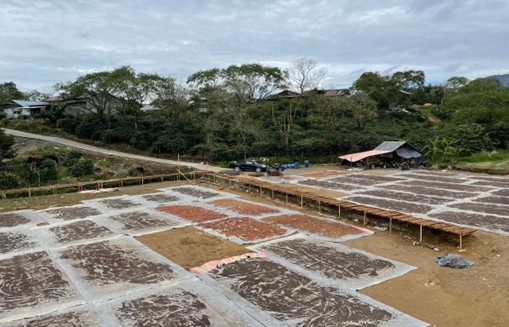
This coffee is dried on patios at CSC’s various processing facilities around Bener Kelipah. From the cherry stage, this coffee is first dried in a thin layer, then in successively thicker pilings with more agitation as the coffee dries. In the cooler climate of Bener Meriah, this drying process is stretched out for up to 20 days. Space is not as much of an issue at the tail end of harvest, and this coffee is harvested much later than the bulk of the harvest due to the elevation at which it is grown. Mount Burni Telong stands at 2645 meters above sea level, and while most of the mountain is inaccessible forest, some coffee is grown on the East and West flanks, the Southern flank being prone to lahar/lava flows and active volcanism.
The result is a super clean and even cup, with dense sugars and subtle but complex fruit flavors. This is not the ‘winey’ Sumatra natural you may be used to, but rather a new evolution using the coffee industry’s best practices for natural coffee processing alongside a heavy helping of patience and fastidiousness.
Sumatra’s Aceh Province
Aceh (pronounced AH-CHEY) is the northernmost province of Sumatra. Its highland territory, surrounding Lake Tawar and the central city of Takengon, is considered to be the epicenter of one of the world’s most unique coffee terroirs.
Coffee farms in this area are managed with the experience of many generations of cultivation, while also harmoniously woven into their surrounding tropical forests. The canopies are loud and fields are almost impenetrably thick with coffee plants, fruit trees, and vegetables, all of which are constantly flushing with new growth. Year-round mists and rain showers never cease, farm floors are spongy and deep with layered biomass, and almost every square meter of the region seems to exude life. Nothing is ever still. Including coffee ripening, which occurs ten months out of the year.
Central Sumatera Coffee
Central Sumatera Coffee (CSC) is a young group, with young leadership. It was originally founded in 2015 by Enzo Sauqi Hutabarat, then a University student with family ties to Bener Meriah. Aware of the growing demand across greater Indonesia for Sumatra’s best coffees, he gravitated toward Aceh as a culture and potential business environment. Until 2020 CSC only sold coffee domestically, but starting in 2021 they began to export as well, selling bits of coffee to the Middle East, Europe, Asia, and finally, in 2024, the United States, via Royal Coffee, for the first time.
CSC buys coffee from smallholders like a typical processor does. However, CSC also operates three large estates of about 100 hectares each: one in Bener Meriah, where this lot was produced; as well as two others in North Sumatra province, near Lake Toba. Their farms are organized varietally, allowing them to maintain unique genetic separations during harvest and processing.
Typical smallholder coffee in Aceh tends to be a blend of cultivars, most of which are catimor hybrids, and this gives much of the area’s coffee a set of common characteristics that can be hard to transcend for a single producer. In CSC’s case, they have the genetic isolation, and the volume from such a large estate, to help them produce something unique. Even with similar processing styles as the collectors and coops around them.
Green
Green Analysis by Isabella Vitaliano
This coffee has an iridescent quality in the cup profile, and the green specs are a great match. Density is slightly below average with moisture content and water activity in average ranges. Most of the coffee’s screen size sits in the 16-19 range, be sure to check for evening roasting. Green specs are in ranges we would expect from this coffee and origin, and we see the work of small holders involved reflected in the final product. When tasting, we found this coffee tasted best once rested and we preferred it through a filter more than on the cupping table.
Diedrich
Diedrich IR5 Analysis by Doris Garrido
When roasting a Sumatran coffee, I usually start with a clear plan for approaching wet-hulled beans, a process I really enjoy for its unique roasting dynamics and signature heavy body with bold spice notes. But this lot is something entirely different: a slow-dry natural. Considering how rare and labor-intensive natural drying is in Sumatra, this coffee is truly special, and the hard work put into it makes the results well worth a taste. Ever since we first featured this coffee on The Crown Jewel menu, its complexity has only improved year after year.
On the roasting side, processing always dictates how we handle the heat. With wet-hulled coffees, I typically opt for a long soak and extended drying phase while stretching Maillard as much as possible. For this slow-dry natural, however, I charged at 420°F with a one-minute soak, then applied full energy (100% gas) to build momentum into Maillard. At 316°F, I cut the gas to 0 for about two minutes to protect the delicate beans from scorching, control the caramelization rate, and maximize sweetness. This resulted in a 4:21 drying phase and a 3:41 Maillard phase. For airflow, I increased it to 50% as the roast approached First Crack, then bumped it to 100% after cracking to clear out smoke.
I kept the development time concise—just enough to finish caramelization while preserving the clean, vibrant fruit flavors inherent to the natural process. In the cup, this translates to a rich, structured body anchored by dense base notes of cacao nibs, hazelnut, milk chocolate, dates, and marzipan. This sweetness is beautifully balanced by bright, clean accents of pear and jicama, finished with a refreshing burst of blackberry, grapefruit, and subtle herbal spices
Aillio
Aillio Bullet R1 IBTS Analysis by Evan Gilman
We use the RoasTime app and roast.world site to document our roasts on the Bullet. You can find our roast documentation below by searching on roast.world, or by clicking on the link below. Take a look at our roast profiles below, as they are constantly changing!
This phenomenal coffee returns to us in its second year of production. After meeting Enzo in 2023 through a close friend in Medan, we have carried coffees from his company Central Sumatera Coffee, anticipating their arrival with bated breath each time.
Natural coffees from Sumatra are no longer the rarity they once were, but finding a consistent one without heavy fermentation notes or the divisive ‘winey’ profile is still a tough job. Enzo and team have once again prevailed. The attention to detail in processing shows, and its presence extends to the experience roasting. From last year’s crop, I knew that this coffee would have phenomenal texture, and I wanted to play that up in the roaster.
I started with 455F charge temperature, P8 power and F2 fan – pretty standard stuff. At turning point, I increased fan to F3, and at peak rate of change, I adjusted power back to P7 in an effort to extend Maillard. It worked. I increased fan to F4 later on, then reduced power to P6 before first crack to really stymie any of the typical runaway problems that natural coffees can give a roaster. I continued subtracting heat from the equation, finally reaching P4 and F7 before dropping the coffee into the cooling tray at 10:06 / 398F; a pretty long roast, all things considered.
At first I was disappointed in the cup. I thought to myself that I could have roasted faster or focused more on Green/Drying than on Maillard. As the cup cooled, I was justly rebuked for letting my train of thought pass that junction. Dried raspberry brightness came through clearly as the cup cooled, and a custardy vanilla flavor pervaded through until the end of the flavor experience. There’s a black tea tannic nature to this coffee, and a tart hibiscus finish as well.
This coffee is going to perform well in any context, but I’d love to see it as an espresso. The thick and coating mouthfeel will certainly be a star whether in a cappuccino or as a straight espresso. CSC does it again!
You can follow along with my roast here at roast.world: https://roast.world/egilman/roasts/LxEmpw-iIzqirBnMFOe_v
Brew
Brew Analysis by Katie Briggs
I started brewing this coffee at a pretty standard recipe, at least for me. I did a dose of 19g, and ground on a 10, and brewed it on the V60 cone brewer. I did an initial 50-gram pulse of water and let it bloom for 40 seconds. This brew turned out a bit heavy on the body, with a TDS of 1.51, and also had some bitterness to it. I wanted to sweeten it up a bit and soften the body, so for the next brew I coarsened the grind to 11 to achieve that.
I liked that next brew a lot more! It was much sweeter and more delicate; we got notes of milk chocolate, orange, jasmine, and peach. I liked the complexity of this brew a lot and the acidity was perfect.
I did one more brew at a lower dose, to see how it would taste. I did the same brew as the last one, but at a dose of 18.5g. I also liked this brew a lot! It was a little more delicate on acidity; we got notes of chocolate cherries, chamomile, and peach.
Overall, this coffee was very floral and fruity, and delicious! I would recommend a coarser grind with an average to higher dose on a conical brewer. But either way, you’re in for a delicious cup!
espresso
Espresso Analysis by Joshua Wismans
Sumatran coffee has been a staple espresso blender for as long as I can remember. The wet hulling process generally makes for a sweet, fruity, and chocolatey profile. With this slow-dry natural, that classic profile remains, while the attention to detail in the growing and processing elevate this coffee to a delicious single origin.
Our first recommended profile is built around a higher dose at 19.5 grams and a moderate yield of 40 grams. Pulling around 25 seconds, we found a profile that allows for the classic dark fruit notes to mary with a zesty orange acidity and complex herbal notes. Look for fig, honey, basil, and rose in this profile.
Our second profile stretches out the coffee a bit more. Using an 18 gram dose and 42 gram yield, more sweet lime, pomelo, raspberry, and cane sugar came through in the shot.
Again, this is a delicious coffee on espresso that reminds you why Sumatra has been a part of espresso blends for so long, while also offering more for the contemporary palette, highlighting citrus and sweet florals.
Related Coffee
Chocolate, strawberry, stone fruit, baking spice, and strawberry
Oakland 46 Boxes
Crown Jewel Kenya Natural Ndiaini Factory Nyeri
16TY0014 – 39976-1 – SPOT RCWHSE
Chocolate, strawberry, stone fruit, baking spice, and strawberry
Spot
46 Boxes
$248.35 per box

Lavender, lemon, strawberry, floral, and berry jam
Oakland 63 Boxes
Crown Jewel Uganda Natural Kigezi Valley
39619-1 – SPOT RCWHSE
Lavender, lemon, strawberry, floral, and berry jam
Spot
63 Boxes
$267.84 per box

Berries and cream, lemon, raspberry, red wine, and allspice
Oakland 42 Boxes
Crown Jewel Uganda Anaerobic Natural Kigezi Valley
39620-1 – SPOT RCWHSE
Berries and cream, lemon, raspberry, red wine, and allspice
Spot
42 Boxes
$276.91 per box
Black Tea, caramel, lemongrass, passion Fruit, apricot
Oakland 6 Boxes
Crown Jewel Burundi Honey Peaberry Heza Washing Station
38863-1 – SPOT RCWHSE
Black Tea, caramel, lemongrass, passion Fruit, apricot
Spot
6 Boxes
$255.49 per box