
Editor’s Note: I first encountered Phyllis Johnson’s mind in 2020, working behind the scenes on Royal Coffee’s webinar Race & Specialty Coffee. I sat in on some of the earliest conversations that would eventually become the Coffee Coalition for Racial Equity. I left those calls changed. There’s a quality to the way Phyllis thinks and speaks that makes you feel the weight of what’s at stake, and the possibility of what’s still ahead.
Six years later, The Crown just hosted the first Brewing for Equity Fellow, Martell Mason of Sepia Coffee. It felt like the right moment to revisit that conversation, to ask Phyllis what she’s learned about leading something this meaningful, and what she hopes the industry is finally ready to hear.
Phyllis Johnson has spent decades doing the kind of work that rarely comes with a clear job title. She founded BD Imports, one of the few Black-owned specialty coffee importing companies in the country. She co-founded the Coffee Coalition for Racial Equity (CCRE), an organization built to address structural inequities in the coffee supply chain and create real pathways for Black and brown professionals. And she launched Brewing for Equity, a fellowship program rooted not just in career development, but in the deeper, harder work of adaptive leadership.
What makes Phyllis singular isn’t just the volume of what she’s built. It’s the clarity of why. She doesn’t talk about diversity as strategy or inclusion as brand positioning. She talks about creativity, about what an industry loses when it only makes room for one kind of person, and the immense possibility once that changes.
We spoke about legacy and what it actually means to lead. Not on the good days, but on the ones when inspiration is nowhere in sight.
Legacy, Identity, and What Really Matters
We began by talking about how Phyllis is often introduced in coffee, and what she hopes people truly see when they hear her name.
Alexandra Pemberton: When people introduce you as a coffee luminary, what’s missing from that? What part of you do you hope people aren’t overlooking?
Phyllis Johnson: When I think about my life, my work, my legacy, I want to be thought of as someone who cared. But not just cared. Someone who acted. Someone who found a way to do something about the things that mattered. The meaningful stuff. Someone who looked beyond the coffee and saw the people. I know we all try to do that, but sometimes we fall in and out of it. I’d like to be thought of as someone who leaned into that most of the time, if not all the time.
“I want to be thought of as someone who cared. Not just cared. Someone who acted.”
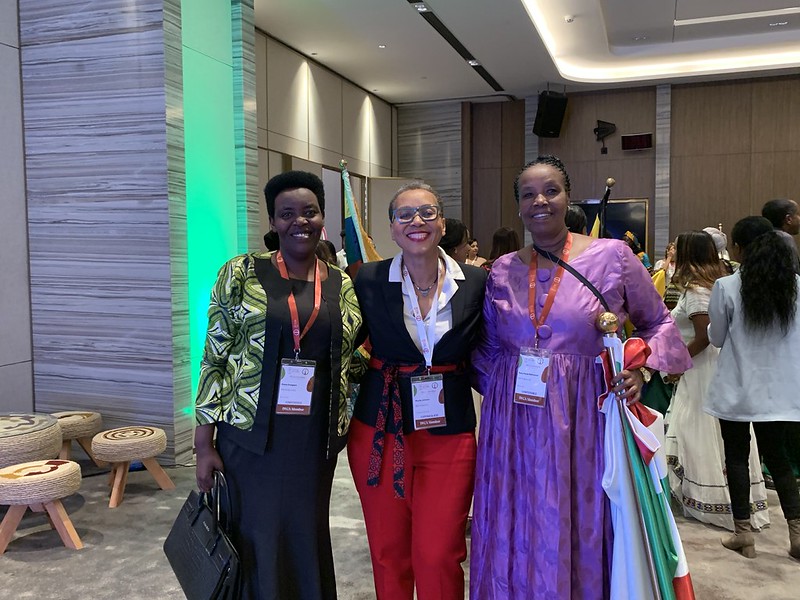
Phyllis Johnson, center, with friends from Kalico Coffee from Burundi representatives at the IWCA 20th Anniversary, Addis Ababa, Ethiopia Oct. 2023
Before the Programs Had Names
Before the Coffee Coalition for Racial Equity or the Brewing for Equity Fellowship existed, there were emotions and observations that shaped the work.
Alexandra: Before this work had a name, what were the feelings that led you to start?
Phyllis: Being alone. Not seeing myself. Thinking about other brilliant people who weren’t represented in this work. And seeing a lack of creativity, with everyone trying to fit into a norm and not stepping out. People of color, Black and brown people, we don’t tend to work inside a perceived box all the time because we’re often othered. When you use that to your advantage, you can be freer in your creativity. I saw an industry lacking a level of creativity. Sometimes you don’t know what’s missing because it hasn’t existed, but you know it in your heart because what you have isn’t it.
If we’re able to be more inclusive as an industry, we’re going to have more creativity. Better solutions. More joy and fun getting to know and experiencing each other’s ideas.
Trust, Intuition, and Becoming the Leader You Already Are
Alexandra: What has coffee taught you about your personal power that you didn’t fully understand before?
Phyllis: It’s taught me to trust myself. To lean into the lessons I’ve learned and the intuitions I’ve had. To stop looking for answers in other people. To step from behind the fears and insecurities and truly lead from experience and wisdom. That’s probably the greatest thing I’ve learned.
Alexandra: How did you start tuning into that inner voice?
Phyllis: I was asked to do a podcast with a friend from graduate school, and she asked me to go back and identify all the things I did in high school. I didn’t even remember. So I called a friend and asked her to read from my yearbook. She listed all these clubs. National Honor Society. Future Farmers of America. I even won best dressed. It made me realize I showed signs of leadership early. I think we are who we are from the start, and you’re on a journey of cultivating and carving out that person. For most of us, we are that person. You either pay attention to the voice inside you, or you don’t.
Introversion, Voice, and Learning to Lead Anyway
Phyllis describes herself as an introvert, but one trained early to speak.
Alexandra: Would you describe yourself as an introvert or extrovert?
Phyllis: I’m an introvert. I do not like to be engaged all the time. The idea of being around people can make me feel physically sick. But I grew up in a rural area, and in church you were required to write and deliver speeches from a very young age. I was groomed to speak. Everyone in the community was. I had to push past my introversion when I started a company. Someone at my high school reunion said, “Phyllis was always soft-spoken.” That’s actually who I am. But once I decided to be a business owner and travel globally, that didn’t serve me. I had to move into something uncomfortable and gain comfort being uncomfortable.
And what bothers me is when people say, “That’s not who I am.” That might be who you are now. But what if you became something more? To live more fully, we all have to become something more.
Leadership When Inspiration Disappears
Some of the most revealing moments came when Phyllis talked about leadership during low periods.
Alexandra: What does leadership look like on days when you’re not inspired?
Phyllis: People who seem inspirational, just know that their highs are high, and their lows are low. Sometimes leadership doesn’t look like charging forward. Sometimes it looks like standing still. Sometimes it looks like no movement at all. Just existing. Breathing in and out.
Sometimes it looks like someone else showing you a glimpse of motivation. A picture. A memory. You try to keep yourself ignitable so someone else’s fire can ignite you when yours isn’t burning. I question decisions. I question my skills. I never question the work itself. I don’t always see myself as a good leader. But that keeps me hungry for a better answer.
“You try to keep yourself ignitable so someone else’s fire can ignite you.”
Adaptive Leadership and Inner Work
This philosophy is at the core of Brewing for Equity.
Alexandra: You describe the fellowship as doing the inner work of adaptive leadership. What does that mean?
Phyllis: Adaptive leadership requires self-reflection. Understanding how your upbringing, your experiences, and generational thinking shape how you move through the world. You can’t change other people or systems, but you can change how you perceive them and how you function within them. Teaching fellows how to exist in the world they’re given, and how to nurture the internal forces they bring to the environment.
Selecting Fellows and Building Community
Selection was about far more than resumes.
Alexandra: What were you looking for in the first Brewing for Equity cohort?
Phyllis: We looked for people who understood community. That it’s bigger than they are. Black and brown individuals are far behind in terms of generational companies and social capital. We don’t often inherit networks. We wanted people serious about getting things done, but also building something bigger than themselves.
Burnout, Joy, and Learning to Pause
Alexandra: How do you keep from burning out?
Phyllis: I’ve burned out before. I’ve learned to engage other parts of life. Dancing. Sewing. Walking. I realized joy shows up when you pause. Writing thank-you letters to donors gave me pause. One donor has given $100 every month since 2021 without ever reaching out. It wasn’t until I sat down and paused to reflect, and write those letters, that I fully absorbed the magnitude of that gift. That gave me joy. And seeing the evolution from being the only Black American on a trip to Ethiopia to me taking an entire delegation of 13 Black and brown individuals there. That gives me joy. That gives me joy that I’m still learning how to hold.
Responsibility, Culture, and What Comes Next
Alexandra: What does responsibility feel like to you now?
Phyllis: Responsibility feels shared. It’s not all me. It looks like nurturing other people’s dreams, handling them carefully, and dreaming with them. Culture gives coffee staying power. It makes it more than a commodity. There’s so much we don’t know we don’t know. And I hope the industry moves from talking to showing. Show us the work. Show us the numbers. Show us what you’re building.
Get Involved
The Coffee Coalition for Racial Equity and the Brewing for Equity Program can be found on Instagram @coffeeforequity and online at coffeeforequity.org. For direct outreach, email info@coffeeforequity.org.
