
The coffee market has reached historic highs, leaving roasters and buyers facing difficult pricing decisions. Between rising shipping costs, unpredictable weather conditions, potential tariffs, and shifting global demand, many are wondering: How did we get here, and where do we go next? We sat down with Royal Coffee’s cofounder, Bob Fulmer, to discuss the factors driving today’s prices, what to expect moving forward, and how coffee businesses can navigate this challenging moment. At the end are some tips from our trading team.
Article Summary:
Global coffee prices have hit record highs due to rising shipping costs, drought in Brazil and Vietnam, aging farmers, increased consumption, and market speculation. Tariff threats add further strain. Prices will drop once traders expect future supply surpluses but are likely to stabilize above $2.00/lb long term.
Key Actions for Coffee Roasters & Coffee Buyers:
- Raise prices now to maintain profitability—by $2–4/lb for whole bean or $0.25–0.50 per cup.
- Track costs closely and buy smaller volumes more frequently.
- Consider flexible sourcing—origins like Sumatra and Ethiopia offer better value.
- Communicate increases transparently with customers and emphasize commitment to quality.
- Improve packaging efficiency, reduce waste, and streamline menus.
- Explore financing tools like Credit Key and attend The Crown’s “Navigating the Price Surge” for further guidance.
- Bottom Line: The market is volatile but temporary. Stay agile, adjust prices fairly, and manage costs carefully to weather the surge.
How did we get here?
Huge increases in shipping rates at the end of the pandemic got the ball rolling. Shipping rates tripled and quadrupled due in part to consolidation in the shipping industry. Several long-standing factors are also at play: rising coffee consumption in producing countries, crop losses due to rust and other plant diseases, an aging farmer population, and a shift toward farming alternative crops. Drought conditions in both Vietnam and Brazil lowered crop yields, and the coffee market started to climb, relatively slowly at first. Prior to coffee’s rally, the cocoa market had already soared to all-time highs. I think the cocoa rally emboldened similar speculation in coffee. Of all the factors driving the market, speculation by far is the reason the market gets too high or low and gets there too fast. It is a casino. At times, like right now, risk management becomes the biggest risk. And now, we are at historically high price levels and with threats of a pending trade war tariffs dominating the news.
I can tell you that Royal has weathered every bull market since the Brazilian black frost in 1974, which changed the coffee industry. The situation that we are experiencing now is just as disruptive, if not more so, and has more complexity. In our 47 years in business, we have navigated market fluctuations, recessions & economic downturns, coffee shortages, and pandemic shutdowns. We’ve always helped our customers weather uncertainty, and we will continue to be here to support you through these challenges.
When are prices going down?
When the perception of future supply surpluses triggers speculative selling. Said another way, coffee prices will come down when traders believe there will be more than enough supply in the future, leading them to sell off their positions. What goes up must come down—often faster than it rose. However, it’s important to remember that green coffee prices, like wages, have struggled to keep pace with inflation since the 1970s. When this rally ends, I expect prices to settle lower than their peak but remain above $2.00 per pound. With climate change impacting production, long-term challenges will persist.
Should I raise my prices?
Yes. Immediately, if not sooner. By how much? Enough to make a fair profit in which to run your business. At some point, there will be a terrific market downturn. When this happens, we can all reward our loyal customers with lower prices. I look forward to this opportunity. But for now, we have to hang in there and do our best to ride this out.
What will you do if tariffs pass?
We’ve been busy exploring our options. Our operations and logistics teams have been meeting to map out different scenarios, troubleshoot challenges, and explore solutions that minimize risk for everyone. Our goal is to reduce the impact as much as possible and try to ensure stability for our customers in this unpredictable market.
What should I do as a green coffee buyer?
Keep careful track of your inventory costs. To maintain profitability, your selling price must be high enough. You have to carefully manage this. Do not be afraid to raise your prices. Price gouging is a sensitive issue, but raising prices to cover costs is not gouging. We all will go broke trying to buy high and sell low. I suggest being flexible in your buying choices. For example, coffees from Sumatra and Ethiopia are shaping up to be relative values in this market. In high markets, buy less inventory all at once. Work with your trader to come up with a buying strategy. Above all, do the best job you can. Stay positive, be empathetic, and keep your eye on the bottom line. We know this: Royal only does well if our customers do well. We’ll do our very best to help you.
Tips from Our Team
How much should we raise our prices?
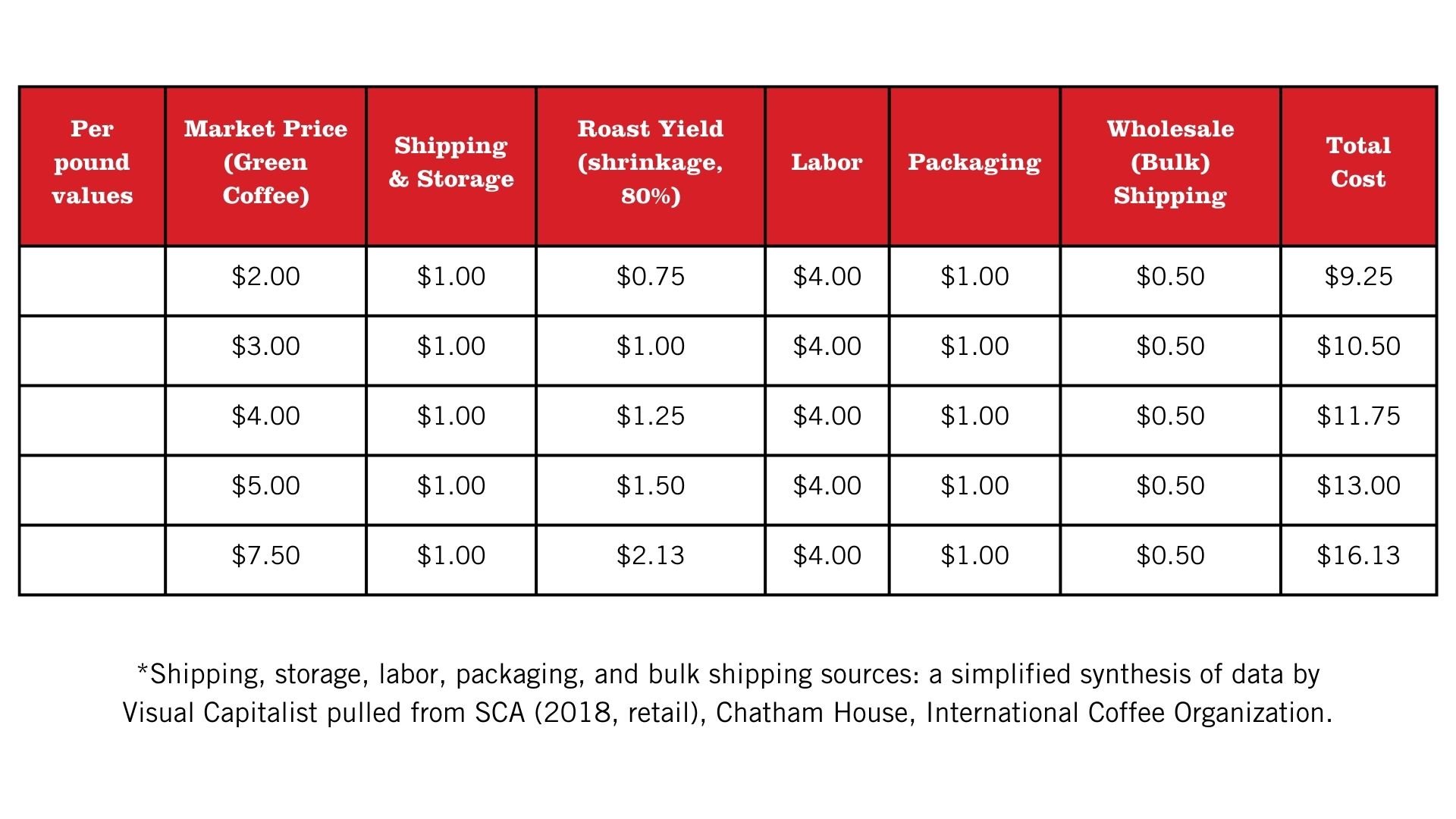
For whole bean roasted coffee, a $2-4 per pound markup at retail or wholesale should cover your increased costs of green coffee, if you haven’t changed your prices in the last year or so. For retail, a $0.25-0.50 per cup or drink should do it.
While the green coffee price is indeed a shock, and the expense of other inputs can be expected to rise – whether due do inflation, tariffs, logistics, or other factors – ultimately a relatively small increase in the price to your customers should cover your bases and be relatively painless to implement. You may find this cost matrix helpful:
Talking to Customers About Roasted Coffee Price Increases
Keep in mind that there’s probably some communication needed here for both staff and customers. There’s a limit to what any given market can absorb, cost-wise, and your customers (like you) may find sudden changes jarring.
Acknowledge the Increase with Honesty
“We want to be upfront with you—due to rising green coffee prices, we’re making some necessary adjustments to our pricing. We know price increases are never ideal, but we want to share why this is happening and what it means for your coffee.”
Explain the Why Simply
- Green coffee prices have reached and then skyrocketed past historic highs due to global supply chain disruptions, climate challenges, and increased demand.
- Coffee farmers are facing rising production costs, and sustainable pricing helps maintain their livelihoods.
- Shipping, labor, and operational costs have also increased, impacting the entire coffee industry.“Like many other businesses, we’re experiencing rising costs at every level, from sourcing to roasting to shipping. Our goal is always to provide you with the best coffee possible while ensuring sustainability for both farmers and our team.”
Reassure Them About Quality and Commitment
“Rather than cutting corners on quality, we’re choosing to maintain the exceptional coffee you know and love. We remain committed to sourcing responsibly, roasting with care, and providing you with the best coffee experience possible.”
Offer Perspective on Future Pricing
“While coffee prices fluctuate, we will always do our best to keep prices fair. If the market stabilizes, we look forward to passing those savings along to you in the future.”
Express Gratitude
“We appreciate your support and understanding. Your continued loyalty allows us to keep doing what we love—bringing you great coffee while supporting the people who grow it. If you have any questions, we’re always happy to chat!”
What Else Can I Do?
- Stay on top of your usage and be lean with inventory, buying 1-2 months out. You can review your Usage Tally in your Customer Portal, and our team is here to help you create an inventory strategy.
- Consider downsizing your menu and thinking about smaller packaging sizes for your whole beans, as a way to help customers absorb the costs more gently. If you’re selling whole beans by the pound, consider 12oz packaging.
- Consider reducing your drink sizes and upcharge for additional shots in lattes, for example.
- There’s possibly an argument here for upgrading your coffee quality. If historically you’ve settled on mid-tier coffees to anchor your menu, the price difference between these and a discernably better cup value is less than it ever has been. It’s possible you could stand out from a crowd of mediocre coffee by featuring a premium product and signaling its value with an appropriate price point.
- Review and implement best shipping practices to avoid upcharges. We share some in this article “Sustainable Green Coffee Shipping Efficient Logistics Strategies”.
- If you need credit, consider B2B credit lending platforms, like Credit Key.
- Join us for Navigating the Price Surge, a gathering at The Crown to commiserate and share how we’re dealing with these tumultuous times.

Latest Articles by Royal Coffee
IEEPA Tariff Refunds: Where Royal Coffee Stands
CBP's new CAPE refund portal is live, and Royal Coffee has filed its Phase 1 claims. No refunds have been issued to date, and timing at the customer level remains...
Why Don’t We See More Organic Coffee?
Organic coffee didn’t disappear. It just stopped being the headline. While global demand continues to grow, specialty roasters have shifted focus to varietals, processing, and story, pushing organic into the...
Understanding The IEEPA Tariff Refund Process: What Coffee Roasters Need to Know
Recent court rulings around tariffs imposed under the International Emergency Economic Powers Act (IEEPA) have created understandable confusion across the coffee industry. In this article, we break down what the...
This is very helpful & well-crafted. Thank you!
I kept looking on your blog for such a post over the last few weeks.
Thank you for this level of care, support & dedication to your customers & the industry.
I very much appreciate the level of transparency, accountability & info that Royal Coffee is sharing via its website & online platform. It is extremely valuable to remote location roasters such as myself.
Royal Coffee, beyond showing great passion for coffee, is showing tremendous care for every player in the coffee industry, leading with integrity & inclusiveness.
I look forward to a follow-up article on this topic.
Many thanks!
P.S. I am a small micro roaster located on a small island, off a larger island, on the West Coast of Canada.
Nice job on this one. Super helpful messaging to customer and a real perspective on what’s happening. Thanks Bob. Thanks Royal!
Thanks! This was quality content for all at World Cup.
Thank you much for your information, as always very helpful.
Excellent and helpful information on how to inform our customers about the “why” of the price increase of our product. All at Royal, thank you for all you do and thank you for this.