
Crown Jewel Colombia Fermented Natural Pink Bourbon Juliana Guevara and Wbeimar Lasso
38643-1 – SPOT RCWHSE
Boxes 0
Warehouses Oakland
Flavor Profile Lemonade, cherry, lime, lemon, and hibiscus
Out of stock


Overview
Overview
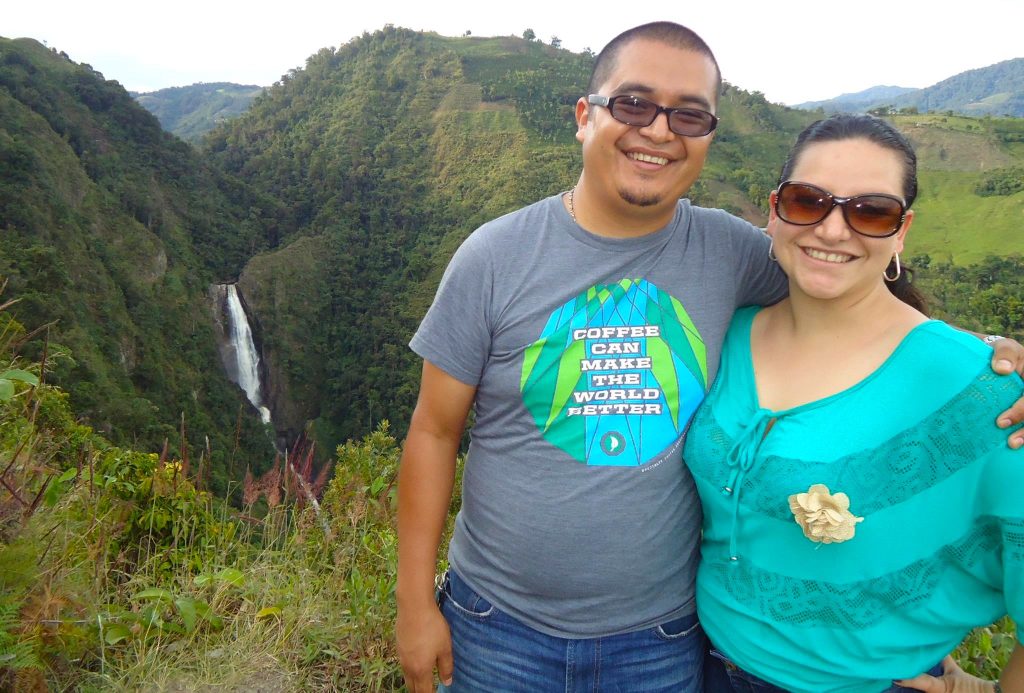
This is a moderate intervention fermented natural Pink Bourbon (aka Rosado) cultivar coffee from Huila, Colombia, produced by Juliana Guevara and Wbeimar Lasso on their farm, La Terraza.
The flavor profile is fruit-forward and punchy, with notes of pineapple, guava, orange wine, and hazelnut brittle.
Our roasters found, despite the fermented natural processing style, the coffee responded well to slightly faster, hotter styles of roasting.
When brewed as espresso, moderate doses yielded balanced cups, while updosed shots resulted in a slightly boozier profile.
Taste
Taste Analysis by Isabella Vitaliano
La Terazza is one of the producers that has consistently high marks and is a guaranteed buy for the Crown Jewel program year after year. Due to the diverse microclimate of the Huila department and the perfect weather patterns, coffee is available almost year around without any decrease in quality.
In September of 2025, the Crown team got the chance to meet with Juliana and Wbeimar during Development Stage, a 2-day event held at The Crown. The duo visited Oakland to discuss the intersection of the global coffee market and coffees sold in tiny quantities. While these coffees are not available by the ton, they do have impact. Impact to the communities that they serve, the roasters that sell them, and the consumers that drink them. Both of them are fiercely passionate and proud of the work they do, and it is obvious to anyone that speaks to them. After meeting them, it was even more exciting to receive offer samples from them, putting a name to the coffee and the personal investment that they feel in the lots they offer.
When The Crown received the initial offers, a quiet standout was this Pink Bourbon with notes like blood orange, fresh strawberry jam and pinot noir. On the cusp of botanical and ethereal, this soft but delicious coffee reminded the team that not all great coffees have to be the loudest on the table. Starfruit, kiwi, rosé and pineapple are the first notes you’ll experience in this profile. It opens up as it cools to some other dynamic flavors of white grape and dried oregano. Each drop in temperature provides a different experience and leaves you wanting more.
On the arrival cupping table, the team got notes of mango, quince, orange wine, hazelnut brittle and Hawaiian punch. Guava, cherry and pineapple seem to be the general consensus among the team. As it cools, you’ll find more tannin like qualities of those wine characteristics come out.
It can shine on pour-over as a steady but sure leader of your coffee menu and hold it down as a single origin espresso. With sweet fruit notes, it is not full like maybe some blackberry or dark fruit notes but the flavors that are present in this profile will please a range of coffee drinkers.
Source
Source Analysis by Charlie Habegger
La Terraza does it again, this time with a macerated natural of their beloved borbon rosado (pink bourbon), from one of the highest plots on Juliana and Weimar’s family farm.
Pink Bourbon, once thought to be phenotype of the centuries-old bourbon lineage, now known as a descendent of an Ethiopian landrace, expresses a rose-colored cherry pigmentation when ripe as opposed to the more common red, and sometimes yellow, cultivars. Southern Huila has become a kind of niche market for Pink Bourbon. Enterprising farmers have isolated, propagated, and promoted the cultivar, along with the idea of its uniquely delicate cup quality, which many roasters find to be true. We love the Pink Bourbon microlots from La Terraza, in all their expressions. Juliana has a strong affection for the cultivar, calling it “kind” and “generous” in the cup—amenable to different processing manipulations and always delicious.
Southern Huila
Huila is arguably Colombia’s best-known department for top microlots. Huila’s geographical accessibility, dense population of knowledgeable farmers, warm and subtropical forests, high elevations, and microclimate diversity have for many years sustained one of specialty coffee’s most beloved regions. The fact that most of the department is harvesting coffee almost every month of the year means that fresh coffee is always available.
Huila is a long and narrow valley that follows a winding gap between two large cordilleras of the Andes. Colombia’s 950-mile long Magdalena river has its source in southern Huila and has shaped the agriculture here for centuries. Uphill from the valley’s lush and picturesque lower slopes are a diverse array of coffee producing communities, often dramatically steep, and each with their own unique climate and history.
Finca La Terraza & Processing
Finca La Terraza is the name for the farm owned and managed by Juliana Guevara and her husband, Weimar Lasso. Juliana and Weimar are the duo behind the processor group Terra Coffee (more below). The farm is very passionately run—with a delightful and educational Instagram account no less (@Fincalaterraza). Finca La Terraza resembles countless farms in this part of Colombia, being only a few hectares in size and in a very specific microclimate that encourages coffee trees to fruit nearly the full calendar year—requiring constant monitoring and harvesting in small quantities. We regularly carry their coffees at the Crown.
La Terraza has a number of separated varieties, including Pacamara, yellow Colombia, and Gesha. The farm’s elevation means a cool climate with particularly frigid nights, which retards everything in coffee production that is temperature dependent, including the maturation of cherry on the tree, fermentation, and the drying of parchment.
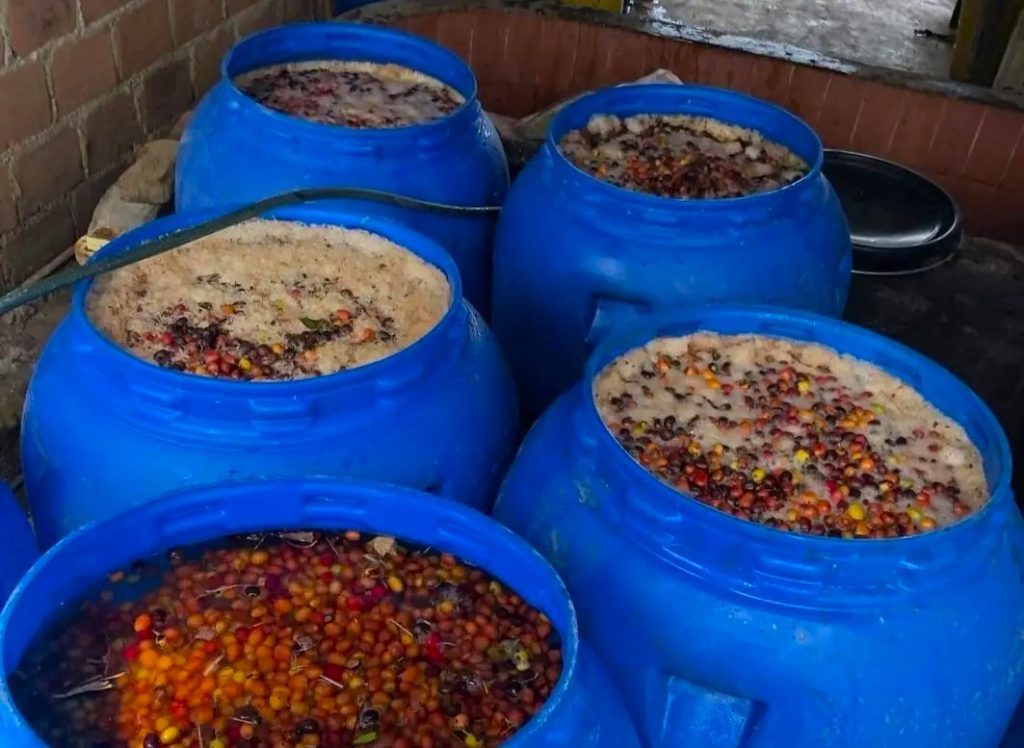
This natural Pink Bourbon was hand-picked by La Terraza’s permanent labor force, who are considered by Juliana and Weimar to be calibrated to each cultivar’s unique ripening patterns. Once picked, the coffee was macerated in full cherry in the farm’s fermentation tanks for 18-24 hours, and then immediately moved to exposed drying tables in full sun, where it spent 25-30 days to fully dry in the farm’s cold high-elevation climate.
Terra Coffee SAS – Beyond La Terraza
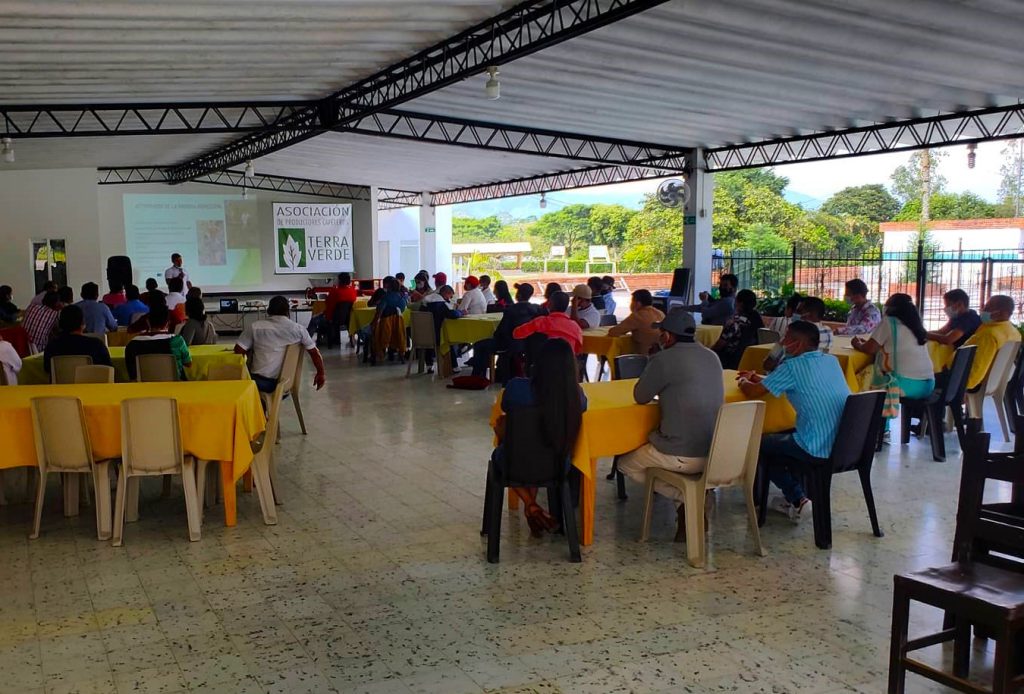
Terra Coffee SAS is a local producer group, established in 2016 by Weimar and Juliana, with a narrow focus on developing high quality coffees alongside select producers in the Huila and Nariño departments, and sharing them with the world. The small company manages one single producer association in each department where they work, “Ecoterra” in Nariño, with 140 producer partners, and “Terra Verde” in Huila, with 120.
For Terra Coffee SAS as a whole, quality in coffee is very rationally understood as a direct pathway to well-being for volume-limited, small coffee farming families. Driving their business model is an understanding that quality results from small harvests have direct impacts on not just the farm owner, but the many dependents on each small farm, including young children, older adults, and the women of the household performing essential labor that often goes unpaid. By increasing quality and placing microlots in the market, Terra Coffee SAS plans not only to increase prices to growers and their families, but also increase their sense of pride in the details of their work.
Green
Green Analysis by Isabella Vitaliano
Screen size is a moderate spread with most of the density coming from the 18-16 range, typical for Bourbon beans. The cultivar is named after the pinkish color of the cherries and in a semi-recent discovery, researchers found that it is not related to the Bourbon family and more genetically similar to Ethiopian landrace genetics.
Regarding the density, the coffee is in the above average range and has normal moisture content and water activity ranges. Be sure to check out the roasters’ notes to get advice on how best to roast this coffee.
Diedrich
Diedrich IR5 Analysis by Doris Garrido
Lately, while at Colombia’s Pink Bourbon cupping table, I can’t help but notice a distinct reminisce of Ethiopia’s delicate flavor. I know I am influenced by the knowledge of its genetics but in this case, it is more than that, the meticulous work of Julianna and Wbeimar Lasso adds a deep layer of complexity. On this coffee I found florals, delicate soft sweetness, blueberries and homemade strawberry jam, pink grapefruit, and blood orange.
I didn’t have a chance to taste the baristas brew, but Isabella Vitaliano filtered a cup using her signature minimalistic brewing techniques. Among all the favors I have mentioned, the natural process gifts us a clean, crisp acidity that reminds me of the Pinot Noir Rosé we used to process at Chimney Rock winery in Napa where I worked in a past life. Even the aftertaste leaves me thinking of those Pinot Noir tannins. It’s a delicate, complex coffee where I feel like tasting the bridge between Africa and America.
For this roast I preheated up the Diedrich drum at 440F. Knowing that was my only roast of the afternoon, I decided to charge and wait until I was getting close to the turning point to add gas, as I was worried the drum might be too hot for the beans. Turning point happened around 189F, on the higher side, but where I wanted to be, I cranked the gas at this point and held it close to 3 minutes. I then started stepping it down, eventually cutting the burners at 324F, allowing the build-up energy to do its magic. As we moved through Maillard, I was looking for a soft caramelization to capture that signature Pink Bourbon silky body. As I approached First Crack, I opened the full air flow, marked the first crack, and brought the burners back slightly to help finish the roast. My totals were 4:12 in drying, 3:20 in yellowing, and 1:47 in post development, for a total roast time of 9:19 minutes.
Soon, this coffee will be hitting The Crown menu as an espresso. Stop by and have a taste!
Aillio
Aillio Bullet R1 IBTS Analysis by Evan Gilman
We use the RoasTime app and roast.world site to document our roasts on the Bullet. You can find our roast documentation below by searching on roast.world, or by clicking on the link below. Take a look at our roast profiles below, as they are constantly changing!
Absoultely every time a Pink Bourbon coffee comes in, I’m all smiles. Natural, cofermented, washed… it doesn’t matter! I’ve yet to be disappointed with a Pink Bourbon arrival for Crown Jewels.
This particular natural was supremely bright and refreshing. I wanted to harness that profile while also providing a counterpoint and complementary set of flavors from what is at base so beautiful.
As stated above, my roast was still hot and fast, but I did temper the beginning of roast a bit in order to tone down the acidity just a touch. Starting with 464F charge temperature, I opted for a slight ‘soak’ (though that’s a bit of a misnomer on the Bullet) by only adding P6 power at the beginning. Shortly after, I increased power to P8, and then fan to F3 from its original F2. At peak rate of change I added fan to F4, which is much earlier than I generally choose to increase airflow. I even lowered power to P7 earlier than usual. At 5:30 / 354F I decided to do one better: increase fan to F5 for extra extra airflow going into first crack. My only other moves were to reduce power to P6 and P5 through post-crack development. Enhanced airflow can really move some coffees along (generally, denser ones), and this coffee was no exception.
I spent the majority of this roast in Maillard, and this really came through in the flavor profile. I found that that in comparison to Doris’ roast above, I got some creamy texture and tasty caramelized notes beneath the overtones of watermelon, raspberry, and Meyer lemon curd. Honestly, you’re going to have a fine time roasting this coffee in whatever style you usually plot. It has flexibility in spades, and I found that it kept getting tastier as it rested with the peak being around day five off of roast.
Looking for a coffee to show off to your friends and family, or just one to get you these last few weeks into the start of spring? Look no further, and quaff with confidence.
You can follow along with my roast here at roast.world: https://roast.world/egilman/roasts/yZi3IH9m7Py0htA-xlt6k
IKAWA
Ikawa Pro V3 Analysis by Isabella Vitaliano
Our current Ikawa practice compares two sample roast profiles, originally designed for different densities of green coffee. The two roasts differ slightly in total length, charge temperature, and time spent between color change in first crack. You can learn more about the profiles here.
An Ethiopian cultivar from Colombia with high density, low moisture walks in the bar… what profile do you serve it? Not a trick question like you may think.
True to the specs, the team found that the high-density profile really showcased this coffee to its full potential with full maraschino cherry, deep jammy flavors and pineapple acidity.
A milder version of this coffee was display in the low density profile with some nice acidity and warming herbal notes coming through. I highly recommend trying out the high density profile of this coffee, but really both are great. This is a wonderful coffee that has t ability shapeshift as you need.
You can roast your own by linking to our profiles in the Ikawa Pro app here:
- Roast 1: Low Density Sample Roast
- Roast 2: High Density Sample Roast
Brew
Brew Analysis by Tim Tran
La Terraza continues to impress with coffee excellence! This Colombian Pink Bourbon had me striving to really squeeze all the coffee goodness in my brews – something that really attests to how packed with tasty flavor this coffee carries!
Ultimately I favored brews that showcased high clarity in flavor due to the dynamic range of flavors this coffee expressed in between different sweetness intensities, fruit and florals, and clean acid. There was a lot to taste in the cup and as I found points to parse and process this truly taste-full coffee.
My favorite brew pushed grind fineness to really bring extraction up, while still providing plenty of brew clarity for extended flavors to really shine. Made with a moderate dose of coffee with a moderately fine grind setting, this brew hit about 20% extraction, showcasing hibiscus florals, sweet lemonade, and confectioner’s sugar, across a fairly silky brew. This brew really had a nice dynamic range too, extending the sweetness as it cooled.
I found myself enjoying this same dose of coffee at a moderate grind setting too, perhaps a testament to the flavor range this coffee is capable of. Moving to the coarser grind setting brought this brew’s total extraction down, but the flavor expression shifted to notes of rose, baker’s chocolate, and cherry, while still preserving some of those fun lemonade notes.
Even in other brews that were not necessarily favorites, the shift in balance and expression were a neat exploration. Maybe the real lesson here is that this coffee is so flavorful there doesn’t seem to be a particularly wrong way to brew this coffee. For instance, I found that creaminess and confectioner’s sugar notes were elevated when made on a flat-bottom brewer, while still keeping some of those punchy citrus notes.
Always a treat to brew some great coffee from La Terraza and this coffee proved no exception. My recommendation is a moderate dose with a fine grind setting on a conical brewer, but there really is a great amount of flexibility in how you approach this coffee. Pick some up and enjoy!
Espresso
Espresso Analysis by Alisha Rajan
“You belong to me, rose, like everything that exists on earth, and the poet cannot close his eyes to your burning cup, close his heart to your fragrance.” -Pablo Neruda, from the Elemental Odes
Elegant and unabashedly romantic, this Pink Bourbon from La Terraza has stolen our hearts here at the Crown. Refreshing pink lemonade and cherry cordial dance with the sweetness of pineapple and the creaminess of a tres leches cake.
At lower doses, this coffee brings forth punchy fruit notes and an intriguing lemongrass/green apple acidity accompanied by pleasant pastry-like elements. My favorite shot came in at an 18.0g dose, 36.9g yield, extracted in 30 seconds. This shot was the most pastry like of them all, reminiscent of a tres leches or pineapple upside down cake. Rounded out with a hint of caraway seed, ripe peaches, and freshly squeezed orange juice, this one was unforgettable.
Another shot I was delighted by came in at an 18.7g dose, 39.3g yield, extracted in 30 seconds. This one brought forward more boozy fermented character, reminding me of a brandy-soaked black forest cake. Other notable flavors were rose, strawberries and cream, toffee, and white wine.
Overall, I recommend a moderate dose and 1:2 ratio for dose to yield for the best extraction. A conservative recipe allows for the optimal balance of sweetness and body. If you prefer more booziness, I recommend dosing up to around 19.0 grams and maintaining the extraction time at around 30 seconds. This coffee is versatile enough to be extracted at a range of doses and times yet maintain its fruit forward sweetness and remarkable body. The type of fruit and fermented character can vary depending on the recipe, yet I found every shot to be complex and very palatable.
Soft and generous in its expression, this coffee is a beautiful ode to its cultivar, terroir, and producers. Supremely lovely in all its facets, this one will linger in our hearts indefinitely. Wishing you sweet and happy tasting.
Related Coffee

Black Tea, caramel, lemongrass, passion Fruit, apricot
Oakland 10 Boxes
Crown Jewel Burundi Honey Peaberry Heza Washing Station
38863-1 – SPOT RCWHSE
Black Tea, caramel, lemongrass, passion Fruit, apricot
Spot
10 Boxes
$255.49 per box
Banana Bread, plum, rosemary, cocoa Nib, and toffee
Oakland 41 Boxes
Crown Jewel Yemen Anaerobic Natural Sharqi Haraz Cooperative
39818-1 – SPOT RCWHSE
Banana Bread, plum, rosemary, cocoa Nib, and toffee
Spot
41 Boxes
$710.39 per box
Orange blossom, red wine, baker's chocolate, and black tea
Oakland 19 Boxes
Crown Jewel Yemen Washed Sharqi Haraz Cooperative
39817-1 – SPOT RCWHSE
Orange blossom, red wine, baker's chocolate, and black tea
Spot
19 Boxes
$580.58 per box
Lemon, floral, hibiscus, rosemary, and apple
Oakland 59 Boxes
Crown Jewel Ethiopia Anaerobic Natural Rue Co-ferment Banko Chelchele
40654-1 – SPOT RCWHSE
Lemon, floral, hibiscus, rosemary, and apple
Spot
59 Boxes
$358.51 per box