
Crown Jewel Colombia Washed Java Huila
35997-1 – SPOT RCWHSE
Boxes 0
Warehouses Oakland
Flavor Profile Basil, orange, cherry, lemongrass, and plum
Out of stock

Overview
Overview
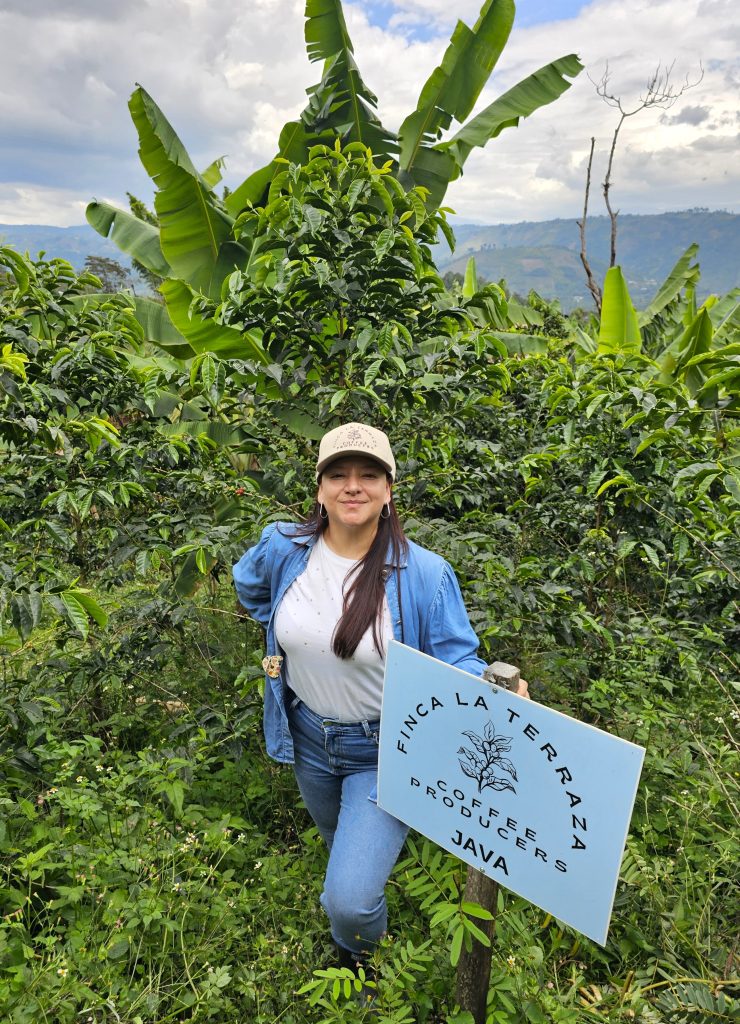
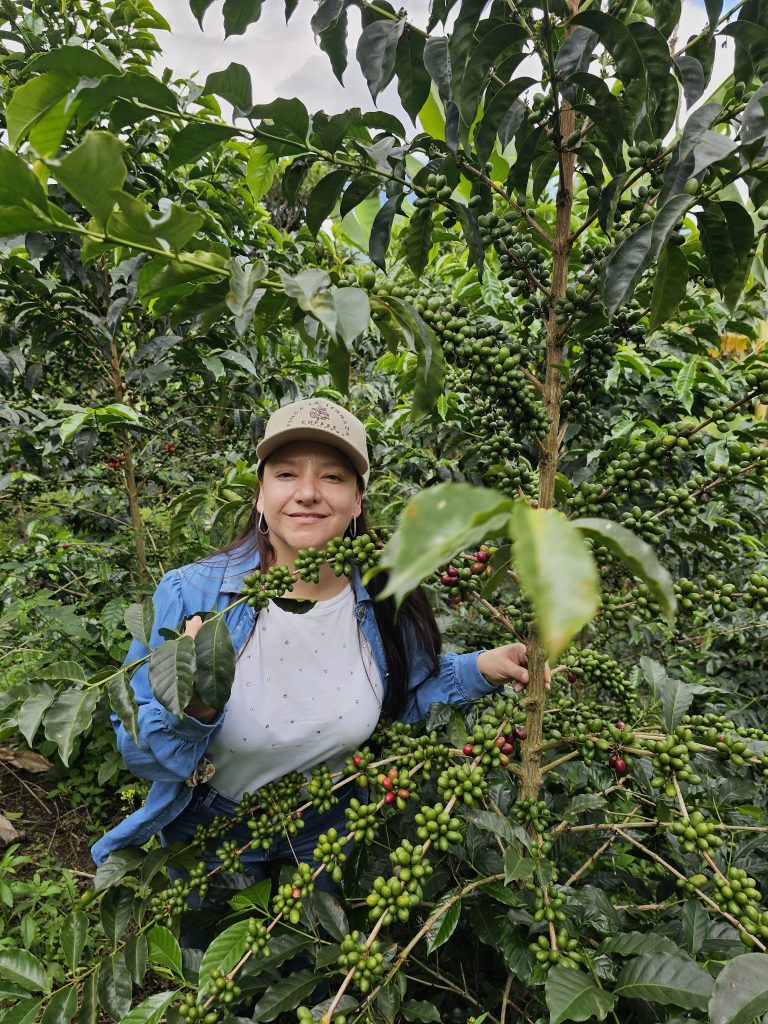
This is a low intervention washed Java variety coffee from Huila, Colombia, produced by Hazel Juliana Guevarra (La Terraza), Hernán Calderon (Finca Bilbao), and Albeiro Ordoñez (Finca Buena Vista).
The flavor profile is intriguing and chuggable, with complex floral and citrus notes. We taste sweet basil, lemongrass, orange, and cherry.
Our roasters found stretching out the Maillard reactions yielded additional complexity and balance.
When brewed, our barista team found the coffee very user-friendly with lots of delicious brew specs. We especially liked conical pour-overs with slightly finer grinds, and espresso extractions with slightly higher-than 2:1 ratios.
taste
Taste Analysis by Chris Kornman
It’s not as obvious, ostentatious, or ornate, but this coffee hints at its origins just like Gesha, Pink Bourbon, and Sidra. It’s the florals – a dead give away to the IYKYK crowd – manifested here as hibiscus, lemon blossoms, lemongrass, bergamot, sweet basil, and hops. They’re not its only feature, nor even the most apparent, but they might be the most lauded.
Java’s a funny cultivar. You’d be forgiven for thinking it’s Indonesian in origin, and while it certainly has history there, that’s not where its story begins. Simply called “Abyssinian Arabica” in P.J.S. Cramer’s posthumous A Review of Literature of Coffee Research of Indonesia, it would seem the author (and longtime director of coffee research in Java) introduced seeds from mother trees directly from “estates in Abyssinia” (what outsiders called Ethiopia, at the time) in 1928. Still known locally in Indonesia as “Abyssinia,” (or as cognates “Adsenia” or “Abissinie”), it would next travel from Java to Cameroon, where the tree’s genetics were preserved and eventually taken to Costa Rica, soon spreading throughout the Americas. Morphologically similar to Typica, it’s often been mistaken for a relative, but World Coffee Research’s genetic fingerprinting validates its provenance as directly Ethiopian. At high elevations, like those in southern Colombia, it reveals itself by its taste – idiosyncratically floral and citric when processed as a washed coffee, as it frequently is.
This selection was grown on three separate plots and processed individually (and very traditionally, with minimal intervention other than standard depulping, fermenting, washing, and drying) before blending at the dry mill. Producers Hazel Juliana Guevarra (La Terraza), Hernán Calderon (Finca Bilbao), and Albeiro Ordoñez (Finca Buena Vista) have collaborated on a miniature masterpiece, a microlot of unexpected deliciousness.
A survey of cupping notes from the multiple tables and the dozen or so cuppers it’s been placed in front of here in Oakland gives us a picture of its taste profile. The coffee is sweet, floral, and citric. We taste lemongrass, pink grapefruit, basil, cherry, and loads of balancing caramelization flavors like brown sugar and chocolate.
The coffee, for me, tightrope-walks the line between utterly fascinating and irreverently chuggable. On the one hand, I’m intrigued by its complexity and balance, its effortless integration of sweet-soft florals with bright punchy lemonade-like acidity. On the other, I simply can’t be bothered to stop long enough to think about it too deeply; all I want to do is keep sipping.
Pairs well with dew-strewn porches and checkered picnic blankets. I won’t be mad at all if you make it chilled over ice.
Source
Source Analysis by Charlie Habegger, MasterCol, and Terra Coffee SAS
I tasted the test roast of this coffee at the Crown recently and enjoyed it immensely. It is a very clean, conventional washed process coffee, but with a huge range of zesty botanical flavors in the cup—from pink peppercorn to chamomile, juniper, lime, and fennel. If this sounds a little too “greenish” to you, imagine these flavors more like little garnishes on top of an otherwise sweet, tangy, totally drinkable washed Colombia, and you have a better idea of how good the coffee is. It’s subtle, no doubt about it, but still effusive. It is probably most expressive at a very light roast, but that’s my predictable opinion as someone who loves very light roasts.
This tiny lot is, paradoxically, a multi-farm blend. It’s a single cultivar grown and processed on three separate small farms, and the fully dried parchment was blended together. This is a fascinating way to produce coffees this uniquely good. Typically microlots, even in Colombia, are from individual producers, or at least centrally processed. Doing it this way takes a high level of synchronization across farms, in this case kilometers apart and in different microclimates. But the Terra Coffee team lives for these projects. They recruit ambitious growers interested in working together to put out compelling coffees at a scale greater than any one of them is capable of. We are very appreciative of this work.
Producers
HAZEL JULIANA GUEVARA – LA ARGENTINA – LA TERRAZA
Finca La Terraza is the name for the farm owned and managed by Juliana Guevara and Weimar Lasso, the duo behind the processor group Terra Coffee (more below). The farm is very passionately run (with a delightful and educational Instagram account no less, @Fincalaterraza). Finca La Terraza resembles countless farms in this part of Colombia, being only a few hectares in size and in a very specific microclimate that encourages coffee trees to fruit nearly the full calendar year—requiring constant monitoring and harvesting in small quantities. We regularly carry their coffees at the Crown.
The farm’s elevation means a cool climate with particularly frigid nights, which retards everything in coffee production that is temperature dependent, including the maturation of cherry on the tree, fermentation, and the drying of parchment.
La Terraza is a production facility that evokes the work of peasant hands, respecting the traditions and culture of the countryside. On the terrace, we work as a team and strive to ensure that the knowledge that has been cultivated for several generations, from our parents and grandparents, continues to generate new learning opportunities. On the farm, we grow Gesha, Java, Caturra Chiroso, Bourbon Chiroso, Pacamara, Yellow Bourbon, Red Catuai, Red Caturra, and Bourbon Rosado.
HERNÁN CALDERON – ACEVEDO – BILBAO
For more than 20 years, Hernán has dedicated his life to his coffee farm, a fertile corner nestled in the mountains where every dawn smells of damp earth and freshly roasted coffee. Together with his wife and two children, he has turned this land into a true life project, where family work and love for the countryside blend with a vision of the future.
Hernán is not just any coffee farmer. He is a restless, observant man, deeply committed to quality. Over the years, he has understood that the heart of coffee is in the soil, and that caring for and improving it is the key to obtaining exceptional beans. Therefore, he has incorporated sustainable practices such as the use of plant cover crops, always seeking to give back to the soil what it gives to his family: life and sustenance.
On his farm, in addition to growing the Java variety, Hernán has focused on specialty coffees. Among his lots, three gems stand out: the Bourbon Rosado, recognized for its sweetness and fruity profile; the exotic and sought-after Gesha, with its floral and citrus notes that have conquered the most demanding markets; and the robust Colombia, which offers consistency and body, perfect for those seeking a balanced cup. These varieties not only represent a commitment to quality, but also a strategy to diversify the estate and address the challenges of climate change and the international market.
ALBEIRO ORDOÑEZ – ACEVEDO – BUENA VISTA
Don Albeiro is a coffee farmer who, like many young people from the countryside, once thought his future lay in the city. For years, he tried to make his way away from the farm, but fate and his childhood memories guided him back to his true roots: coffee and the land where he grew up. Finca Buena Vista has been in his family’s hands for over 60 years, ever since his father, Don Luis Ordóñez, purchased it with effort and vision. Today, father and son work together with dedication and commitment, convinced that the countryside is not only the present, but also the future for them and their loved ones.
With a blend of tradition and innovation, they are renovating the farm and focusing on high-quality coffees. There, they grow specialty varieties such as Java, Caturra, Chiroso, Bourbon Rosado, and Castillo, seeking to offer a unique cup that reflects the love and work behind each bean.
Today Don Albeiro is convinced that his life is linked to coffee, and together with his father he leads the projection of Buena Vista towards a sustainable, family-oriented future full of pride in its origins.
Terra Coffee SAS – Beyond La Terraza
Terra Coffee SAS is a local producer group, established in 2016 by Wbeimar and Juliana, with a narrow focus on developing high quality coffees alongside select producers in the Huila and Nariño departments, and sharing them with the world. The small company manages one single producer association in each department where they work, “Ecoterra” in Nariño, with 140 producer partners, and “Terra Verde” in Huila, with 120.
For Terra Coffee SAS as a whole, quality in coffee is very rationally understood as a direct pathway to well-being for volume-limited, small coffee farming families. Driving their business model is an understanding that quality results from small harvests have direct impacts on not just the farm owner, but the many dependents on each small farm, including young children, older adults, and the women of the household performing essential labor that often goes unpaid. By increasing quality and placing microlots in the market, Terra Coffee SAS plans not only to increase prices to growers and their families, but also increase their sense of pride in the details of their work.
Processing
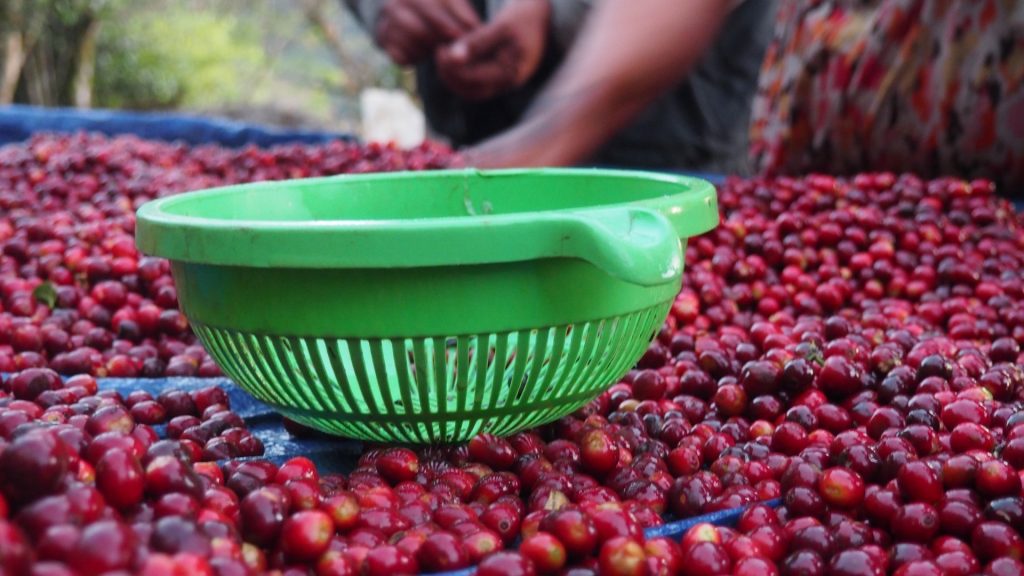
The coffee is manually harvested by the farms’ permanent workers, who carefully select only the ripe cherries, ensuring that only the highest-quality beans are processed. This careful harvesting process is essential to obtaining high-quality coffee, as the harvest is carried out at the optimal point of ripeness, ensuring a superior sensory profile. Once harvested, the coffee undergoes traditional pulping, where the outer pulp of the cherry is removed using manual or mechanized equipment. The coffee is then placed in fermentation tanks, which can be made of concrete or plastic, where it remains for 36 to 48 hours. During this time, the beans undergo a controlled fermentation process that eliminates mucilage and other residues that could affect the quality of the beans. Once fermentation is complete, the coffee is thoroughly washed using traditional methods, including agitation and clean water, to remove any impurities and leave the beans completely clean. The final step in the process is drying, which takes place in the sun for a period of 14 to 20 days using a solar parabolic dryer. This type of drying allows the coffee to retain its properties and dehydrate evenly and naturally, protecting its sensory characteristics while reducing the risk of moisture damage. This entire process, carried out using traditional and artisanal methods, contributes to the coffee maintaining a unique flavor profile, a reflection of the conditions and care with which it is grown and processed on the farm.
Huila, Colombia
The department of Huila, located in southern Colombia, is known for its rich biodiversity, mountainous landscapes, and high-quality coffee production. It borders several departments and is crossed by major rivers, such as the Magdalena, which contribute to its fertility. The region has a varied climate, from warm in the lowlands to cool in the mountains, allowing for the cultivation of various agricultural products, especially coffee. Furthermore, Huila is famous for its cultural heritage, with archaeological sites such as the San Agustín Archaeological Park, declared a UNESCO World Heritage Site, and its cuisine, which reflects the region’s Indigenous and mestizo traditions.
Huila is arguably Colombia’s best-known department for top microlots. Huila’s geographical accessibility, dense population of knowledgeable farmers, warm and subtropical forests, high elevations, and microclimate diversity have for many years sustained one of specialty coffee’s most beloved regions. The fact that most of the department is harvesting coffee almost every month of the year means that fresh coffee is always available.
Huila is a long and narrow valley that follows a winding gap between two large cordilleras of the Andes. Colombia’s 950-mile long Magdalena river has its source in southern Huila and has shaped the agriculture here for centuries. Uphill from the valley’s lush and picturesque lower slopes are a diverse array of coffee producing communities, often dramatically steep, and each with their own unique climate and history.
Green
Green Analysis by Isabella Vitaliano
Clean, crisp and a delight, this Java lot from Colombia is a beautiful expression of the cultivar with minimal intervention in the processing phase. These are larger beans with a slightly widespread 16-19 range. The density is a bit lower, and the moisture content and water activity are in average ranges.
Java is well known for its resistance to coffee berry disease and is a selection from an Ethiopian landrace. First brought to Central America in 1991 when it was introduced by breeder Benoit Bertrand. Java quickly makes its way throughout central America and Panama was the first country in the region to officially recognize the cultivar in 2016.
Diedrich
Diedrich IR5 Analysis by Doris Garrido
In my roasting life I believe I’ve gone through distinct phases: from initial observation of heat and air and the formulation of personal theories, to my now “slow down” approach. I recently tasted a roast from a roaster for whom I have deep admiration, and it allowed me to perceive a new dimension of clarity, revealing a perspective I hadn’t yet approached. This experience made it my goal to discover and translate this insight onto my Diedrich. After practicing I feel I achieved some of this with the roasting of this Colombian Java.
For this slightly low-density varietal, I tried a low impact start. My intention was to slow the heat absorption and precisely manage the gas application based on the coffee’s response to the heat. I charged the coffee at 375F, adjusting the gas to 60% within the first minute. As I observed the rate of rise approaching its maximum, I increased gas to 85%, then shortly after to 100%. After letting it work for 1.5 minutes, I began gradually reducing the gas: first to 60%, then a minute later to 30%. At this stage, with the energy actively driving caramelization, I introduced full airflow. First crack initiated at 381F at 8 minutes in the roast with a Rate of Change of 20F per minute. I allowed for a minute and 33 second development time before dropping the coffee at 397.8F.
The resulting aroma of this Java impressed me, I rarely call orange blossom so easily, yet it was distinctly present in the aroma, promising a remarkable sweetness. On the palate, this translated to a taste of fresh sweet pear, a citrus and pink lemonade, with a character of a well-crafted rose and a hint of rhubarb. The cup presented as tangy, clear and crisp but with a complex cake batter sweetness all integrated seamlessly. After tasting this roast alongside others from the same coffee but different machines I felt that adding the airflow earlier in the roast could further stretch caramelization and bring even more complexity to the sweetness.
Aillio
Aillio Bullet R1 IBTS Analysis by Chris Kornman
We use the RoasTime app and roast.world site to document our roasts on the Bullet. You can find our roast documentation below by searching on roast.world, or by clicking on the link below. Take a look at our roast profiles below, as they are constantly changing!
Evan’s in Indonesia this week so I got to play on the Bullet in his absence, and I had a nice time roasting this delicious Java variety coffee from southern Colombia.
I had a few goals for the roast, which included preserving floral notes while also leaning into the caramelized sweetness that brought balance to the cup. I only had a little bit of coffee, just 340g to work with so I’d need to make it count on my first try. Fortunately, the coffee was cooperative.
I like a pretty warm drum for starting my roasts, my preheat temp on the IBTS is 464F and 350F on the standard thermocouple. I tend to pay attention to the latter for my charge temperature and for the first half of roasting, then switching to monitoring the IBTS temps for Maillard and beyond, including any ROR data I might be interested in monitoring. This is a personal idiosyncrasy, not necessarily a recommendation, but it makes sense to me based on my experience with larger equipment, typically outfitted with standard J or K type thermocouples.
P5, F2, and D4 out of the gates, the coffee yellowed just before 4 minutes and I increased the fan up to P5 (maybe a little too much) to draw out the Maillard stage, yielding more than 4 minutes in color change. First crack began rolling consistently at about 8:00 of roasting and I dropped the power and increased the fan, allowing first crack to mostly finish in 1:50 of very low, slow development for a fairly light roast.
On the cupping table, it was a little brighter than Doris’ Diedrich analysis, slightly delicate with juicy pear and yellow peach flavors, a jammier texture, and nice marshmallowy sweetness. It wasn’t especially floral, but it was very sweet and clean. I’m taking the roast home with me to brew for the long weekend ahead, no complaints.
Given a second chance, I’d probably go for a slightly higher post-crack ROR and try to shorten the total roast time by 20 seconds or so, shooting for the same color but maybe a little more caramelized with a slightly higher end temperature. Overall, the coffee was pretty easy to roast and fairly predictable, rewarding my slightly clumsy attempts at Maillard extension with a very drinkable result.
You can follow along with my roast here at roastworld: https://roast.world/ckornman.wnD2/roasts/yw7MLn16VrCef-F3jPK7a
Brew
Brew Analysis by Tim Tran
Java as a place has strong associations to coffee; Java as a cultivar carries a fairly geographic lineage going back to the island of Java, to Cameroon, then to Costa Rica. This particular coffee comes to us grown in Colombia and was an absolute treat to brew. Unpacking this coffee gave me several delicious brews and it really felt like every brew excelled in different areas.
I started the brew analysis with a moderate grind setting with a moderate ratio on a conical brewer. This first brew had some pleasant plum, a little bit of currant, and some sweet herbal notes, reminiscent of basil. This first brew carried a rich mouthfeel with an almost confectioners-like sweetness. This coffee picked on a lovely sweetness as it cooled and struck a resounding balance between some soft citrus zest acidity and the developed brown sugar sweetness you’d hope to find out of a caramel-like coffee.
The next couple brews sought to push some of the extraction boundaries. Moving to a moderately fine grind yielded a more herbal-forward profile, with notes of lemongrass and highlighting sweet sun gold tomatoes. Brewing on a flat-bottomed brewer highlighted the herbal elements while still providing pronounced sweetness and richness of the coffee. Interestingly, the brews on both conical and flat-bottomed brewers, at the same dose and grind setting, yielded similar extraction parameters in TDS and extraction percentage. While not particularly indicative of any significant brewing guidelines, it made for an interesting observation of extraction in this coffee across drippers and served as a fun test of the difference in extraction profiles between the 2 drippers, with the conical dripper providing a touch brighter citrus and zest, while the conical dripper brought forward more of the herbal qualities in the coffee.
The last brew, I sought to crank the dose higher to 20 grams, for a ratio of 1:15, at a moderate grind setting on a conical dripper. At a high dose, the coffee was incredibly flavor-dense but still managed to hold balance, elevating more of the citrus to a focused flavor note. While at first I thought perhaps the coffee was too concentrated, I couldn’t stop coming back for additional sips and tastes, and especially as it cooled, this brew became one of my favorites. If anything, perhaps this speaks to the quality of solubility in this coffee – definitely a favorite of this season for me.
This was a fun treat for me to brew and every brew impressed! When brewing this coffee, ultimately, my recommendation is to aim for a moderate to moderately high dose with a moderate to moderately fine grind size on a conical brewer.
Espresso
Espresso Analysis by Asha Wells
Hailing from the lush, green landscapes of Acevedo, Colombia, this coffee left quite an impression on me. With a high degree of complexity, this coffee surprised me again and again. Just when I thought I had seen all it had to offer, it hit me with another yet unseen facet. This coffee is wonderfully clean, but has loads of out-of-the-box potential, and she’ll take you for a ride, if you’re so lucky.
A very strong start with my first recipe, a 19.5g dose, yielding 44g, at 25 seconds. This shot felt grounded and bright, with many a flavor to glean, the most apparent of these being sunflower butter, cacao, and dandelion greens. I drifted deeper into tasting and was surprised to encounter bursts of melon and the weight of body that reminded me of pho broth and brown butter, plus a subtle zest of lime. Outstanding.
Our second contender (my favorite shot) weighed in at 17.5g, with a yield of 38g and extracting in 26 seconds. Delicate and lithe, she danced across my palate, leaving notes of green mango and cashew in her wake. An immaculately balanced shot, fullness of clove or buttery chardonnay, with an herbal melody at the front palate resembling the likes of jasmine tea and pomelo.
Overall, I found this coffee to be extremely user friendly. Of all the shots I tasted, none were unpleasant, some just more delicious than others. Seems to me that these two profiles are just the beginning for this remarkable coffee.
Related Coffee
White Tea, basil, biscoff cookie, cacao, candied fruits
Oakland 43 Boxes
Crown Jewel Bolivia Organic Washed Yulissa Chambi
39122-1 – SPOT RCWHSE
White Tea, basil, biscoff cookie, cacao, candied fruits
Spot
43 Boxes
$220.94 per box
Cherry, grapefruit, apricot, floral, and lime
Oakland 33 Boxes
Crown Jewel Colombia Washed SL-28 Juliana Guevara & Wbeimar Lasso
38868-1 – SPOT RCWHSE
Cherry, grapefruit, apricot, floral, and lime
Spot
33 Boxes
$259.91 per box

Chocolate, bubbly, cherry, grape juice, orange
Oakland 39 Boxes
Crown Jewel Bolivia Organic Anaerobic Washed Yulissa Chambi
39121-1 – SPOT RCWHSE
Chocolate, bubbly, cherry, grape juice, orange
Spot
39 Boxes
$232.27 per box
Coconut, piña colada, mango, upside down pineapple cake, floral
Oakland 4 Boxes
Crown Jewel Colombia Carbonic Honey Mango/Coconut Co-Ferment Pedro Nel Salazar
38870-1 – SPOT RCWHSE
Coconut, piña colada, mango, upside down pineapple cake, floral
Spot
4 Boxes
$392.02 per box