
SUMATRA ORGANIC KPGLA GAYO MANDHELING GRADE 1
40932 – GrainPro Bags – Intend Ship: Jun 16, 2026 – RCWHSE
Bags 320
Warehouses Oakland


Grower
Smallholder farmers organized around Koperasi Pertanian Gayo Lauser Antara (KPGLA)

Altitude
1200 – 1500 masl

Variety
Tim-tim, catimor

Soil
Volcanic loam

Region
Jagong Jeget district, Aceh Province, Sumatra, Indonesia

Process
Wet hulled and dried in the sun

Harvest
September - March | May - July

Certification
Organic
This is a big-bodied, earthy and peaty coffee from a single cooperative in remote Aceh province. The Jagong Jeget district is further southwest than much of the coffee we source in Aceh, and this tends to impart a heftier, fudgier character to the cups that many roasters find indispensable in blends and darker roasts.
Sumatra’s Aceh Province
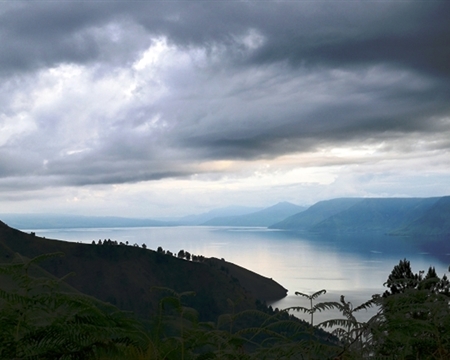
Aceh (pronounced AH-CHEY) is the northernmost province of Sumatra. Its highland territory, surrounding Lake Tawar and the central city of Takengon, is considered to be the epicenter of one of the world’s most unique coffee terroirs.
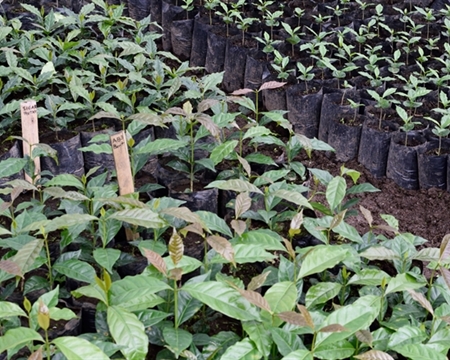
Coffee farms in this area are managed with the experience of many generations of cultivation, while also harmoniously woven into their surrounding tropical forests. The canopies are loud and fields are almost impenetrably thick with coffee plants, fruit trees, and vegetables, all of which are constantly flushing with new growth. Year-round mists and rain showers never cease, farm floors are spongy and deep with layered biomass, and almost every square meter of the region seems to exude life. Nothing is ever still. Including coffee ripening, which occurs ten months out of the year.
KPGLA Cooperative
The Koperasi Pertanian Gayo Lauser Antara cooperative (shortened to KPGLA), was first established in 2015 with 446 farmer members. KPGLA is located, along with its grower members, in the Jagong Jeget district, on the western end of the Aceh Tengah regency, whose transitional landscape allows both high elevation arabica and lower elevation robusta. Today the cooperative has just under 1,000 members from 6 different villages who collectively control over 1,100 hectares of farmland, shared between coffee and fruit trees like banana, jackfruit, avocado, and other subsistence crops.
KPGLA regularly distributes farming tools and cash dividends to cooperative members, as well as school supplies for families with schoolchildren.
Wet-Hulled Processing
Sumatra’s smallholder supply chain is a complicated process. Notably, processing is typically not overseen by a single individual or team; instead, coffee moves task by task through different parties before reaching its final, fully dried, state.
Coffee farms in this part of Aceh average 0.5-2 hectares each. Every village with cooperative members has a collector (or more) who receives fresh-picked cherry for processing each day. Once a batch of coffee has been depulped, fermented overnight, washed clean, and the parchment sun-dried to the touch, each collector then delivers the batch to one of the cooperative’s local hulling stations. It is here where the coffee is mechanically hulled of its parchment, leaving behind just the soft, high-moisture coffee seed (thus earning the term “wet-hulled”), which is then spread out on large patios and tarpaulins to continue drying until the coffee reaches an internal moisture content of 12-13%. Each handoff is orchestrated by the cooperative, and the members’ coffee is traced throughout each step of the chain. Final, dried coffee is winnowed by machine and repeatedly hand-sorted to Grade 1 standards prior to export.
“Gayo” and “Mandheling” terms
KPGLA, along with many local industries in the region, identifies itself as “Gayo”, after the Gayonese ethnic group which has long made Aceh their home, and which comprises a vast majority of farmer members.
Regional coffee distinctions in the northern provinces of Sumatra are interestingly all based on human ethnicity, rather than geography itself, which unfortunately has muddled the island’s traceability over time. “Mandheling” for example, is a broad label for a widespread cultural group in Sumatra and Malaysia and subsequently the broadest coffee trading term, applying to almost any chosen blend of wet-hulled coffees from across the northern half of the island. These terms are malleable, and it is often difficult to pinpoint a coffee’s exact origin without direct partnerships that allow buyers to trace the entire value chain themselves. So, it is helpful to work with exporters with a local supply chain, who themselves operate in the highlands and are personally invested in their community’s success.
Related Coffee

Cup notes available upon arrival
Oakland 123 Bags
HONDURAS ORGANIC COMSA SHG EP
37734 – GrainPro Bags – SPOT RCWHSE
Cup notes available upon arrival
Spot
123 Bags
$4.16 per pound
Cup notes available upon arrival
Oakland 116 Bags
HONDURAS ORGANIC COMSA SHG EP
37735 – GrainPro Bags – SPOT RCWHSE
Cup notes available upon arrival
Spot
116 Bags
$4.16 per pound
Lemon/lime, caramel, chamomile, dark chocolate
Oakland 267 Bags
GUATEMALA ORGANIC SHB EP
37997 – Ecotact Bags – SPOT RCWHSE
Lemon/lime, caramel, chamomile, dark chocolate
Spot
267 Bags
$4.72 per pound

Strawberry, dried apricot, watermelon, floral, sugary
Oakland 275 Bags
HONDURAS FT-USA ORGANIC APROCOMSA NATURAL SHG EP
38664 – GrainPro Bags – SPOT RCWHSE
Strawberry, dried apricot, watermelon, floral, sugary
Spot
275 Bags
$4.60 per pound