
Crown Jewel Timor Leste Organic Sabelo Café Brisa Serena Washed
35801-2 – SPOT RCWHSE
Boxes 0
Warehouses Oakland
Flavor Profile Caramel, brown sugar, grape, floral, and fudge
Out of stock
Overview
Overview
This is a low intervention washed coffee from Letefoho, Timor-Leste, produced by 11 smallholder farmers of the Sabelo group, organized around Cafe Brisa Serena.
The flavor profile leans into caramelized sweetness, full mouthfeel, and delicate floral, herbal and citrus notes. We found hints of vanilla ice cream, fudge, cardamom, and lemon curd.
Our roasters found that a gentle approach with lower heat at charge and even-handed heat application serves to profile this coffee well in a variety of roasters.
When brewed, the team recommends a conical brewer for a cleaner cup, as well as a moderate to high dose and coarser grind setting to preserve some of the more delicate citrus notes while maintaining the brown sugar/caramel notes.
Taste
Taste Analysis by Isabella Vitaliano
Coming from the island of Timor-Leste, this coffee goes through multiple rounds of extensive quality control to arrive at our warehouse. Café Bisa Serena is a social enterprise and exporter that has built infrastructure and systems within the area to support small farm holders.
The bulk of this coffee is close to a vanilla bean ice cream with toasted pine nuts and herbal aromatics. Fudgy and sweet, it’s the perfect treat for your spring and summer menu. Although the profile is super dense, it still has a complex lightness of honeydew melon, lime and orange in the mix.
On Evan’s roast of this coffee, we got even more thickness from this coffee like milk stout, tiramisu and pumpernickel. Berry notes support the coffee by bringing in more sweetness. We also got hints of cacao and cardamom. During the espresso analysis, Marie workshopped shots that range from lemon curd and grapefruit to sweet caramel and spicy florals.
This coffee is your all-around daily driver: good for drip, espresso, pour over, cold brew, the works. A crowd pleaser for the masses but also nuanced enough for customers that are looking for something more complex. Cheers!
Source
Source Analysis by Charlie Habegger and Evan Gilman
Timor-Leste, or East Timor, takes up the eastern half of the greater Timor island, part of the Indonesian archipelago and not far from the northern coast of Australia. It is a young republic with a long and chaotic political history, having only achieved full independence in 2002, after almost 500 years of consecutive occupations by the Portuguese, the Dutch, and Indonesia.
Timor-Leste’s coffee industry is small in overall scale but highly significant to the Timorese, 25% of whom rely on coffee production for their livelihood. The island’s inland forests also happen to be historically significant, being the origin of coffee’s most adaptive genetic cross—the Timor Hybrid—a natural breeding of local robusta and typica trees that was identified in the 1920s, and whose vigorous genetics can be found in countless Timor-based cultivars in almost every producing country today. The island’s isolation has also allowed for a unique preservation of endemic typica variety coffees, whose purity and diversity resembles that of nearby Papua New Guinea and expresses similarly in the cup.
The greater Timor island is sun-baked and humid along its coast, but the interior quickly rises to lush and rugged highlands, with sharp ridges and vibrant grass-covered slopes. The Ermera municipality is one of the island’s highest in elevation and includes its highest peak, Tatamailau. The villages in the mountain’s vicinity are where Café Brisa Serena (CBS), a social enterprise and exporter, has spent the last 10 years developing smallholder coffee value chains.
This coffee is produced by 11 select farmers from the Ducurai village, whose farmer community group is called “Sabelo”, a local word for “slaughter farm”, a title retained from generations ago when this area was the center of the local cattle industry. Sabelo was first established in 2010. The Ducurai village is just north of Tatamailau’s peak and Sabelo is one group in a small portfolio we import each year from CBS, who began by training remote smallholders in farm management and processing, and who is now a highly capable exporter with some of the best smallholder traceability in the world. Each year we receive a spreadsheet with farmer names and farm data, as well as parchment prices paid. This harvest Sabelo group farmers received $3.25 per kilogram of dried parchment, which after final dry milling is roughly equivalent to $2.11 per pound of exportable green coffee.
Coffee in Letefoho is not young. Trees have been tended to for decades, and due to the lofty, vine-like typica varieties throughout, coffee is often harvested by leaning long wooden ramps against the trunk so that pickers can access the sprawling canopy. Farms range between 0.5 and 1.5 hectares only and tend to be well-shaded by evergreen she-oaks (or Casuarina), a natural mulcher and nitrogen fixer. During harvest coffee is picked painstakingly by hand and processed at home on personal or shared pulping equipment, which is often hand-made using wood and textured metal discs.
After fermenting in small containers, the coffee is dried on raised beds and constantly sorted for quality. Many of the current harvesting and processing standards come directly from CBS, who has helped establish specialty protocols and invested in improvements to processing equipment. The addition of drying structures, for example, has greatly improved farmers’ ability to consistently meet quality standards for moisture content and water activity. In addition to coffee, Ducurai farmers also manage crops of taro and cassava, as well as pigs, goats, fowl, and cows, and many also have personal compost programs in addition to being organic certified.
Café Brisa Serena works with over 400 farmers in the Letefoho area. The organization was formed in close collaboration with Peace Winds Japan, a Japanese NGO that had been working in Timor-Leste’s coffee lands during the first decade after independence, when violence and crumbled infrastructure had disenfranchised many remote coffee communities. CBS continued the development work of Peace Winds, and in 2015 began a formalized specialty export chain. CBS also runs a café in Dili, the nation’s capital, where it promotes Letefoho’s specialty coffee to locals.
For more on CBS and Peace Winds Japan, see Evan Gilman’s interview with Armando de Araujo of CBS, here: https://royalcoffee.com/producer-interview-armando-de-araujo-from-cafe-brisa-serena-timor-leste/
Green
Green Analysis by Isabella Vitaliano
This is a dual cultivar lot, composed of both Timor Hybrid and Typica. Timor is one of the OGs in the coffee cultivar world, it is a hybrid plant that spontaneously occurred between Robusta and Arabica plant.
When you take a look at the green of this coffee, you’ll find it is mostly uniform and has a slightly darker emerald tone, with a good amount of silverskin still attached to the surface of the bean.
Moisture content is a little bit below average with a wider screen size spread from 19-16. Water activity is also a little bit lower than average and with a below average density, make sure to take care of this in the roaster. On the Ikawa analysis, we found that the light density roast supported the profile the best. Be sure to check out the roaster’s notes on how to handle it in larger machines.
Diedrich
Diedrich IR5 Analysis by Doris Garrido
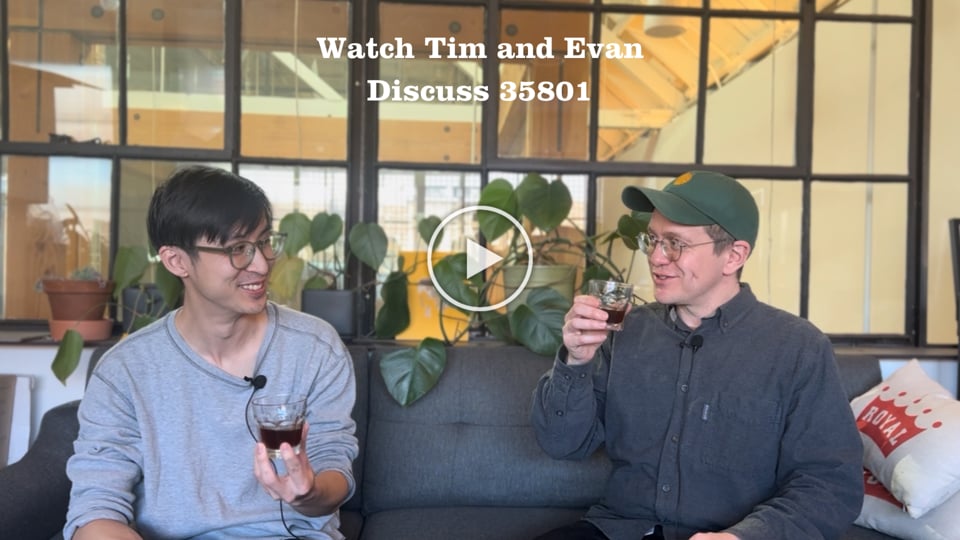
We’re happy to present our offer from Timor-Leste: a truly unique hybrid, born from the natural cross-pollination of Arabica and Robusta plants. This coffee offers an intriguing proposition: a Robusta baby that is believed to contain less caffeine than its Robusta parent, yet slightly more than its Arabica counterpart. Intriguing right? Taste wise, the roast I did of this coffee ended up with delightful contrast: smooth, creamy and buttery notes (I believe inherited from the Arabica) beautifully balanced by the zesty, bold, and herbal (characteristic of the Robusta). It’s a fascinating combination that could very well please the most classic, traditional coffee enthusiast.
For this roast, I decided to step away from my usual approach and experiment with a soaking method. I charged the roaster at 421.4F and began with a minimal gas setting of 30% for just over two minutes. I then ramped up to 100% gas, maintaining it for approximately three and a half minutes before dropping back to 30%. This resulted in a drying phase lasting 5 minutes and 46 seconds which accounted for significant 60% of the total roast time. Giving the softer, lower-density beans, I opted for a gentle start. And considering the Timor hybrid’s flavor profile I aimed to extend the drying phase to mellow out the zestiness and the herbal notes. The yellowing stage was kept brief, lasting only 2 minutes and 17 seconds, which helped preserve the coffee’s juiciness. I then developed the coffee for 1 minute and 36 seconds, dropping it at 404F.
The outcome? This boasts a remarkably soft and buttery body, complemented by notes of vanilla icing, apricot, orange, and cranberry, finishing with pine and butterscotch aftertaste. It’s a truly enjoyable cup.
Aillio
Aillio Bullet R1 IBTS Analysis by Evan Gilman
We use the RoasTime app and roast.world site to document our roasts on the Bullet. You can find our roast documentation below by searching on roast.world, or by clicking on the link below.
Take a look at our roast profiles below, as they are constantly changing!
Once again, coffees from Cafe Brisa Serena Timor-Leste have arrived in Oakland! This is our eighth year working with them to bring differentiated and traceable coffees from villages in the Ermera municipality of Timor-Leste. This year was a tough one, with lots of leaf loss due to drought, heavy rains when drying usually occurs, and a general reduction in productivity. That said, this particular lot from Sabelo village came in with heavy sugars, buttery texture, and fruity acidity.
Since I know these coffees generally have a slightly lower density, I wanted to start the roast gently. With 455F charge temperature, P8 power, and F2 fan, I allowed the coffee to soak up the ambient heat of the roaster until just after turning point, where I increased power to P9 and increased fan to F3. I only kept this up for a short time, and gradually reduced heat to P8, then P7, and increased fan further to F4 shortly afterward. My rate of change flattened out around 6:00 / 361F, so I reduced power further to P6, then toggled fan between F5 and F4 to get a reduction in rate of change. With P5 at first crack and for the remainder of the roast, I was able to achieve 21% post crack development with a drop at 9:21 / 395F.
While this roast was on the darker side of things, it really brought out the thick texture and heavy sweetness of this coffee. Tons of butter brickle caramelized sugars, date and dried fig sweetness, and a Scotch whisky-like maltiness came through in my cups. Right on the finish, there’s a tart dried fruit note something like rose hip or hibiscus, keeping me coming back for more sips. This is our first year with the Sabelo village, and if this is any indication as to the quality possible, I’m really looking forward to what the future holds for their coffee!
You can follow along with my roast here at roast.world: https://roast.world/egilman/roasts/ZA2EvMcnJGG8VnBTamdh7
IKAWA
Ikawa Pro V3 Analysis by Isabella Vitaliano
Our current Ikawa practice compares two sample roast profiles, originally designed for different densities of green coffee. The two roasts differ slightly in total length, charge temperature, and time spent between color change in first crack. You can learn more about the profiles here.
The more I taste this coffee, the more I come to discover the nuanced flavors that appear. While this coffee is very straight forward, the more you try it in various brew forms the more there is to uncover.
The low-density roast of this coffee was extremely sweet, had a nice orange juice-like acidity accompanied by cardamom allspice and molasses.
On the high-density roast, the finish was clean but overall, this version had more dried herbs, banana-like sweetness and a slightly thin body.
I highly recommend trying the low-density roast profile as it was sweet, fudgy and bound to please everyone in your customer base.
You can roast your own by linking to our profiles in the Ikawa Pro app here:
Roast 1: Low Density Sample Roast
Roast 2: High Density Sample Roast
Brew
Brew Analysis by Alisha Rajan
This coffee from Timor-Leste’s Cafe Brisa Serena, apart from being a stellar display of brown buttery caramel goodness, tells a tale of grit and perseverance. Despite a difficult harvest year, CBS has delivered a coffee that extols the virtues of the Timor-hybrid cultivar. Supremely sweet with notes of molasses and delicate citrus, I enjoyed the versatility of this coffee.
I began the brew analysis with a moderate dose and EKG grind of 9 on the V60 as a baseline, which yielded an overall smoky brew with notes of dark chocolate and cedar. I wanted to see if I could extract some more fruity brightness, so I decided to coarsen the grind in the subsequent brews. With varying degrees of success, I was able to balance the smoky sweet notes with the brightness of grapefruit and delicate spices.
One of my favorite brews on the V60 came in at an 18.0g dose at an 11 EKG grind and an extraction time of 3:35. Toasty caramel and poached pear danced with a bold grapefruit and dainty Meyer lemon on the finish. I enjoyed the citrusy notes and tea-like consistency yet was curious about adding more body to the next brew.
My absolute favorite brew, again on the V60, came in at a 19.0g dose at an 11.5 EKG grind and an extraction time of 3:09. This one had accomplished the balance that I was after while maintaining a pleasantly syrupy body. The grapefruit on this one was present yet more mellow, mingling with syrupy molasses and deep caramel and poached pear on the finish.
Overall, I would recommend a conical brewer for a cleaner cup, as well as a moderate to high dose and coarser grind setting to preserve some of the more delicate citrus notes while maintaining the brown sugar/caramel notes. If you desire a more negroni-esque citrusy feel, you can dose a little less (around 18g). If you desire a fuller body, however, I found a higher dose such as 19-19.5g to be ideal. In either case, I hope you enjoy the versatility of this unique coffee.
Espresso
Espresso Analysis by Marie de Courcy
It’s not shocking that this coffee from Timor-Leste, a hybrid plant, would lend to versatility in extraction. It can really play nice with longer extractions, producing caramel or candy-like sweetness, bright citrus and berry flavors, and pleasant florals on the finish. But you can also find a bit more traditional profile with a shorter extraction, with notes of dark chocolate, black tea, and wheatgrass. This coffee seems to like a higher dose but is flexible with its yield.
The first recipe has a dose of 19g, 45g yield, and a 27 second extraction time. I had played with a couple different extractions and found that there’s a lot of potential for a sweet and juicy shot with a higher yield. This shot had notes of lemonade, lilac, tootsie roll and sesame.
The second recipe leans into a more traditional profile, with a recipe of 19g, a 36g yield, and a 23 second extraction time. This extraction produced a fuller body with richer flavors. Notes of dark chocolate, Earl Grey, and blackberry came through, notably the floral notes seemed to be a bit spicier.
This coffee has potential for a wide variety of flavors, able to please any palate. A heavier dose seems to lend best, but feel free to play around with yield and extraction time to dig into the possibilities. For a more contemporary profile my recommendation is a dose of 19g, a 45g yield, with a 27 second extraction time. For a more traditional profile try a 19g dose, a 36g yield, and a 23 second extraction time. The possibilities are endless!
Related Coffee
White Tea, basil, biscoff cookie, cacao, candied fruits
Oakland 40 Boxes
Crown Jewel Bolivia Organic Washed Yulissa Chambi
39122-1 – SPOT RCWHSE
White Tea, basil, biscoff cookie, cacao, candied fruits
Spot
40 Boxes
$220.94 per box
Cherry, grapefruit, apricot, floral, and lime
Oakland 18 Boxes
Crown Jewel Colombia Washed SL-28 Juliana Guevara & Wbeimar Lasso
38868-1 – SPOT RCWHSE
Cherry, grapefruit, apricot, floral, and lime
Spot
18 Boxes
$259.91 per box

Lime, raspberry, peach tea, honey, sweet, clean
Oakland 10 Boxes
Crown Jewel Rwanda Natural Busanze Washing Station
Lot 3 – 38186-1 – SPOT RCWHSE
Lime, raspberry, peach tea, honey, sweet, clean
Spot
10 Boxes
$206.66 per box

Orange blossom, ruby red grapefruit, cherry juice, bright, clean
Oakland 16 Boxes
Crown Jewel Rwanda Washed Rwamiko Washing Station
Lot 1 – 38183-1 – SPOT RCWHSE
Orange blossom, ruby red grapefruit, cherry juice, bright, clean
Spot
16 Boxes
$204.39 per box