
Sulawesi Rantekarua Wet Hulled
35090 – GrainPro Bags – SPOT RCWHSE
Bags 0
Warehouses Oakland
Flavor Profile Plum, rosemary, cacao nib
Please Note This coffee landed more than 8 months ago.
Out of stock


Grower
Smallholder coffee farmers organized around Rantekarua Estate

Altitude
1400 – 1800 masl

Variety
Catimor, S795, Typica, Catuai

Soil
Volcanic loam

Region
South Sulawesi, Sulawesi, Indonesia

Process
"Giling Basah" - Semi-washed and wet hulled after pulping, then dried in the sun

Harvest
March - September

Certification
Conventional
Wet hulled coffee from the team at Rantekarua Estate is always a notch or two above the traditional wet hull grades commonly found in Sumatra. Unlike its organic certified counterpart which comes from the estate itself, this lot was grown, harvested, and processed by smallholder farmers working in the vicinity of Rantekarua Estate. PT Sulotco, the owners of Rantekarua Estate, train and support the smallholders who then sell their parchment coffee to Solutco for wet hulling, final drying, and final sorting.
Colonial Origins
Indonesia has one of the oldest modern cultivation histories of coffee on the planet. Dutch colonialists brought coffee directly from Yemen in the 1600s, gradually spreading coffee through smallholder planting programs, and eventually vast estates for coffee’s production (interestingly, mostly fully washed at the time, one of the world’s earliest supplies of this type of process). Dutch presence was mostly on Indonesia’s largest islands of Java, Sumatra, and Sulawesi.
The Rantekarua Estate is located in the Bittuang district of Tana Toraja Regency, South Sulawesi province on the island of Sulawesi. Originally founded by Dutch settler H.J. Stock van Dykk, it persisted under Dutch colonial management until Indonesia’s national revolution in the 1940s, during which it was abandoned. The young sovereign Indonesian government gave cultivation rights to PT Sulotco Jaya Abadi in 1987, and the estate is still managed by the same group.
Since the late 80’s the 1200 hectare estate has undergone substantial renovation and become a beacon of innovation particularly in matters of land conservation. More than 200 hectares have been converted into natural forest and coffee cultivation is managed with organic inputs.
The estate also works with a local network of smallholder farmers in Toraja, from throughout the northern and eastern areas around their processing site. Farmers grow, pick, and process their coffee to semi-dry parchment, at which point PT Sulotco buys it and centrally manages the final wet hulling, drying, and hand-sorting for export.
Smallholder Processing Near Rantekarua
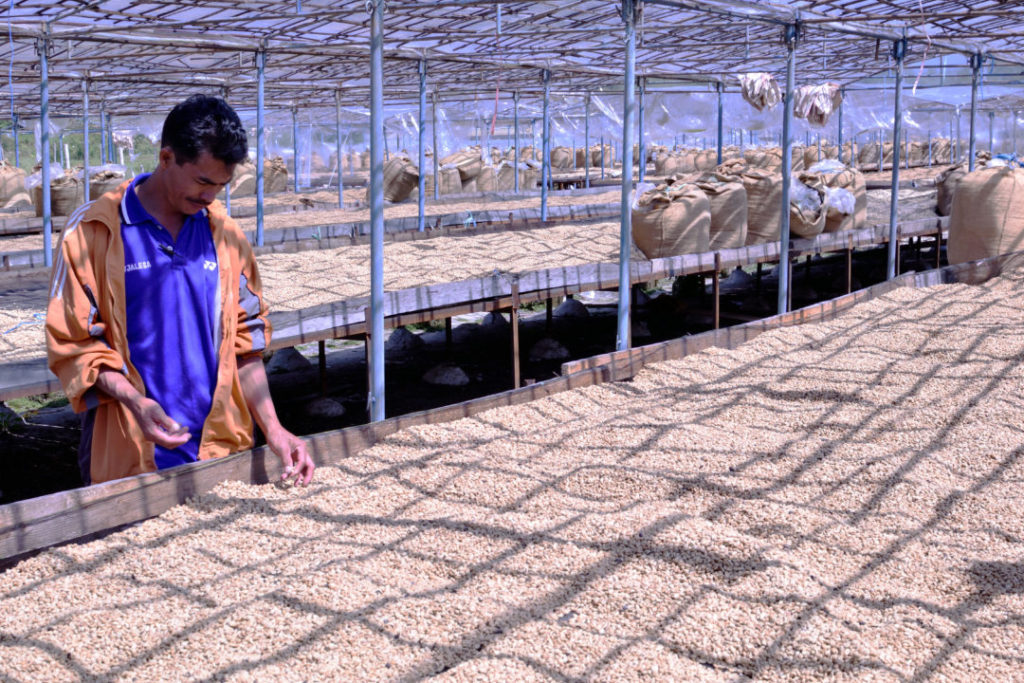
Smallholder processing in the Toraja area closely resembles that of traditional northern Sumatra: coffee is hand-picked and depulped in small quantities, commonly on shared pulping equipment. Parchment is then fermented overnight, washed clean with groundwater, and sun-dried rapidly on tarps until it is dry enough to transport. At this stage the parchment is sold to PT Sulotco and consolidated for wet-hulling, and then the final drying stage on raised beds until the internal moisture is 11-12%, at which point they are hand-sorted for physical imperfections and moved to indoor storage.
This wet-hulling process, called Giling Basah in the Indonesian language, first became popular in the 1980s, mainly as a way for Indonesian coffee processors in constantly humid, drizzly areas like northern Sumatra to hasten their drying as much as possible. The by-products of such a technique in these particular areas are the uniquely full mouthfeel and forest-like complexity that are now widely associated with all of Indonesia’s coffee. While much of the country’s coffee is in fact fully “washed” (in this case, fully dried in parchment like in Latin America), the wet-hull process is a regional signature that makes much of Indonesia’s coffee indispensable for roasters and blenders.
Related Coffee

Raspberry, roasted nut, full-bodied
Oakland 101 Bags
Mexico Altura Veracruz Don Pepe SHG EP
40037 – SPOT RCWHSE
Raspberry, roasted nut, full-bodied
Spot
101 Bags
$4.21 per pound

Dried dates, cocoa powder
Oakland 84 Bags
ETHIOPIA GUJI 4 NATURAL ORGANIC
37967 – GrainPro Bags – SPOT RCWHSE
Dried dates, cocoa powder
Spot
84 Bags
$5.10 per pound
Grapefruit zest, almond butter, baking spice, cacao nib
Oakland 134 Bags
El Salvador Washed HG EP
38735 – SPOT RCWHSE
Grapefruit zest, almond butter, baking spice, cacao nib
Spot
134 Bags
$4.06 per pound

Lemon verbena, green apple, melon, baker's chocolate
Oakland 85 Bags
Costa Rica La Palma SHB EP
36675 – SPOT RCWHSE
Lemon verbena, green apple, melon, baker's chocolate
Spot
85 Bags
$4.40 per pound