
Article Summary
Brazil 2026 Coffee Export Review:
- World’s largest coffee producer (~40% of global output); diverse microclimates, commodity to specialty.
- Key regions: Minas Gerais (~70% of national arabica), São Paulo, Espírito Santo; also Bahia, Paraná, Rondônia.
- 2025: arabica down ~13%, robusta up ~19%.
- 2025/26 exports down ~2.4% to 40.75M 60kg bags; record-high prices; reduced crop + tariffs (Apr–Nov 2025).
- 2026/27 outlook: production up substantially (arabica up to 30%), potentially record; El Niño a risk.
- Total coffee exports $12.2B; top buyers Germany, Italy, US; ports Santos, Vitória, Rio.
- Royal Coffee: 2025/26 arrivals delayed to Feb by tariffs; standard timelines expected for 2026/27.
Brazil Export Review:
Agricultural infrastructure, land availability as well as government investment has made Brazil the top coffee producing country in the world year after year. The country produces a wide range of quality availability simply because of the quantity. It is known in the industry that it is easy to get ‘cheap’ Brazils as indeed this is true but it is also true that high quality coffee comes from this origin and the land is widely diverse with microclimates conducive to a variety of terroirs. Three main growing regions are Minas Gerais, São Paulo and Espírito Santo, all located on the southern portion of the country.
Export Stats:
A large amount of Brazilian coffee is consumed internally, as no green coffee can be imported into the country. Consumption is on the rise and is now comparable to that of the U.S. According to the USDA agricultural site, Brazil consumed roughly 3 billion lbs internally, and the U.S consumed 3.4 billion lbs from the 2024 production.
Production in Brazil is important to the overall industry as it makes up roughly 40% of the worlds production and impacts overall coffee availability. In 2025, there was a slight drop in Arabica production, roughly 13% compared to the year prior. Robusta production increased 19% due to weather conditions. Exports during the 2024/25 shipping period hit 44/75 million 60kg bags. 2025/26 exports decreased about 2.4% and hit 40.75 million 60kg bags. Prices reached record high numbers and the overall decline in 2025/26 exports is due to reduced coffee crop availability, in part as a result of new tariffs applied between April and November of 2025.
2026 production volumes are expected to increase substantially—especially for arabica—due to favorable weather, as much as 30% over last year pushing the estimated 2026/27 export volumes into potential record-breaking territory. At the time of publication, the C market is responding with corrections downward, but traders remain cautious as a possible El Niño event could affect both the 2026/27 and 2027/28 export cycles.
Research suggests that the agricultural sector in Brazil will continue to face challenges in the upcoming decades due to water shortages and thermal stress. It has been also implied that the increase in temperatures will reduce the quality of microbiome cultures and increase the prevalence of pests, impacting not just Brazil but agricultural production worldwide.
Production
Coffees from Brazil were originally processed by drying cherries on patios in thick layers and then raked and covered with tarps, in some cases at the end of every day. Producers named this processing type ‘Rio’. This caused a reputation that coffees from the region were a bit leathery and unflavored. To this day cupper use ‘Rio’ interchangeably with the ‘phenol’ defect due to Brazil’s reputation of shipping phenolic coffees. Pulped naturals were introduced in the 1990s and helped improve the quality and reputation of Brazilian coffee.
Growing Regions
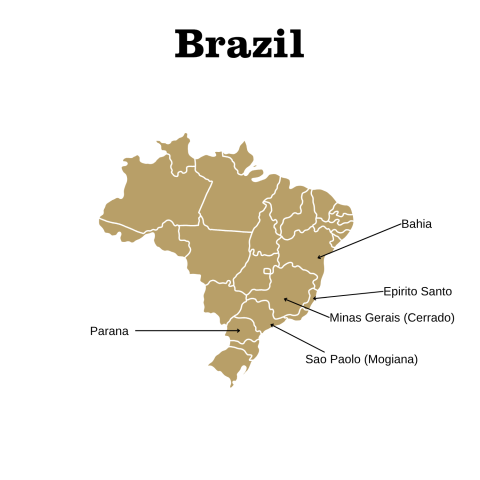
Bahia is one of the largest states in the country and is the northernmost coffee growing region. The state is known for its Robusta production and have steadily increased production in the southern region. Robusta harvest for 2025/26 has benefited from heavy rainfall and yields are expected to be higher than originally thought.
Minas Gerais, while smaller in size than Bahia, is the largest coffee growing region in the country and produces 70% of the country’s arabica production. The region has experienced heat waves, droughts, and irregular rain patterns before the flowering stage which impacted the crop’s yield potential.
Sao Paulo is another region in the eastern portion of the country that produces only Arabica coffee. Adverse weather conditions like rising temperatures have impacted Arabica production as it has a lower tolerance to heat. One recent example was the lack of rain during the 2025 harvest cycle, which impacted the leaf development and the plant’s ability to fruit fully, reducing yields.
Espírito Santo is the third largest producer of arabica coffee. Up to 95% of the production is grown without irrigation in the southern region. It is known for large amount Robusta production and has experienced no yield drops in the past couple of years due to its hearty nature. USDA estimates that 70% of robusta production is managed using irrigation. Most of the country does not use irrigation for coffee cultivation but has increased in prevalence due to unpredictable weather patterns.
Paraná was once a very high volume producing region, but the 1975 “black frost” devasted the state’s coffee fields. Now the Norte Pioneiro do Paraná (aka Pioneer North of Paraná) produces smaller volumes of arabica, though the region is generally underrecognized by specialty roasters. Paraná has the distinction of being the world’s southernmost coffee producing terroir.
Coffee is also grown in Rondônia, almost exclusively robusta, in Brazil’s northwest.
Cultivar
Bourbon was first planted in Brazil around the 1860’s as a more productive alternative to Typica, helping the country along its meteoric rise to global coffee production leader. Brazil is known for many research stations developing cultivar types but there were spontaneous mutations as well, such as Caturra (dwarfism), Marigogipe (gigantism), and Yellow Bourbon (believed to be a hybrid of Bourbon and a yellow-fruit Typica called Amarelo do Botucatu). Researchers found them in the field and brought them back to labs to replicate and stabilize the plant.
Catimors and Sarchimors were first planted in 1967 in Brazil after being developed in Portugal. During this period, plants were often bred to improve hardiness and high yields and increase cup quality. Other noteworthy Brazilian cultivar contributions include Mundo Novo (a Typica-Bourbon hybrid), Catuai (Caturra x Mundo Novo), Obata (a Sarchimor x Catuai), and Icatu (Bourbon x Mundo Nuvo).
Obata and Icatu are both newer cultivars (2010’s) but widely grown throughout the country. Both resistant varieties were bred for productivity and rust resistance primarily according to the Brazilian ministry of agriculture. Obata is a Sarchimor and Catuai hybrid, a shorter plant that is known for very high productivity. Icatu is a natural cross between Bourbon and Mundo Novo, also known for medium to high yields but is a taller plan that takes up larger space as it’s branches spread out wider. Three main Icatu cultivars in circulation in Brazil; 2944, 3282 and 4045.
Logistics
Brazil is viewed as a country that has logistics that is a little bit easier to handle from the import perspective than other countries. This is due to the large amount of infrastructure availble in the country. Farms here are some of the biggest in the world and many are classified as estates, which implies they have a wet and dry mill on site. With such large estates, comes with more financial flexibility and you often see processing centralized on these farms. Wet mills and dry mills can both be available on a singular estate, this type of set up rarely happens in other countries.
In general, purchases from Brazil happens at such a large scale that importers can have difficulty in consolidating with microlot, single-farmer lots. (I say in general because Royal has a particular perspective of buying smaller lots but also providing larger, bulk cheaper options to clients who need it, some focus on just one of these products). Overall the country makes 12.2 billion in exports with the top destination being to Germany ($153M) and the second Italy($125M) and then the U.S($96.8M).
São Paulo, port of Santos, is in the Southern portion of the country and is one of the busiest ports for all shipments but especially coffee, sugar and soy shipments. In 2023 the port handled 29% of the country’s trade flow (165.8 billion). Vitoria is the northern part of the country also move a lot of coffee through this port but importers have to be purchasing from the northern regions for it to make logistical sense. Rio is another port that exports a lot of coffee and is in-between São Paulo and Vitoria.
Royal Coffee Availability:
Brazils typically begin arriving late in the calendar year, around November and December, and continue arrivals throughout the winter and spring.
However, the 2025 harvest and 2025/26 export period for the United States were affected dramatically by tariffs, reducing availability during the usual shipping timeframes. As a result, many of our Brazilian coffees did not begin arriving until February and our overall import volume was greatly reduced.
We are anticipating a return to standard shipping and arrival timelines for 2026/27.
Check out our full Brazil offering sheet including expected arrival dates here. For those that want to explore high-end lots from the country, check out our Crown Jewel line. Each lot comes in a 22lb box with a full six-part analysis – highly traceable and extremely delicious.

Latest Articles by Isabella Vitaliano
Kenya Green Coffee Export Review
One of the most sought after origins in specialty coffee, its profile has iconic savory notes like tomato and punchy acidity.
Costa Rica Green Coffee Export Review
Well known for organic coffee production, eco-tourism, and modern processing culture dominated by top quality honeys and naturals, Costa Rica contributes a little over a million 60kg bags annually to...
Yemen Green Coffee Export Review
Yemen is where commercial coffee cultivation began, and where it remains among the rarest and most prized in the world. An arid climate, heirloom varieties, and traditional natural processing produce...